Welcome to The Backlist, where The A.V. Club dives into recent older book releases that deserve their moment in the sun.
They say everything old is new again, and rarely has that adage felt as true as in the world of dystopian young adult. A genre that caught fire with the release of Suzanne Collins’ megapopular The Hunger Games in 2008, it’s seemingly as popular as it’s ever been in the year of our Lord 2026. (And long may it continue, I say.)
That this resurgence is taking place just as another film adaptation of Collins’ work—prequel novel The Hunger Games: Sunrise On The Reaping—is set to arrive at a local multiplex near you is almost assuredly not an accident. But it does present a perfect opportunity to dive into some of the excellent dystopian young adult novels you might have missed in recent years.
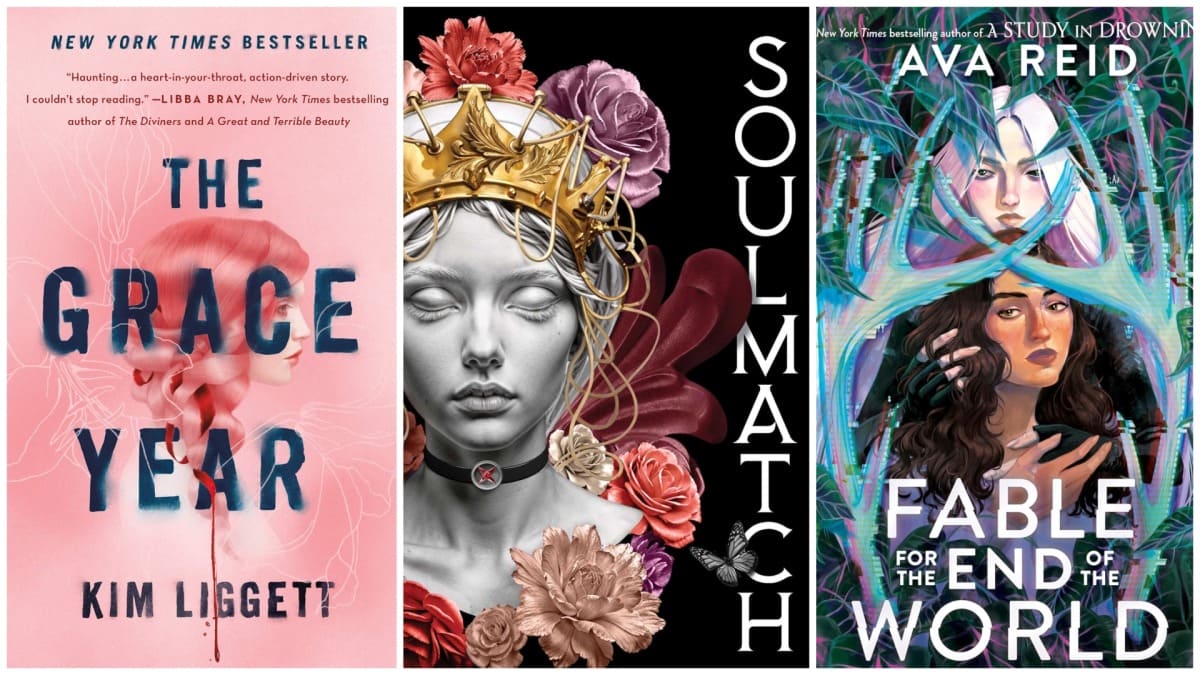
Soulmatch by Rebecca Danzenbaker (2025)
Danzenbaker’s debut novel puts several intriguing new spins on familiar dystopian tropes in a tale that deftly wrestles with questions of identity, guilt, atonement, predestination, and the cost of the surveillance state. Set in a post-World War III America where a process known as “kirling” matches souls with their previous lives on each person’s 18th birthday, the story follows Sivon, who’s anxiously awaiting the chance to get some answers about her future. In this world, good souls get rewarded with a career path, generational wealth, and maybe even a soulmate. Bad ones are given nothing, with many sent to prison to finish out sentences for previous lives’ crimes.
But when Sivon’s kirling produces uniquely abnormal results, it turns much of society upside down, making her an instant celebrity—as well as the target of many threats. Thankfully, she has a handsome, if somewhat antagonistic bodyguard named Donovan to help keep her safe. (The love story here definitely takes a backseat to the complicated plot, but the slow burn is handled well.)
The Grace Year by Kim Liggett (2019)
Set in a patriarchal culture that believes women must be exiled to live in the wilderness for a year when they turn sixteen to purge their bodies of a dangerous magic before they can be married, Liggett’s novel feels a bit like Yellowjackets meets The Handmaid’s Tale. But this so-called “Grace Year” is anything but, and the young women who manage to come back from it—and not all of them do—are scarred both inside and out.
The story follows Tierney, a smart, outdoorsy girl who doesn’t have much interest in being a wife or mother. But the fact that she’s been given a Veil—the outward sign that someone wants to marry her if she survives her trial—puts her at dangerous odds with the most popular girl in her year, as well as all the other young women who’ve been raised from birth to distrust and resent one another. That things immediately turn to violence and moral collapse won’t surprise anyone, but this story at least has a slightly more hopeful ending than most.
The Stranded by Sarah Daniels (2023)
Set aboard a luxury cruise ship turned refugee camp for those fleeing Europe after an apocalyptic war unleashed a deadly virus, Daniels’ The Stranded may win the award for most original dystopian setting on this list. The Arcadia has been sitting off the coast of what was once the United States for 40 years as it slowly devolved into a harsh world of classism, inequality, and systemic oppression. Upper-level cabin dwellers are well off, while the poverty-stricken who live on the decks beneath the waterline are rarely allowed to see the light of day.
The story follows teenage Esther, who has only known life aboard the ship but is studying to be part of an elite group of medics allowed to work on land within the isolationist Federated States. Alternating chapters follow fellow teenage passenger Nik, a member of a group of revolutionaries who are plotting a rebellion against the ship’s authoritarian leader. But when he’s shot, Esther is kidnapped to treat him, and their lives become inseparably intertwined. It’s a disturbingly creepy setting that validates all of us who are a little uneasy about cruise ship culture. Sequel The Only Way Out (also published as The Exiled) concludes the story.
Hell Followed With Us by Andrew Joseph White (2022)
A pitch-black dystopian YA horror story that pulls no punches when it comes to explicit violence and dark themes, White’s debut novel is like almost nothing else in this space in recent years. (And is most certainly not for the faint of heart.) It follows 16-year-old Benji, a trans boy raised by an apocalyptic Christian cult that released a deadly virus in an attempt to “cleanse” the Earth. Their so-called Flood killed billions and transformed still more into grotesque monsters known as “Graces.” Benji manages to escape their clutches, but not before he’s been injected with an even more advanced serum meant to transform him into a living bioweapon.
It’s difficult to overstate how dark this story is, nor the fact that it is absolutely not a book for everyone. But it’s a wonderful example of the ways that YA dystopian fiction is pushing boundaries, and White’s bleak world-building and bottomless rage are tempered by a strangely hopeful through-line of queer survival and perseverance.
Scythe by Neal Shusterman (2016)
The first installment in Shusterman’s excellent Arc Of A Scythe trilogy is almost a reverse dystopia, in which a seemingly perfect on-the-surface world is revealed to have uncomfortably dark underpinnings. Set in a far future where disease, hunger, war, and poverty have essentially been erased, a benevolent AI known as the Thunderhead governs a united Earth. But to keep the size of the now near-immortal population manageable, a select group of humans known as Scythes is charged with the moral duty of not only “gleaning” (a.k.a. killing) their fellow man but determining whose time it is to die.
The story follows Rowan Damisch and Citra Terranova, two teens who are both chosen to serve as apprentices to the Scythedom but forced into a fatal competition with one another. Full of thoughtful philosophical questions and ethical dilemmas, the book asks its readers to question whether the needs of the many really do outweigh the needs of the few. Sequels Thunderhead and The Toll continue the story, and Rising Thunder, the first installment in Shusterman’s forthcoming First Blades prequel trilogy, will be published in December.
Snowglobe by Soyoung Park, translated by Joungmin Lee Comfort (2024)
Set in a world where climate change has essentially ushered in never-ending winter, temperatures around the globe are subzero and life for most people is bleak. For those like 16-year-old Jeon Chobahm, who trudges to work in a local power plant, the only real form of escape is voraciously consuming the reality TV content produced in Snowglobe, the glass-domed city where the climate is mild, and the residents’ lives are broadcast for the entertainment of those in the wider world.
But when beloved reality star Goh Haeri dies suddenly, Chobahm, who happens to look just like her, is asked to secretly replace her in exchange for the chance to chase her dreams of becoming a director. But as glamorous as life in Snowglobe seems from the outside, Chobahm swiftly learns that it’s much darker and more dangerous than she ever imagined as she’s caught up in a complicated conspiracy. The story wrestles with everything from the long-tail impact of climate change and social inequality to questions of celebrity, privacy, and identity. What do we really lose when we offer ourselves up as little more than products for public consumption? What does so willingly losing ourselves in the lives of others do to our own? The sequel, titled Snowglobe 2, picks up after the first book’s devastating cliffhanger and sees Chobahm charged with murder.
Fable For The End Of The World by Ava Reid (2025)
A timely dystopian tale about a post-apocalyptic society where everyone is in debt to (and subsequently controlled by) an all-powerful megacorporation, Fable For The End Of The World follows Inesa, a teen struggling to keep her family’s taxidermy shop afloat (literally and figuratively) in the flooded Lower Esopus neighborhood of their half-sunken town. But everything gets an order of magnitude worse when she learns that her mother has entered her into the Lamb’s Gauntlet to pay off her own significant debt.
A deadly, live-streamed event that takes place over several days, the Gauntlet features lab-modified humans known as “Angels” hunting down the entrants, or Lambs, for sport. Melinoë is the physically and psychologically conditioned killing machine assigned to hunt Inesa. But the assassin has been glitching lately, remembering things (and kills) she shouldn’t, and when the two women meet, they’re drawn to each other in ways they really shouldn’t be, considering only one of them is meant to come out of this Gauntlet alive. Told via dual POVs, Reid explores everything from economic and geographic inequality to the dehumanizing effects of streaming culture through beautifully written prose and a compelling queer romance.


 Keep scrolling for more great stories.