The almighty Disney machine is built on the ruthless recycling of its own nostalgic legacy. If the House Of Mouse made it, then it can be remade, rebooted, sequelized, merchandized, and endlessly returned to the forefront of pop culture. It’s a method that has made the company culturally sturdy in ways its fellow studios have not been able to maintain, but it is a business plan with major downsides. Ceaselessly plundering your back catalog becomes difficult when the hindsight of time reveals the deep-seated issues with older content. You can try to repair the problem with a remake, but some problems are unfixable.
For Disney specifically, there’s one elephant in the vault the company has spent decades trying to ignore: Song Of The South. It’s been 80 years since the notorious film premiered, but more intriguingly, it’s only been 40 years since it last played in theaters. For a while there, Disney tried to turn its most infamous film into a nostalgic favorite.
Despite its notoriety, Song Of The South is a difficult film to get hold of, thanks to Disney’s choice to never give it a home release in the U.S. Inspired by the Uncle Remus stories from Black American folklore, the film was immediately controversial for its depiction of formerly enslaved people as passive and jolly figures who are both forever obedient to white people and seemingly yearn for the bygone days on the plantations. Upon its release in 1946, screenings were picketed by the National Negro Congress, and even the film’s screenwriter, Maurice Rapf, would later call it racist. (Rapf, a Jewish left-winger, had been hired by Walt Disney to make the film less offensive, but there’s only so much anyone, let alone the film’s all-white writing team, could do.) That distastefulness has only soured over time: Cultural historian Jason Sperb described the film as “one of Hollywood’s most resiliently offensive racist texts.”
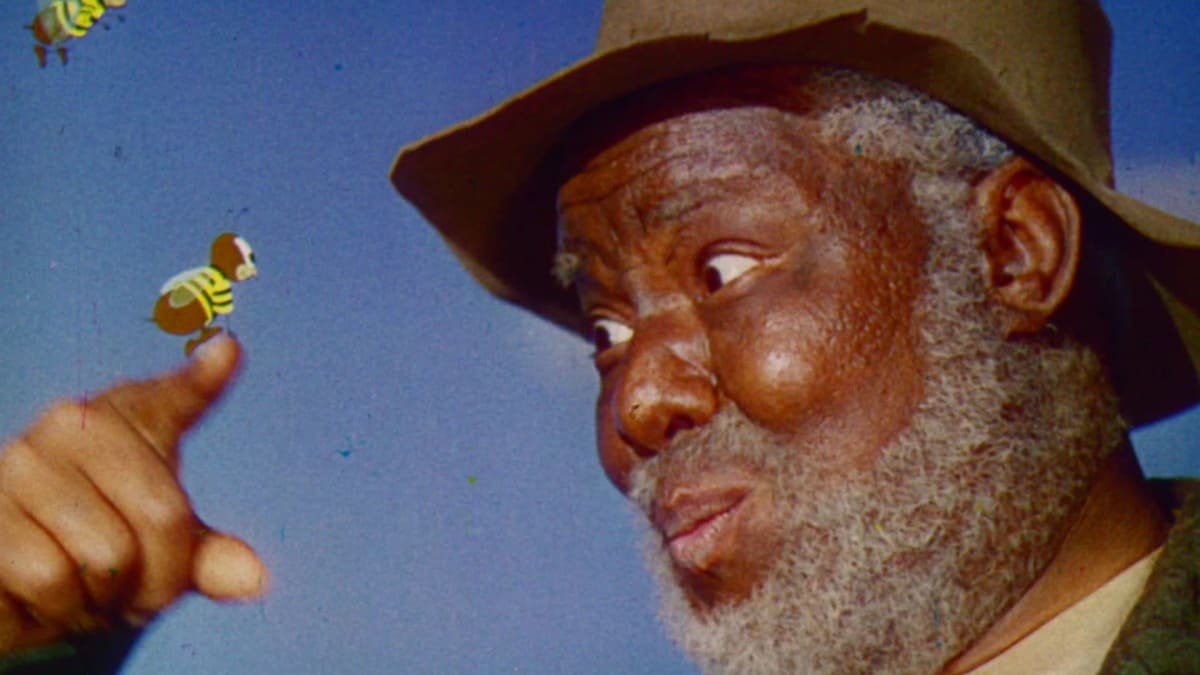
Set on a Georgia plantation during Reconstruction, Song Of The South follows a young boy named Johnny (Bobby Driscoll) as he spends the summer with his mother while his father goes to Atlanta to work as a newspaper editor. He meets Uncle Remus (James Baskett), a formerly enslaved person who tells him tales of Br’er Rabbit and his friends. Here, real Black folktales exist only as teachable moments for white kids, and smackdab in the middle of one of them is a tar baby. The animated segments are what most people remember, if only because the live-action stuff is as dull as dishwater as well as staggeringly racist.
All of the Black characters are giddily obedient to the white ones, with the evils of slavery entirely ignored in favor of having the recently freed characters sing about how they’re “gonna stay right here in the home I know” on the plantation. Song Of The South is thoroughly built on the lie that slavery wasn’t all that bad, and—at a time when the movie’s own Black actors couldn’t attend their film’s premiere in Georgia—it was a huge commercial success, even winning an Oscar for Best Original Song. By Disney’s metrics, the film did everything it was supposed to.
Contrary to popular belief, Disney didn’t hide Song Of The South after its initial release. In fact, the company re-released it in cinemas at least five times across the following four decades, usually as a tie-in to a major anniversary. This was typical for the studio in the pre-home-release days, and an easy way to keep its films fresh in audiences’ minds. There were theme park attractions to shill, after all. These re-releases were not without controversy either, especially as the film industry moved away from Hays Code-mandated segregation and into the era of New Hollywood.
Disney had moments of indecision about reissuing the film. Variety reported in 1970 that Disney was “permanently” removing Song Of The South from circulation. Two years later, it was re-released nonetheless, then again in 1980. A Disney official told the Los Angeles Times in 1986, the year of Song Of The South‘s final re-release, that the film was now part of the studio’s “classics reissue program” alongside Sleeping Beauty and Fantasia. The Times also reported that the 1986 re-release “was met with no organized opposition and the studio apparently received little criticism for its decision” as the film played to “millions of children across the country.” But Times writer James A. Snead also called the film out for perpetuating “myths of plantation life (kind master, contented servant, pastoral harmony) that had been convincingly exposed and rejected well before 1946.”
After that final reissue 40 years ago, Disney finally removed Song Of The South from its release slate. Clearly, it knew the tides were turning. Yet, Disney’s sudden eagerness to hide this part of its history couldn’t cover up its desire to strip-mine Song Of The South for parts. The song “Zip-A-Dee-Doo-Dah” remains a studio staple, sung by everyone from Julie Andrews to Miley Cyrus, and is available on many a sing-along VHS compilation. Then there’s the log flume ride Splash Mountain, which was created as a Band-Aid solution for the Imagineers to recycle expensive animatronics from a defunct singing animals show called America Sings. The Imagineers chose to theme the ride around Song Of The South, because it was easy to reskin the robots as Br’er Rabbit characters and use the briar patch scene from the film as the impetus for the ride’s big drop. Splash Mountain was a huge success, but as the years passed, its association with Song Of The South became increasingly vague.
The parks didn’t hide the association, but they didn’t lean into it either. There was no Uncle Remus, but you still heard “Zip-A-Dee-Doo-Dah.” By the time the ride opened in 1992, it had been seven years since the last theatrical re-release of Song Of The South, and Disney remained committed to letting the no-longer-marketable parts of the film lapse from public consciousness. For younger generations, Br’er Rabbit was a wacky theme park sideshow and “Zip-A-Dee-Doo-Dah” was an innocent ditty divorced from any sinister context. But even that façade could only stay up for so long; now most versions of Splash Mountain have been re-themed around The Princess And The Frog, Disney’s first animated feature with a Black princess.
In light of this quiet reputation laundering, some celebrities and academics have pushed for Disney to give Song Of The South some sort of official modern release. Whoopi Goldberg has repeatedly expressed a desire for a re-release, “so we can talk about what it was and where it came from and why it came out.” Certainly, there is precedent: Warner Bros. added a disclaimer about the prejudices found in some of its older cartoons, while Disney’s war propaganda shorts were given a lavish DVD release, complete with a crucial historical explanation for why Donald Duck was yelling “Heil Hitler.”
But since phasing out the Splash Mountain connection, Disney has simply kept its head in the sand over Song Of The South. Ignoring history has never made it go away or disempowered the bigoted hijacking of it. This becomes especially egregious once you note that Disney only acknowledges the problems of its past during leftward swings in American politics, and quickly undoes this once the pendulum goes the other way. Consider the way that Disney put disclaimers on certain films and series in the aftermath of the George Floyd protests, then abandoned any reference to queerness in Elio once President Donald Trump assumed his second term.
However, it is telling that even a company as ruthless about exploiting its IP as Disney sees no future in Song Of The South. In an era where the world’s richest man rants about The Odyssey not being white enough, giving that crowd even a hint at what they want would be both disastrous and financially pointless. Even if there was a release intended to align with Goldberg’s vision—of reckoning with the past rather than pretending it never happened—the usual suspects of ginned-up culture war nonsense would try to turn Song Of The South into a symbol. Song Of The South is a racist relic made by a company that thought its song-and-dance brand of fairy-tale comfort could take on something as heinous as the institution of slavery and win. To the country’s great shame, it did for decades too long. Now, after many attempts to rewrite that history, it may be impossible for Disney to ever truly confront its mistakes.


 Keep scrolling for more great stories.