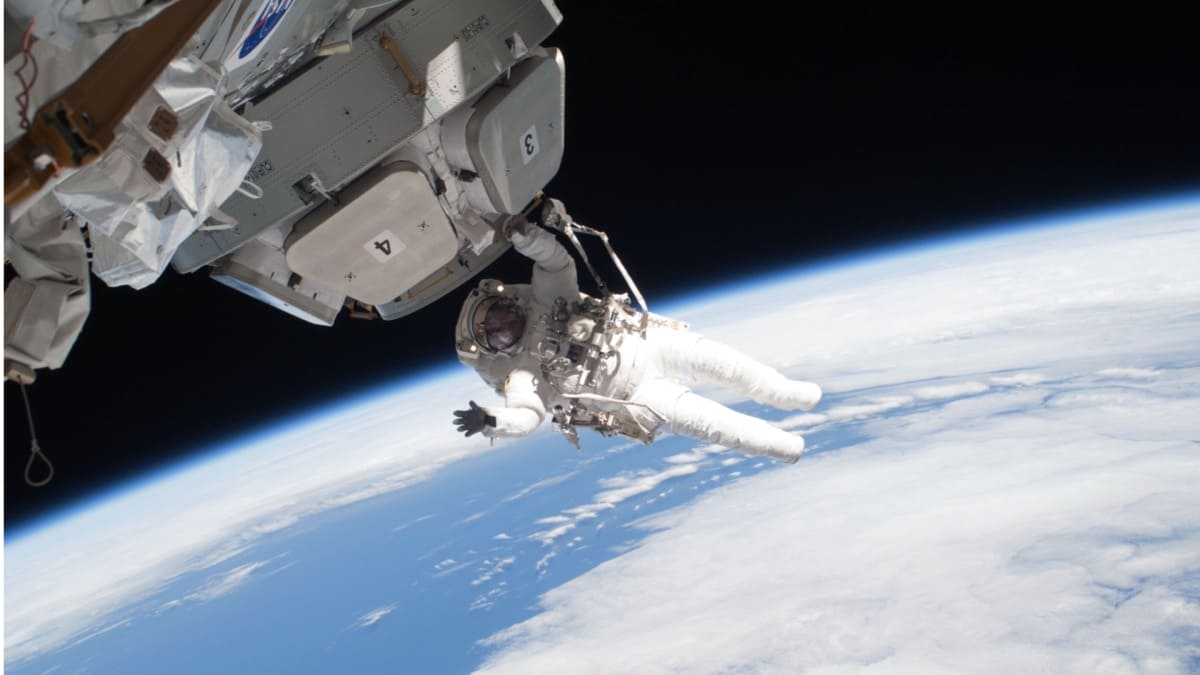
These PBS space documentaries explore the wonders of our universe

Both visually impressive and scientifically fascinating, these documentaries explore the beauty of space (and our place in it)

These PBS space documentaries explore the wonders of our universe

Space: The final frontier. Humanity has been fascinated by it since time immemorial, captivated and frightened in turn by its beautiful scale and vastness. Public broadcaster PBS has long been a home for excellent documentaries on the subject, from films by famed directors to in-depth investigations and histories as part of their NOVA and American Experience franchises. And with science advancing rapidly, so is our understanding of our solar system, galaxy, and even worlds beyond. 

Sometimes, space can be exhilarating, such as when NASA’s Artemis II mission completed a 10-day trans-lunar flight earlier this summer. And sometimes it can be frightening, as depicted in the forthcoming NOVA special, “Space Wars,” which illustrates the escalating military struggle over controlling Earth’s orbit and who, precisely, gets to weaponize it for their own benefit. But while we’re sure that “Space Wars” will be as excellent as most installments of NOVA tend to be, given the steadily encroaching horrors of real life, it’s understandable if you like your space programming a bit more aspirational. To that end, we have some recommendations from the other end of the scale: Some of the most wondrous and awe-inspiring PBS programs about space and humanity’s journey into the stars.


The Planets / The Solar System

A pair of sweeping, five-part documentary series co-produced in partnership with the BBC, The Planets and its follow-up, The Solar System, are visually stunning deep dives into the many wonders of humanity’s little corner of the universe. 

The Planets, which originally aired in 2019, uses a mix of footage and data collected from space missions, as well as some impressive computer-generated imagery, to chronologically document the origins and history of each of the major planets, with episodes focused on “Inner Worlds,” “Mars,” “Jupiter,” “Saturn,” and “Ice Worlds.”  The Solar System, which premiered in 2024, has a slightly more expansive focus, exploring the dynamic forces at work on and among the planets, from storms, volcanoes, and other extreme planetary weather to strange gravity, superionic ice, hidden oceans, asteroids, and more. 

NOVA: “Black Hole Apocalypse” 

Even those who aren’t necessarily regular viewers of science documentaries will love NOVA’s thoughtful exploration of one of the most fascinating cosmic objects in existence. Much studied but not fully understood, black holes are both mysterious and vaguely terrifying. But don’t let the overly sensationalistic title fool you, this NOVA installment offers both an in-depth introduction to what we know about black holes, their origins, and what they can tell us about cosmic evolution. Also features interviews with scientists like Neil deGrasse Tyson and Paul Murdin, who helped discover the first confirmed black hole.


American Experience: “Chasing The Moon”

As much a history lesson as a celebration, this three-part American Experience film was released to in honor of the 50th anniversary of the Apollo 11 moon landing. Using previously overlooked archival material (most of which had never been seen by the public), director Robert Stone successfully looks at the race to the moon in a broader context, one that incorporates the mix of scientific innovation, political calculation, media spectacle, and social turmoil. Even for people who think they “know” the story of the space race, this is fascinating stuff. 


The Farthest: Voyager In Space

In 2017, PBS released the documentary The Farthest: Voyager In Space to celebrate the Voyager mission’s 40th anniversary. Launched in 1977, the probe, which was initially meant for a five-year mission to document Jupiter and Saturn, is still flying and officially crossed into interstellar space in August, 2012. Now 15 billion miles from Earth, it is the farthest human-made object in history and continues to send data back home. (A feat which now takes 22 hours per transmission.) The film is both a historical record of how the Voyager came to be and a deeply satisfying, heartfelt reminder of the best that humanity is capable of. Both Voyager I and Voyager II contain Golden Records with greetings in 55 different languages and an assortment of music ranging from Beethoven to Chuck Berry, carrying human voices out into the vastness of our universe.

NOVA: “Chasing Pluto” / “Pluto And Beyond”

While these two NOVA episodes are a bit dated—they aired in 2015 and 2019 respectively—the story of NASA’s New Horizons mission is still both fascinating and wondrous to behold. “Chasing Pluto” aired the night after New Horizons’ history-making flyby—a fairly stunning technical achievement in and of itself—and gave audiences immediate access to the stunning photos that made us all fall in love with the wonder of the universe all over again. (Plus, it revealed that amazing little heart structure visible on Pluto’s surface.)

“Pluto and Beyond” picks up three years later, as New Horizons aims to shed light on one of the least understood regions of our solar system: The Kuiper Belt.  Now four billion miles from Earth, it’s the most distant flyby in NASA’s history. Whether you’re still upset that Pluto got downgraded from full-fledged planet status or curious about what lies beyond the edges of our own star system, these episodes are both accessible and deeply interesting. 

Once Upon A Time In Space

This four-part 2026 documentary, created in collaboration with the BBC, isn’t so much about space, per se, as it is about the people who helped make space exploration possible. Directed by James Bluemel and the filmmaking team behind Once Upon A Time In Northern Ireland, the series is full of personal anecdotes and insights from astronauts, cosmonauts, scientists, ground support, and family members that touch on everything from key milestones in the space program’s history to geopolitical space rivalries. Focusing primarily on the space shuttle and space station eras, it is more grounded and restrained than some of the more expansive docs on this list. Yet, the human vulnerability on display is powerful stuff. These people are amazing, and we should say so more often. 

NOVA: “Star Chasers Of Senegal”

One of NOVA’s more unique episodes, “Star Chasers of Senegal,” revolves around Maram Kaire, a Senegalese astronomer who dreams of establishing a space agency in his home country. In the meantime, he works with NASA from abroad, helping with preparations for the deep-space probe Lucy’s (yes, like The Beatles’ song) flyby of the Trojan Asteroids, which will take place in 2028. Trapped in Jupiter’s orbit, some of these rocks predate the creation of the Sun and the Earth, and are time capsules that may hold answers about the formation of our solar system.

The episode has both cool science—the extremely technical details necessary for this probe to glean as much information as possible in its brief observation window are fascinating—and an even-handed exploration of the way such study intersects with and can inform faith. Kaire works tirelessly to convince some of his more skeptical and/or religious countrymen that the study of space not only has deep roots in and a connection to Islam, but that its lessons can benefit Senegal as an emerging nation. There are also engrossing details about the history of astronomy and stargazing in West Africa, such as potential uses for the megalithic stone circles at Sine Ngayène and Wanar. 

 
Join the discussion...
Keep scrolling for more great stories.