Peeking beneath the hoods of Blade Runner’s AI beings has always conjured some semblance of a soul. but the latest entry in the series is only skin-deep. Blade Runner 2099’s simulacrum starts at the outset, beginning with a spot-on aesthetic impression of its rain-soaked, Ridley Scott-directed, 1982 predecessor, which was set in a then-futuristic 2019 Los Angeles. The show’s prologue re-purposes cinematographer Jordan Cronenweth’s moody neo-noir imagery for a glimpse at the origins of the Tyrell Corporation’s biomechanical androids, a.k.a. replicants—something that ends up at the center of the series’ mystery. Unfortunately, it takes nearly four whole hours before hints of this premise actually emerge, and in the meantime, Blade Runner 2099 sets up a few promises it can’t keep.
Its protagonist is the human Cora (Hunter Schafer), a young woman trying to survive in a world where the established Blade Runner food chain has been inverted. Onscreen text explains that human beings are now an underclass—presumably after the events of Denis Villeneuve’s 2017 sequel, Blade Runner 2049, lead to a robot revolt—though there’s little sense of what this actually means throughout the series, beyond crowded apartment buildings. Supposed insurgents are targeted by an all-replicant LAPD, but if there’s some kind of rebellion brewing, it’s not one we actually see.
A backroom deal for safe passage sees Cora having to pose as a Blade Runner, once the designation of replicant hunter, now reclaimed by those very same synthetic beings. In this guise, she ends up the new partner of the experienced, stoic Blade Runner Olwen (Michelle Yeoh), a replicant with a fast-approaching expiration date (an inevitability that offers Yeoh few dynamic moments). So long as Cora can retrieve a mysterious package for her benefactor—the very same MacGuffin that Olwen is chasing, while unraveling a mystery surrounding the disappearance of the replicant’s former comrade Marek (Johnny Harris)—she can get the illicit visas she and her paraplegic brother Elias (Lewis Gribben) need to reach an alleged human safe haven in Mexico
Unfortunately, this plot relies heavily on drama manufactured by coincidence, and by characters either switching allegiances on a dime, or staying at odds with one another despite having the exact same objective. The world of Blade Runner 2099 seems, at first, like a place worth exploring—its scorching LA departs from Scott’s downpour and Villeneuve’s snow—but the show is so caught up in switching the positions of each piece on its chessboard that it seldom ruminates on its themes, or allows its characters’ decisions and sacrifices to have lasting consequences. Spread across eight episodes, each about an hour in length, the show feels tremendously outstretched despite its tactile texture.
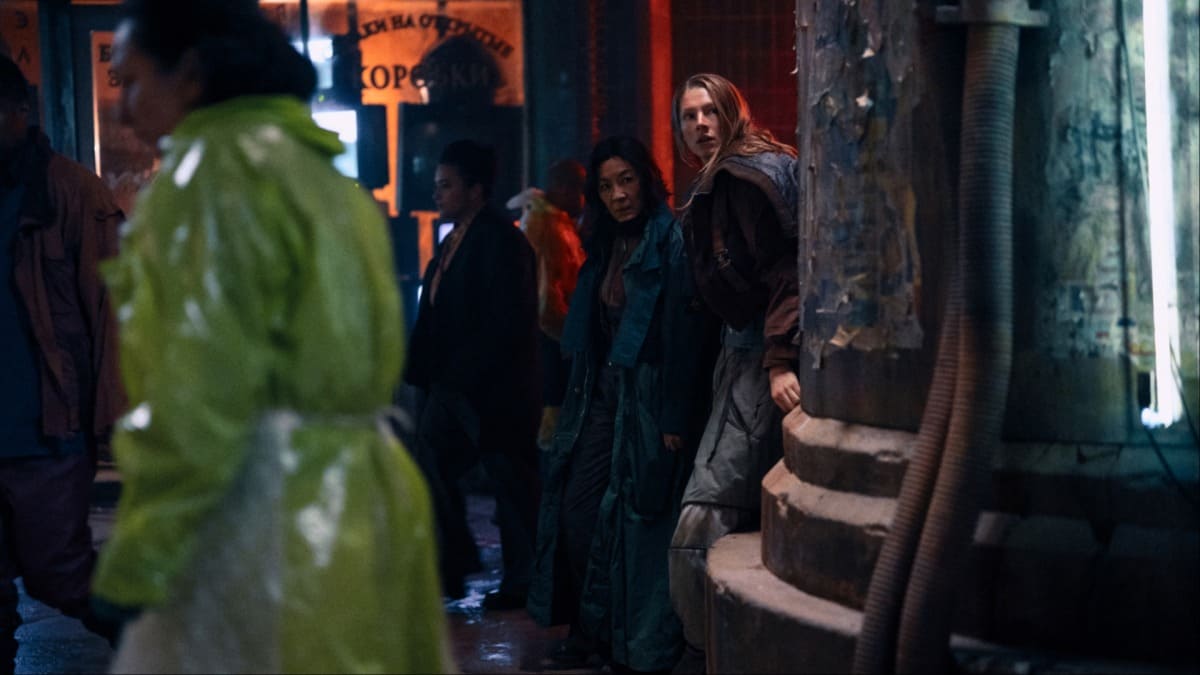
Schafer is remarkable at summoning intensity to make each scene seem like a vital precipice. But the dramatic context of her performance (which is to say, the frequent lack thereof) leaves her work here feeling exaggerated. Despite hints of a tragic backstory—via flashbacks of Cora’s adoptive mother Helena (Sheila Atim)—there’s little for the actress to explore beyond immediate circumstances. The streets of this dystopian .A are dense and detailed, and the show features moody echoes of the grimy cyberpunk that made Scott’s original Blade Runner such a landmark. However, it’s all window dressing at best. Where Ford once stopped to have a vital conversation while eating noodles in a rickety shack, Schafer and Yeoh mostly hit their marks and stand around. Meaningful interactions between characters and these spaces are rare, telling us little about them, or about time’s impact on this backdrop, or how the show’s creators envision this world, its culture, and its basic functions. Say what you want about the original’s techno-orientalism, dude, at least it’s an ethos.
There are mild exceptions to this dramatic vagueness and opaque worldbuilding early on, though they appear in spurts before dematerializing. For instance, when tracking Merrick’s whereabouts, Cora and Olwen end up at a shady business where replicant clientele can pay to don pregnancy suits and other body modifications they couldn’t ordinarily experience. Between this and some of the language used to describe Cora’s mission—her needing to “pass” as a replicant, and so on—there’s the briefest hint at commentary on the transgender experience, before the series moves on from anything resembling musings on the connection between mind and body. (That they cast Shafer, a trans actress, has little to do with this either).
Numerous scenes of Cora and Olwen taking flying cars from place to place afford the show the chance to present landscape shots of enormous, franchise-appropriate pyramid skyscapes, scored by composer Leopold Ross doing a light (and at times overly jazzy) impression of synth-master Vangelis’ Blade Runner score. However, beyond a point, this becomes a repetitive trick to fill up runtime. By the time its real story fades into view, Blade Runner 2099 feels like a good idea for a feature, stretched and contorted across the length of four entire movies, though given that its original length was supposedly 10 episodes, this temporal paradox ends up the most interesting thing about the series.
There are sparse treats for fans of the novel from which this entire world first sprang—Philip K. Dick’s Do Androids Dream Of Electric Sheep—including threads that were trimmed from Scott’s movie. However, these Easter eggs feel like diversions more than anything else. Lip service is often paid to Dick’s core premise of memory being the DNA of experience, but this fluid concept is rendered in dramatic concrete, with little interest in what it says about humans as an evolving species.
Sure, 2099 is seated in a slightly different real-world context than any previous Blade Runner project—it’s the first one whose audience is actually dealing with AI (or what’s been branded as “AI,” at least) running rampant. But the show doesn’t take much advantage of this. Its beats about what makes a person—and what makes Cora, in turn, steely and inhuman enough to impersonate a replicant—are plot conveniences at best, in service of a repetitive side quests to find Character A at Location B, in order to track further information on Object C. Along the way, the odd twist about who is or isn’t a replicant ends up more head-scratching than shocking—the information isn’t just un-surprising, but doesn’t appear to have been established as narrative deception in the first place. Much of the day-to-day LAPD hubbub depends on the Blade Runners not being able to parse Cora’s comically suspicious behavior, so at least the show has one thing right: AI is pretty stupid.
In the end, 2099 has very little to say about our current world or its possible futures, let alone any spiritual ruminations on the bits and pieces that comprise complex beings. Fittingly, it plays as though Dick, Scott, and Villeneuve’s stories were fed into a chatbot with no penchant for artistic analysis, and what came out on the other end was the most boring possible version of a Blade Runner sequel that still bears the façade of cyberpunk traditions.


 Keep scrolling for more great stories.