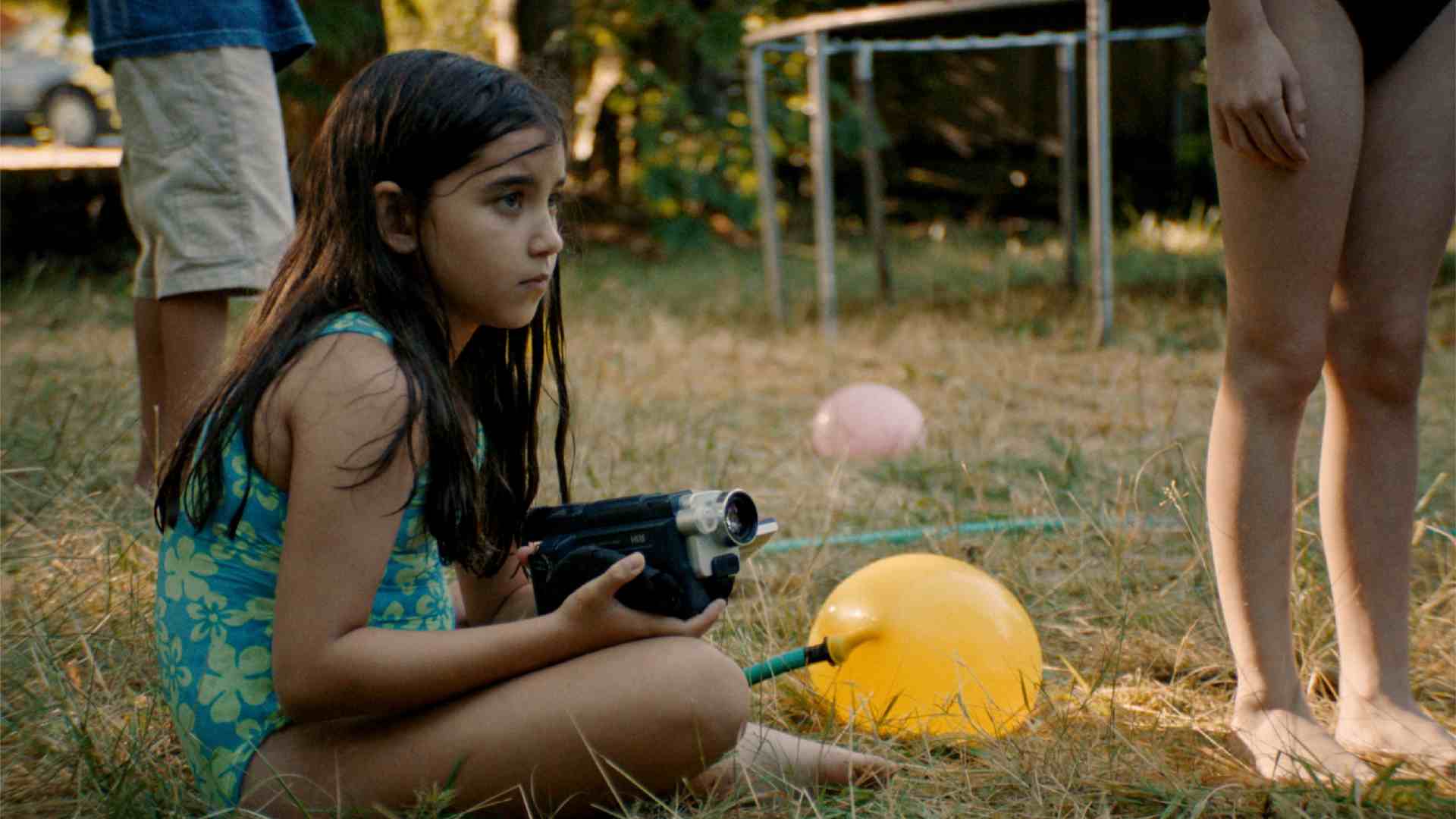
Understanding your present means coming to terms with the past. Not just your personal history, but the histories of all the forces and folks around you, impacting and shaping your life as your timelines bump and intersect, like an asteroid sustaining dings and craters as its trajectory is influenced by the debris fields it flies through. Sophy Romvari’s delicate, engrossing portrait of a Hungarian-Canadian family dealing with their new life and their angry teenager after a move to Vancouver Island, Blue Heron is staggering autobiography because it commits so deeply to this historical work. Her debut feature, based on her childhood and her 2020 short film Still Processing, allows Romvari to time travel between the late ’90s, with its shrine-like computer room, hefty camcorders, and Chia Pet infomercials, and the present, exposing the sepia memories of childhood to the cold light of adulthood. This subtle magic, applied to achingly detailed realism, relitigates the past and the perspective one had while living it, performed with the regret and acceptance that sadly only comes with time.
The 90-minute family history is told with Jeremy (Edik Beddoes) as its fulcrum, his hand-drawn maps and his deeply felt pain and his conspicuously blonde hair serving as the features, frozen in memory, which his parents and siblings’ world revolves around. He’s mostly seen by Sasha (Eylul Guven)—the young daughter surrounded by brothers, who grow up to be a filmmaker played by Amy Zimmer—-and his parents (Ádám Tompa, Iringó Réti), who struggle to help the child simultaneously holding the family hostage and silently screaming for help.
Jeremy’s behavior isn’t anything too outrageous, nothing like We Need To Talk About Kevin. He just drifts off on his own, shoplifts, ignores his parents, lightly bullies his younger siblings, relentlessly thumps a basketball against the side of the house. He’s grasping for control in a world that doesn’t get him, haphazardly expressing his inner turmoil through outer animosity, something Romvari tapped into in Still Processing when digging through family photos by using subtitles to express unspoken thoughts. The latter idea is, in a way, translated in Blue Heron as the parents switching from English to Hungarian; the divide between public and private thinking is bilingual.
This is just one elegant element in Romvari’s complex snapshot, one that it contains all the detail necessary to see the mature parental drama at the edges of the troubled-kid frame, and all the evocative nostalgia that the other children may find looking back even at this painful time—not to mention the job of assimilation undertaken by the entire family. These complicated and sometimes idealized memories are caught in the literal snapshots shot by Sasha’s father, mimicking the storytelling of the script’s snippets, divided into anecdotes framed and composed over time by repeated recollections.
Romvari builds out these moments through textures: the rough rocks of the beach, the spray of rain, the drip of blood on broken glass, and the dainty, consequence-free mess of falling sugar. She and cinematographer Maya Bankovic catch it all in tight frames, alternatingly intimate and claustrophobic, shot through windows and around corners, dense and close and warm, unboxing this relatable story like it’s being discovered in an attic. A soundtrack of realistic childhood chatter and other buzzing annoyances generate the hum of the suburbs. And then, just as we’ve gotten used to the bright colors and hazy sunlight of the ’90s, where young children run through the sprinklers and weather their eldest brother’s escalating tantrums, it all fades as the film leaps into its second half.
It’s here where Zimmer’s Sasha, now making a movie about her life with the help of old photographs and new interviews with social workers, is able to wander back a few decades to speak with her own parents, pushing the grounded drama somewhere between therapy exercise, sci-fi short story, and exorcism—something both more literal and more fantastic than The Fabelmans. It wouldn’t work without both a consistent aesthetic and consistent performances from a cast of all ages. Both Tompa and Réti are excellent at shouldering the hefty burden of parenting a surly teen, tensing and relaxing visibly without ever succumbing to caricature, while Beddoes’ clenched-fist and mostly silent tumult simmers at a perfectly uneasy temperature. By the time Zimmer helps connect past and present, memory and reality, the ensemble’s lived-in performances already gesture towards the logical outcome. We just hope it isn’t true.
And yet, through an unbroken five-minute conversation with her own parents and a stunning final scene, Sasha (and Blue Heron itself) finds closure in subjectivity and solace in clarity. Like the father developing photos in the home’s darkroom, a void gives way to something clear and lasting, something that sparks a complicated memory instead of replacing it.
Director: Sophy Romvari
Writer: Sophy Romvari
Starring: Eylul Guven, Amy Zimmer, Ádám Tompa, Iringó Réti, Edik Beddoes
Release Date: April 17, 2026


 Keep scrolling for more great stories.