BF: We’ve lost our appetite for bite.
You want media that trusts young people, and Dust Bunny does that really well with, like you said, a very subjective story centered around a little girl played by Sophie Sloan. Where did you find her?
BF: Scotland! We had a wonderful casting director named Margery Simkin, and she cast a very wide net with this film. We had something like 9,000 submissions for this role. Of those 9,000 submissions, we had 900 to 1000 auditions, and that was narrowed down to 20, which was narrowed down to 12, which was narrowed down to three.
And Sophie has a very thick Scottish brogue. Mads Mikkelsen also has a very thick accent. Our fear was that if we cast both of them, nobody would be able to understand anything anyone was saying. I had shared auditions with Mads very early on and he was immediately smitten with Sophie. He said, “Don’t mess with her accent, it’s so charming and she’s so authentic.” His worry was that if you give her the additional challenge of doing an accent on top of a performance, we’d lose some of that authenticity. He just wanted to move the film to Scotland. But Sophie, on her own accord, watched TikTok videos for two weeks and taught herself a perfect flat American accent, and handily won the role.
I want to see all those instructional TikToks and the version of this movie where it’s two people totally unable to understand each other.
BF: We get a taste of that with [Mads’] “Aurora” pronunciation.
Did you have that gag written before he got involved?
BF: No, when Mads first read the script, he was like, “I love the script, but you’ll have to change her name. I can’t pronounce it.” And I was like, “No, no, we’ll make it a bit!” But then, as we were making the movie, he was pronouncing it fine. We had to loop mispronunciations to sell the joke!
Mads is so funny in this movie. Even if people are sort of familiar with his work, if they’re not watching stuff like Riders Of Justice, they might not realize that he’s hilarious.
BF: Not only Riders Of Justice, but so many of his collaborations with Anders Thomas Jensen, whether it’s The Green Butchers or Men & Chicken, there are these fantastic movies for Mads—who is usually, in films for American audiences, the heavy; Le Chiffre in Casino Royale, villains in Indiana Jones [And The Dial Of Destiny] and the Marvel universe. But some of his best work is playing the fool in these fantastic Jensen movies. Men & Chicken has one of my favorite performances of his, so much so that that’s why there are so many chicken references with his character in Dust Bunny.
I was wondering about the chicken lamp. It could’ve easily just been a part of the overall aesthetic.
BF: It started with one of the first meetings with Sigourney Weaver. She was talking about the scene where Mads and Sophie are wrapping up a dead body, and she was like, “I don’t know about this scene, it’s so dark. Maybe you should do something cute with the suitcases, like make them into pandas or something that takes the edge off a bit.” And I said, “That’s a great idea.” When we got to designing the props, I said, “We need panda-shaped suitcases.”
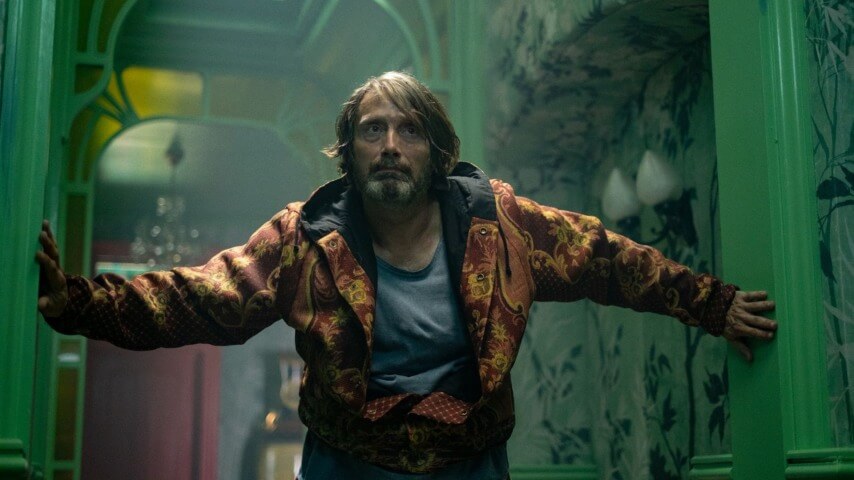
That created an animal farm aspect to the show, where we have the hippopotamus ottoman and the panda suitcases and the chicken-butt lamp. These things that harken to French Maximalism and the movies of Jean-Pierre Jeunet, whether that’s Delicatessen or The City Of Lost Children or one of my favorites, Amélie. It was all about yes-anding my production designer.
I love the aesthetic ideas in here, but it’s not just the vibrant costumes and decor. You also get a hint of ’70s-like maximalism in the needledrops of ABBA and Sister Janet Meade. What were you saturating yourself with before making this movie?
BF: Had you heard that song before? I remember that as a kid. I was raised Catholic, and one of the coolest things about being raised Catholic was Sister Janet Meade and “The Lord’s Prayer” à la rock ‘n’ roll.
For the aesthetic, we talked a lot about the Jean-Pierre Jeunet/Marc Caro collaborations, and even something like John Boorman’s Point Blank. That film had such aggressive stylization to it and was a Crayola-box film noir that had such wonderful use of color that never really interfered with what Lee Marvin was doing, but gave us a heightened sense of a world that was allowed to have a click in its heel. It had the feeling of a romp that allowed you to not take everything so seriously, and have fun first.
The Lee Marvin pull makes me realize how close he and Mads’ performance styles can be. Two actors who can be hulking and physical but so quiet that they can get under your skin. Speaking of, I read about how you and Mads collaborated on fight choreography for the scene with the guy dressed in the wallpaper outfit. Typically, people fixing production problems on the day aren’t the stars, but the department heads. I know Sigourney Weaver pitched in in similar ways. Were they your safety nets on this film?
BF: Mads and Sigourney were both so producorial with this film and cared so much, and performed above and beyond their tasks as actors. It was incredible to be a first-time director and to have that level of championing from such experienced actors who’d worked with a wide variety of directors.
The hallway fight scene, Mads and I choreographed in an afternoon. There was a bit of a language barrier at times with certain departments in Hungary. Sometimes when you wanted less of something you got more of it, because there was just a disconnect. So we were looking at how do we do this action sequence, how do we do it efficiently, how do we do it in the amount of time we have? Mads came over one Sunday afternoon, and we sat there with Bruce Lee action figures and a model of the hallway set and walked through it. Mads is very humble about so many things, but he had more stunt experience than anyone on that set, with everything that he’s done in his career—including cock-and-ball-torturing Daniel Craig in Casino Royale. Anyway we just had a blast, just little boys playing with action figures. We filmed it and showed it to the stunt team and said, “This is what we’re doing.” It was magical.
And it still feels of a piece with the other action, like the grand shootout where they’re sliding back and forth in the hallway. It’s got such fun, cartoonish blocking and choreography that you just don’t see in modern action.
BF: The hardest thing about some of these moments is where you’re putting the camera, what are your setups, and how many you get. Blocking and choreography are lifesavers, because it takes less time than re-lighting and tearing things down and building them up and putting more track down. Hallways limit the directions that you can shoot in, and the camera angles you’re afforded, so it’s up to the choreography. I knew it had to be light on its feet and have a little whimsy. I remember telling the stunt guys we needed sliders on ropes, and that they’d be kicking themselves out and pulling themselves back in. And everybody just stepped up!
That was a wonderful thing about the movie: So much of the crew stepped up. We had a wonderful gaffer and grip department. We only had a technocrane a couple of days—and most of my shots needed a crane—so every morning [our key grip] would come up to me when he arrived and he’d ask, “How long do you need the crane today?” And I’d say, “60 feet?” Which he’d convert into meters, of course, and then built it by strapping scaffolding together with belts. Then I’d have a 60-foot crane that day that the budget otherwise wouldn’t allow but the ingenuity of the crew would. Things like that consistently elevated the experience.
Taking it back to Amblin films, Dust Bunny is absolutely a film that kids should go see with their cool parents, so I imagine the R-rating was a blow.
BF: We all set out to make a children’s movie, one with an object lesson about listening to children and believing their experience even if the facts may seem outrageous or unreal. You still have to listen, to build a bridge of belief to that child that allows them to feel seen and heard and validated in their experience instead of minimized and rejected. So it was a surprise to all of us that we got an R-rating.
A lot of folks were like, “This is fine, we’ll be fine” because it makes it cooler for a lot of the audience members. But I want kids to see this. I want kids to have the experience of going to this movie and seeing something I would’ve seen as a kid in the ’80s that blew my mind with the danger that it represented—something outside the norm of children’s fare that we see so much of now, that is a little toothless and defanged.
Sigourney was really annoyed by it, and Mads was really annoyed by it. But sitting next to them during different screenings, both of them turned to me at points in the film and whispered, “This is why we got the R-rating.” So, parental discretion is advised, but I want kids to see this movie. I want kids to have the experience of being their own champions and being their own heroes. That’s what we get to see [in Dust Bunny]. If only the adults would listen.
If only the adults, and the MPA, would listen.
BF: Yeah!


 Keep scrolling for more great stories.