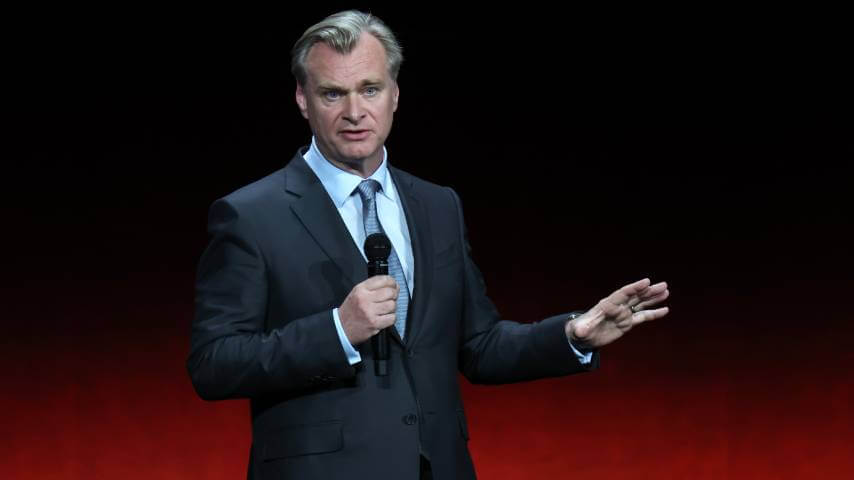
Now that Christopher Nolan is done with the American wing of his Odyssey press tour, Criterion Closet looted and influencers tolerated, he’s had an opportunity to sit down for an interview that not only covers deeper questions about his blockbuster, but about the conversation around the film. During a 17-minute interview with Zhong Shu, podcaster and political philosophy lecturer, for the Chinese video site Bilibili, Nolan was asked probing questions about the themes of his film and in turn gave thoughtful answers about the audience members who think they’re smarter than his movie.
Visibly relieved to not be eating hot wings or telling a late-night host funny stories from set, Nolan dug into larger ideas running through his filmography, like the concept of atonement, the fall of civilization, and the undercurrents of Christian philosophy.
It was all a far cry from the red carpet quips and rehearsed talking points most A-listers trot out over the course of their films’ theatrical runs. Even as the conversation turned to those on the sidelines offering criticism (something A-listers do love to comment on, mostly to reiterate that they’ve made their movie “for the fans”), Nolan gave an insightful answer about the nature of storytelling.
“When you’re characterizing somebody, and the trite version of this, or the criticism that is often leveled at movies in general, is, ‘oh, the character has to be made sympathetic’—so the character is manipulated in different ways or changed in different ways,” Nolan said. “That’s a fundamental flaw of film criticism in a way, or storytelling criticism, because to be able to identify the mechanism does not invalidate the mechanism. And that’s a real problem in criticism today because people have this idea that: because I can understand why the story affects me the way it is, therefore, it didn’t work.”
That specific brand of gotcha-style criticism—Nolan clarifies that he “was talking more about amateur film criticism than professional film criticism, because professional film criticism tends to understand the necessity for the mechanisms”—has run rampant on an internet long addicted to TV Tropes and YouTube videos pointing out everything that’s wrong with the latest release. Even literary giants like Odyssey translator Emily Wilson and author Joyce Carol Oates aren’t immune to this particular siren song.
But when telling an ancient epic, Nolan points out, you’re probably going to be using ancient storytelling concepts. The problem then becomes how you negotiate showing those conventions to an audience who might have become a little too cynical about it all, or who might’ve been conditioned to feel smug when recognizing a storytelling concept.
“When a trope becomes too familiar to an audience, then it has to be changed,” Nolan said. “But we do, as filmmakers, avail ourselves of that common language. We build on that understanding that our audience has seen many films. And that they understand that language. So, you’re playing with that language. It’s the language of genre. It’s the language of audience sympathy. It’s the language of clarity and of narrative direction and how you guide people through a story.”
As much as Nolan cuts to the heart of one of modern criticism’s problems, the sheer virality of this interview—and the lengthy back-and-forth cultural conversation about The Odyssey—offers hope that many moviegoers (including many amateur film critics) would rather think deeply about the latest big release than strive to publish the most cutting one-line Letterboxd review.


 Keep scrolling for more great stories.