Despite the impossibly high standards Christopher Nolan set for himself with Oppenheimer, he and his team, including cinematographer Hoyte van Hoytema, pushed things even further with The Odyssey by making their new epic entirely with IMAX cameras. The result is a modern callback to the Hollywood that gave us larger-than-life adventures like Ben-Hur and Lawrence Of Arabia, to large-scale battles, suspenseful moments of escape, and windswept vistas filmed in different countries. As he did when reviving the Batman franchise, Nolan takes a familiar story and filters it through many of his obsessions, like time-jumping through events and focusing on the lonely hero in the throes of a tortured journey, both making this translation uniquely his and reinvigorating what it means to make a Hollywood epic.
The Odyssey begins with Odysseus (Matt Damon) still trying to return home after a war years before. Back in Ithaca, his wife Penelope (Anne Hathaway) fends off slimy suitors like Antinous (Robert Pattinson). While gorging on Ithaca’s hospitality, the suitors in turn plot to kill Odysseus’ son Telemachus (Tom Holland), thereby forcing Penelope to choose a new ruler. Meanwhile, Odysseus is at war with himself, struggling to remember what happened to his crew and how he arrived on an island with Calypso (Charlize Theron)—and her memory-sapping lotus flowers. Slowly, the pieces of his story return to him in flashes of war, monsters, and senseless loss, and Odysseus sets a course to reclaim his home and his family.
There’s much more to the story—almost three hours’ worth—as Nolan plays with the linear sequence of events by jumping backwards and forwards on the timeline. Nolan’s The Odyssey adapts Homer’s poem in a way that feels modern, seamlessly transitioning from the past to the present with the help of Jennifer Lame’s editing, and briskly flying through pages and pages of source material to keep the adrenaline flowing. The narrative structure also supports Odysseus’ struggle to regain his memories, piecing events together for both himself and the audience.
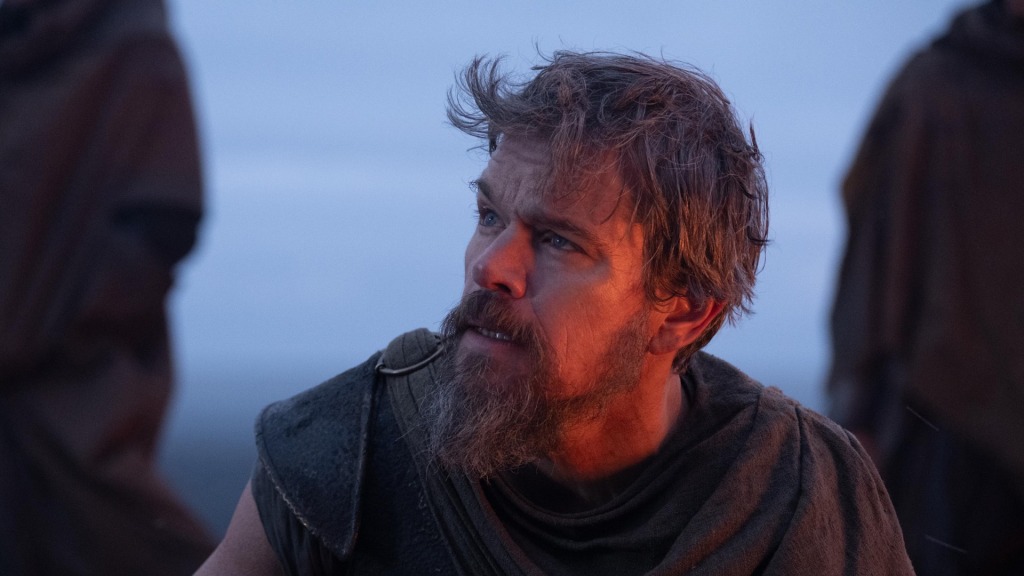
But Nolan’s approach to retelling the epic is also surprisingly intimate, with a fondness for close-ups that capture the drama playing out on the actors’ faces as their world crumbles. Throughout The Odyssey, the camera closes in on Odysseus’ face, making the background a blur and immersing the viewer in the general’s worries and heartache. Although the large-format camera was a challenge, the intensity of that labor never appears onscreen, as the result looks almost weightless in action. Whether the camera is handheld and follows skirmishes right alongside warriors, or floats up above the fray to look out at the neverending horizons where the gods will decide their fate, Nolan and van Hoytema use every inch of their canvas to make the monsters feel imposing and the vistas unending—yet they never lose an actor’s moment of agony, their tearful reaction to loss or fear.
To complete the feeling of an old Hollywood spectacle, Nolan assembled a studio commissary’s worth of stars and sets full of hundreds of extras. Damon plays the age-old hero with a somber sense of weariness. He’s tired of this war even before setting foot on the battlefield, but Agamemnon (Benny Safdie) relies on his wisdom to win the Trojan War. Yet, in his hubris and frustration, he tries to defy both the gods and words of warning. “The gods help those who help themselves,” he insists with macho bravado, which Damon captures as well as the eventual humbling he faces on his epic quest. Damon may have the spotlight, but the collection of stars around him also have their moments to shine, including Samantha Morton as the deceitful witch Circe in one of the film’s most frightening sequences, Zendaya as an ethereal Athena that guides Odysseus home, Safdie as an imposing Agamemnon, and Elliot Page as Sinon, the doomed young soldier sent to die in a rich man’s place. As Antinous, Pattinson is deliciously evil, a cowardly instigator who makes for a great foil for Holland, the devoted son who wants what’s best for his father’s legacy.
With so many performers and so little time for each, some actors are given too little to do, like Lupita Nyong’o as Helen Of Troy, but whoever gets the screentime makes a meal out of each moment, like Himesh Patel’s doomed second-in-command officer Eurylochus and John Leguizamo’s sympathetic and stubbornly loyal sheepherder Eumaeus. As Penelope, Hathaway gives the most impassioned performance in the cast as a woman cornered by droves of men who fights back with politics and plans of her own. Where Damon’s Odysseus is stoic and calm, she is emotional yet focused, ready to do what needs to be done when the moment comes.
Like the cast, Nolan carefully assembled his crew, from the work of production designer Ruth De Jong and the legions who built various cities and far-flung huts to costume designer Ellen Mirojnick’s work outfitting leagues of battalions with their own colors and designs to make each ally and enemy stand out. They make the illusion of this story believable and stunning to watch. The only odd note is Ludwig Göransson’s score, which mostly opts for that grand sword-and-sandals sound, but sometimes utilizes discordant electronic notes to emphasize Odysseus’ isolation, which doesn’t fit into the sound mix or score. It feels like someone blinked in a group photograph, the only noticeable misstep in this picture.
Everything in The Odyssey looks so marvelously tactile, that even when the visual effects do come into the picture for the Cyclops, for instance, it is a seamless extension of the fantasy. We see skyscraper-high cliffs, rolling grassy hills, a dazzling array of coastlines—including a black sandy beach for Hades—fires burn, buildings crumble, and hordes of soldiers stream through the Trojan gates, transporting viewers to mythical moments of wonder and terror as if they were there. The audience may remember how this story ends (this isn’t the first time Odysseus’ journey has been made into a movie), but Nolan’s grandiose vision and craft is rare. The movie’s sense of spectacle is part of its appeal, and Nolan serves it up even better than expected. The scale of the production is breathtaking, but it’s also a morality play writ large, a game of politics and succession, a warning about temptation and greed, a plea for kindness in a harsh world. The way Nolan brings everything together is a meeting of old and new Hollywood, a nod to the spectacles of yesteryear that thrilled audiences for generations combined with new techniques and tools to remind us all that there are more ways to keep pushing the medium—even with the classics.
Director: Christopher Nolan
Writer: Christopher Nolan
Starring: Matt Damon, Tom Holland, Anne Hathaway, Robert Pattinson, Lupita Nyong’o, Zendaya, Charlize Theron, Elliot Page, Samantha Morton, Himesh Patel, Benny Safdie, John Leguizamo
Release Date: July 17, 2026


 Keep scrolling for more great stories.