
Unraveling Conspiracy!: Q&A with the Developer of the New QAnon Satire Game

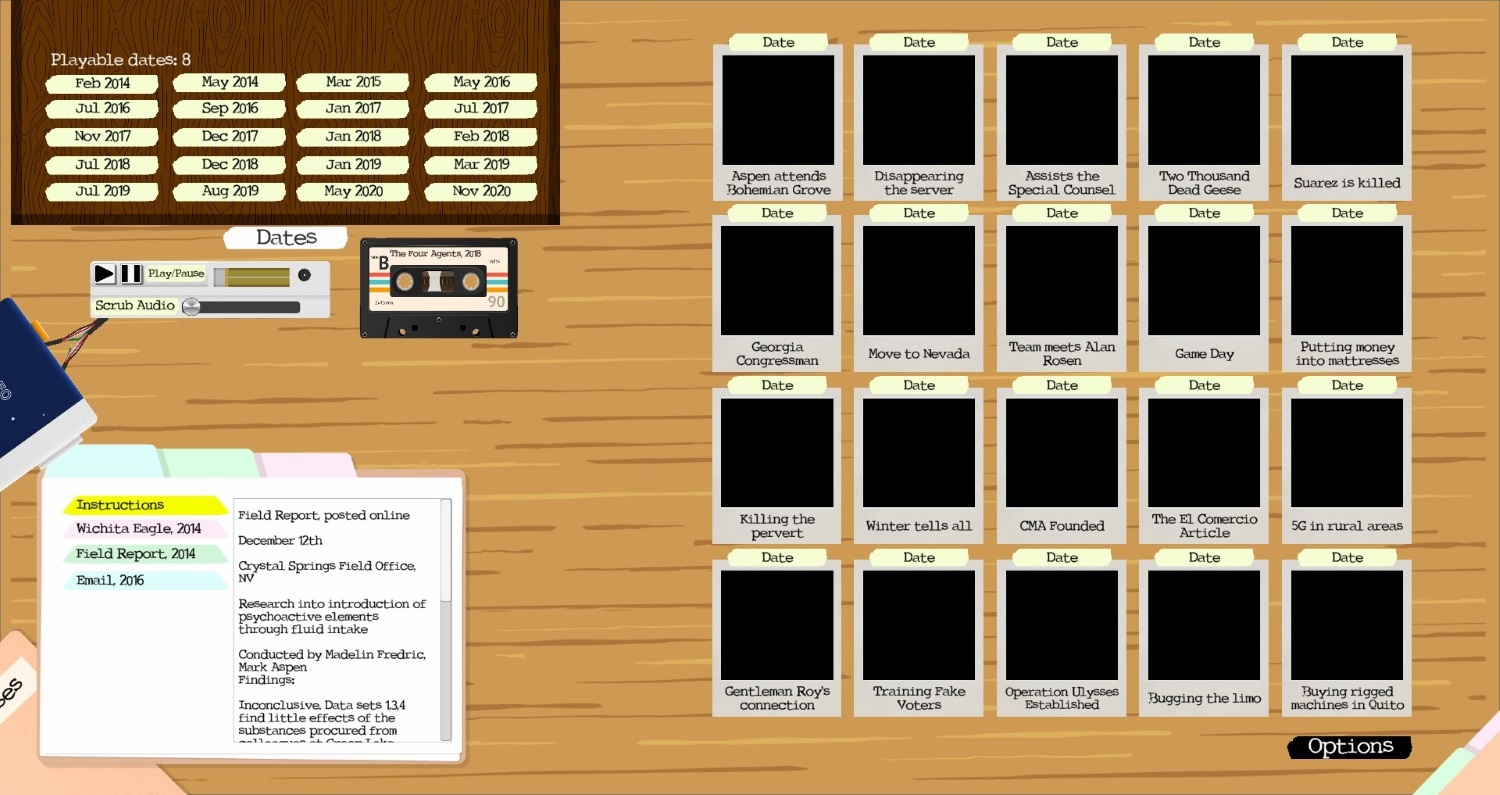
Conspiracy, the latest game from British developer Tim Sheinman, is about as timely as games get. Made in three weeks in December, Conspiracy is a satire of incoherent conspiracy theories like QAnon and the American political media apparatus that feasts upon them. Players sift through articles and recordings from partisan media hacks, liberal podcasters, oblivious social media influencers, and more, piecing together the timeline of a conspiracy theory that threatens to undermine American democracy. Although its central conspiracy is fully fictional and not a direct one-for-one translation of Trump’s election denialism or QAnon, there are clear references to the last two months throughout, with Sheinman’s clever script and realistic voice acting weaving an absurd story that would’ve seemed implausible before the last few months but now feels almost quotidian.
Although Conspiracy’s political satire is a new tool in Sheinman’s kit, the game’s structure will be familiar to anybody who played Rivals and Family, two games he made in 2020 about fictional musicians. You have to unravel the major goalposts of this conspiracy, deducing the timeline of its events by reading newspaper and blog articles and listening to recordings of interviews and radio shows. As you correctly organize these incidents—including the mysterious death of a Congressman, a supposed trip to Bohemian Grove, the sudden introduction of a shady trafficker, and more—you’ll unlock more documents with more clues buried within. Unlike Rivals, which focused on an Uncle Tupelo-esque country rock band and the subsequent solo careers of its two songwriters, you’re not actually piecing together a coherent narrative or history. Like most conspiracy theories, Conspiracy spirals out into an ever-growing cloud of nonsense, a tangle of spurious claims and coincidences that never gets close to making sense but can seem just plausible enough to those who want to believe.
For Sheinman, the point of Conspiracy isn’t the conspiracy itself, or even the cultural and political context that has made something as transparently ludicrous as QAnon possible. Sheinman’s main interest, as it was in Rivals, is in the media, and how it shapes the appearance and understanding of what it covers. As you play Conspiracy, you might feel an uneasy recognition of how the fractured and too often partisan media of our real world has helped lies and misinformation flourish over the last couple of decades. It gives the game a legitimate sense of weight.
I recently talked to Sheinman via email about Conspiracy, how a British citizen came to make a game about American politics and media, and about some of the specific decisions he made in depicting American culture.
Paste: So you’ve already explained to me via a direct message that you started working on the game on Dec. 9. Had you been thinking about making a game about QAnon and other conspiracy theories before work started on that day?
Tim Sheinman: I had not. I was working on a game about art forgery, which I’d commissioned some artwork for, but wasn’t really feeling. I wanted to do something more visceral and exciting to me and the idea just came.
However, I need to state at the outset, while this is a game concerning conspiracy theories, their spread etc, I do not believe that it is a game thematically about conspiracy theories at all. Rather the game has more humanistic concerns, as well as principally being a media satire. It is about the way that people insulate themselves from each other and weaponize narrative to do so. In this respect, its closest relation is the work of Chris Morris, in The Day Today and 4 Lions.
Paste: Was there a specific moment or news story that made you want to tackle this subject?
TS: There were two. The Four Seasons press conference, which I parody at the start of the game and in particular Sidney Powell’s “I’m about to blow up the state of Georgia” speech, which was mindboggling.
 Keep scrolling for more great stories.