
A national Ukrainian cinema erupted from Shadows Of Forgotten Ancestors
Immersed in folk tradition and music, the tragic romance is inherently hostile to Russification and a rallying cry for its own culture.
Photo: The Criterion Collection
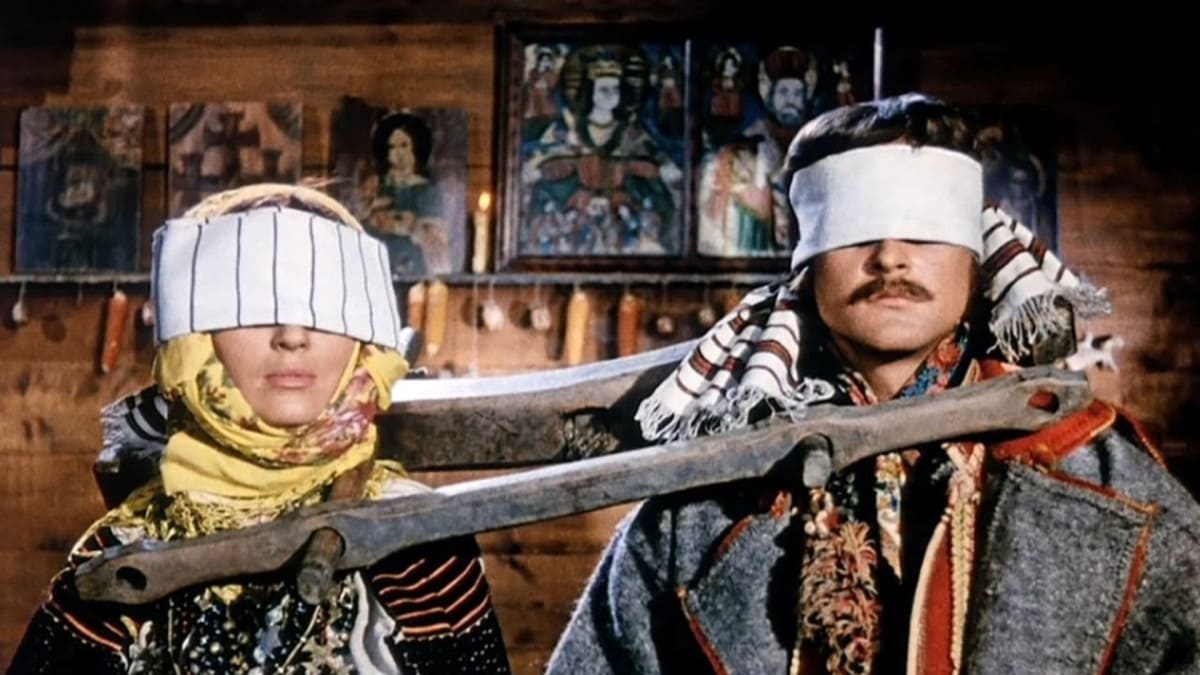
In Cult Of Criterion, The A.V. Club highlights a new release from The Criterion Collection each month, examining the films entering an increasingly accessible film canon.
When Shadows Of Forgotten Ancestors premiered in Kyiv in 1965, dissident Ivan Dziuba stood in front of the audience to read out a list of Ukrainian intellectuals who had been arrested during a Soviet crackdown. “The mothers of Ukraine are weeping and moaning for their sons,” he shouted. “Shame on the authorities! Whoever is with us, stand as a sign of protest!” The theater manager cut him off by switching the PA system over to music, but audience members stood, emboldened by the speech and by filmmaker Sergei Parajanov’s defiant refusal to dub his deeply Ukrainian film into Russian. This premiere wasn’t the moment a Ukrainian national cinema was born, but its folk-infused romance was as bold and confrontational a rallying cry as Dziuba’s comments—an abstract anti-Russification ode to cultural specificity.
Parajanov, best known for his following film The Color Of Pomegranates, faced constant suppression by Soviet authorities. Queer and persecuted throughout his life, imprisoned in labor camps and dogged by the secret police for “Ukrainian nationalism,” he was only officially rehabilitated in 2024. Shadows Of Forgotten Ancestors is where his artistic activism began, united by its opposition to socialist realism and its dedication to the different individual identities caught under the Iron Curtain. “I am an Armenian, born in Tbilisi, incarcerated in a Russian prison for being a Ukrainian nationalist,” the filmmaker said. Of course he bristled against the flattening ideology of the U.S.S.R.
The avant-garde folk festival that is Shadows Of Forgotten Ancestors—equal parts star-crossed romance, ethnomusical soundscape, and pagan ritual—bristled in kind. Parajanov, who had previously made a decade’s worth of films ascribing to the standard Soviet style of socialist realism, disowned all that work in the wake of Shadows. It was in that film’s surreal poetry, where spilling blood takes the shape of leaping stallions and traditional witchcraft holds more sway over villagers than simple logic, that he found the aesthetic approach that would define his future. This new approach found its most effective instruments in cinematographer Yuri Ilyenko and the Hutsul people of the Carpathian Mountains.
 Keep scrolling for more great stories.