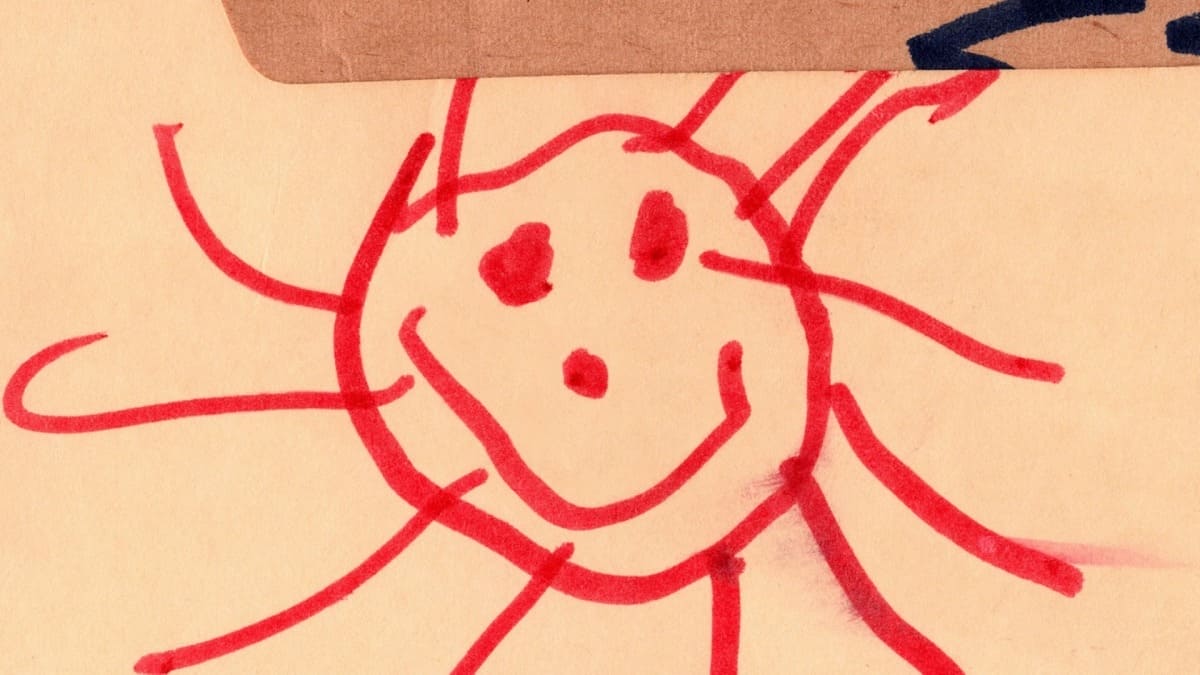
At under 15 minutes, Paper Trail packs a punch over its economical runtime using no line-drawn characters on the screen and no specific plot, at least not in the traditional sense. The story is instead told through clues. At first, the paper is dotted by splashes of colorful paint. The paint splotches soon grow lines, then crayons are added to the mix of mediums. Markers join the party and make the rudimentary shapes of smiling faces and the sun. By following these handdrawn figures, Hertzfeldt traces the development of a person’s hand from childhood to adulthood. The unseen character, a reflection of the audience, learns to print their name, write in cursive, work through their multiplication tables and long division. They will continue writing throughout their life until they find a well-paying job, where over the years, their writing will eventually deteriorate. The page becomes blurry, the lines infrequent. Eventually the unseen, unsteady hand can only leave dots behind.
The life of the unseen character, Steven Richardson, flashes by in the form of the many practice sheets, homework assignments, tests, applications, government forms, and various other pieces of paperwork he has to fill out over the years. It’s a chronological blur from early painted figures to official stamped papers, practically within a few blinks of an eye. In the margins of these changes, Steven strikes up a conversation with a girl named Lindsay as they grow up together from their time in school. Hertzfeldt doesn’t share her responses, only Steven’s vulnerability, heightening the sense of uncertainty waiting to see what the next response might be. But over time, Lindsay falls out of Paper Trail as she similarly falls out of Steven’s world, leading to Hertzfeldt’s subtle warning: Don’t let work take over your life.
In his previous movies, Hertzfeldt used similarly relatable and lo-fi stick figures to explore thematically rich stories, like a man whose illness was rooted in trauma and tragedy or a clone who returns to her originator to encourage her to enjoy life, even though the destruction of the earth is all but assured. Even his previous short, ME, still incorporates these kinds of minimalist characters to tell a story. The audience were easily brought into these characters’ adventures—both internal and in external, highly stylized realms—thanks to their design. In Paper Trail, Herztfeldt goes a step further, needing no onscreen characters at all to tell his story. Steven is simply a stand-in for the audience. His experience is not exactly our own, but many of the rudimentary acts—learning to paint, holding a marker, and repeating the same numbers and letters—are experiences just about all of us can relate to.
Unlike the old Fleischer Studios cartoons that occasionally showed the animator’s hand when drawing their characters, Paper Trail cleverly reveals no particular human element beyond what lands on the paper, erasing even the tools to create such shapes and figures, focusing only on the effect they left behind. Even the decision to speed through a monotonous career that spans decade after decade is a symbolic one, highlighting the unseen character’s age by showing his signature weather away as the dates stretch far into the future. This isn’t the first time Hertzfeldt has triggered such universal deep feelings with one of his shorts, but Paper Trail does so while being a remarkable departure from his recognizable style, letting the audience’s own nostalgia help reinforce its anxieties.


 Keep scrolling for more great stories.