Cupertino’s existence is a bit of a miracle. The latest series from The Good Wife creators Robert and Michelle King is a broadcast drama that expresses a tremendous amount of skepticism toward Silicon Valley and AI at a time when both malevolent forces are gaining untold power and influence around the globe. It expresses this skepticism on CBS and Paramount+, whose merger-happy parent company is backed by a fortune built on database software, and whose CEO David Ellison stated last year, “We’re not going to be afraid of tech, we’re going to embrace it.” Somehow, the Kings have worked around this embrace, making a dynamic, entertaining, and vital new TV series on all the ways modern tech invades and affects our day-to-day lives.
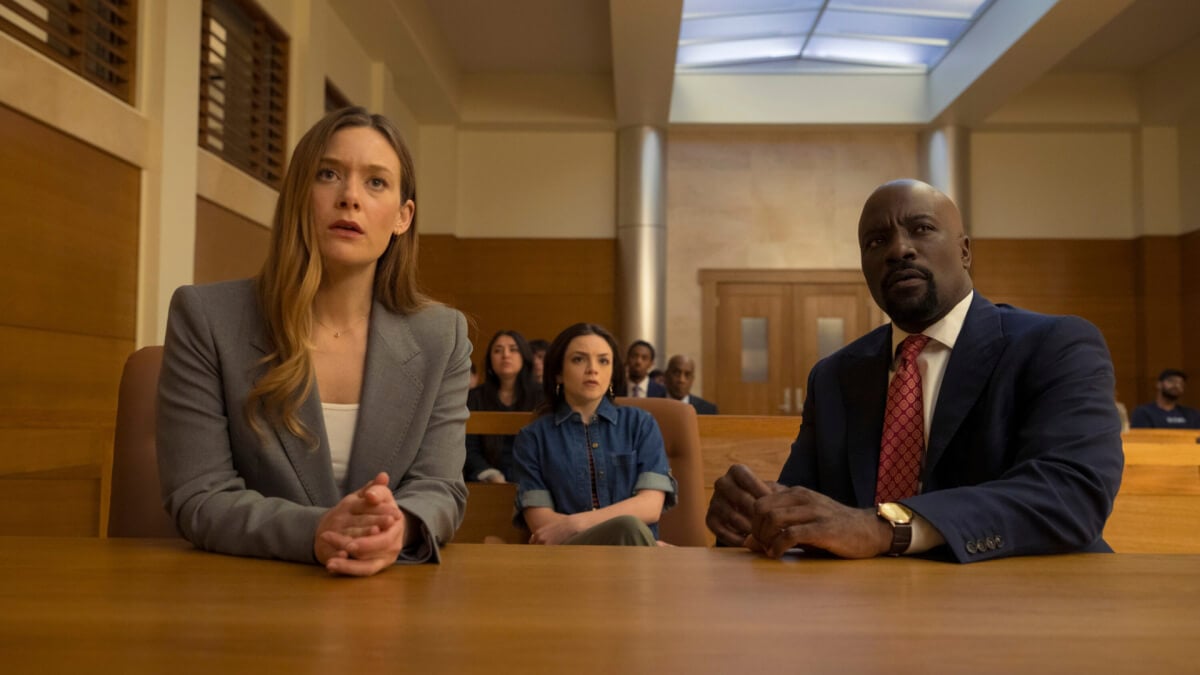
In Cupertino, two attorneys fired from a tech startup on the same day decide to form a new law firm. Initially, established lawyer Michael Price (Mike Colter) and promising rookie Olivia Siffre (Rachel Keller), seek revenge against a common enemy, before realizing that they’re helping fill a void by taking on the difficult cases of people who’ve been wronged by Silicon Valley giants. While fighting these David-vs.-Goliath battles, Michael and Olivia develop a charming sibling-like relationship and draw the ire and surveillance of the mega corporations who, as a mysterious whistleblower client puts it, operate more like sovereign nations due to their trillion-dollar valuations and desire to keep tabs on the public.
It’s a fruitful marriage of material from the Kings’ back catalog. The husband-and-wife duo proved they can navigate courtroom shenanigans with panache in The Good Wife and The Good Fight, and Silicon Valley often served as a conduit for the demonic influences of their excellent supernatural thriller Evil. The former can get a tad soapy here, like whenever Michael goes up against his respected lawyer father, Bayard (Joe Morton). But it never diminishes the Kings’ savvy procedural know-how.
The show’s zippy ripped-from-the-headlines plots provide the momentum as Michael and Olivia’s firm takes on one case of the week after another: Among the 10 episodes provided for review are a chatbot encouraging a kid to turn violent, a betting app-related case with traces of Polymarket and Kalshi, Large Language Models determining organ-transplant recipients, and AI-generated songs taking away royalties from actual artists. In these topical stories, Cupertino sends a clear message about the negative, often unimaginable impact of AI—especially when its creators are free from any sort of oversight or consequence.
The show tells these topical stories with nuance, and that refusal to see things in black-and-white make it all the more juicy and complex to watch. Better yet, Cupertino tests Michael, Olivia, and their coworkers’ moral compasses without being preachy or didactic. Colter and Keller are terrific anchors throughout, each giving a lived-in performance. Even though Michael and Olivia are practically strangers, their instant brother-sister bond feels believable and easy to root for. Keller is particularly effective in her portrayal of how a shy, religious Olivia comes into her own, while Colter’s snarky but compassionate lawyer stands in contrast to the earnest, conflicted Catholic priest he played on Evil. The two leads are backed by an equally magnetic supporting cast, especially Ella Stiller as the firm’s resourceful assistant, Christy Palladino. Unafraid to get her hands dirty or put herself out there to figure out the truth, Christy often involves her extended family of blue-collar workers to help them out in what ends up as a convenient but amusing running plot device.
This seemingly rinky-dink operation would fail without financial backing; that comes from party girl/fellow lawyer Natalia Boutella (Busy Philipps). As long as the firm helps Natalia take down her vindictive, billionaire tech-bro ex-husband (Fisher Stevens), the cash supply flows. In the process, Natalia becomes an asset, using her network to bring in more clients and, most helpfully, furnish the firm’s fancy office building (which sits right across the street from Apple). As a bonus, Philipps shares the screen with her former Girls5eva co-star Renee Elise Goldsberry, who plays Michael’s ex-girlfriend/current adversary, representing the head honchos of Silicon Valley.
For all of Cupertino’s attention to details, it falls disappointingly short demographically: Roughly 70% of the people living in the real Cupertino are Asian, a segment of the population largely represented by one character. Atypical alum Nik Dodani plays Vik, a client-turned-ally guy who drops in whenever Michael, Olivia, or Christie need tech support. Vik is most useful when the firm takes on the aforementioned whistleblower in a saga that gives Cupertino a compelling serialized arc. The lawyers work with the suspicious Bo (Rob McClure), who can help take down an OpenAI-esque company with grand plans to publicly launch an accurate, human-like AI model.
There are plenty of twists and turns involved in Bo’s case, especially when probing the depths of Big Tech’s desire for data and surveillance. Cupertino keeps things mostly fictional, although it name drops the Magnificent Seven often, along with household names like Elon Musk, Peter Thiel, and Sam Altman. While commenting on these relevant issues, the show maintains a brisk pace, speaks in whip-smart dialogue, and explores its protagonists’ inner and personal lives (to a degree). The framework may feel familiar, but there’s no denying its creators have their fingers on the pulse. It’s why Cupertino emerges as not only the strongest new broadcast series in recent memory, but also—the irony of it being a Paramount product notwithstanding—an engaging and contemporary anti-AI drama fit for our times.
Saloni Gajjar is The A.V. Club‘s TV critic.
Cupertino premieres October 8 on CBS.


 Keep scrolling for more great stories.