Like its predecessors, Club Kid is also full of jokes to lighten the heaviness of the situation that stranded an unaccompanied minor with an adult who’s rarely thought about anyone other than himself. There are wry observations and jokes about New York City nightlife and queer culture, delivered at a quickstep pace that feels in rhythm with a city that prides itself on sleep deprivation. When Peter is searching for Edison to try to return Arlo, the father and son end up at a busy house party where one of the attendees asks, “When was the last time you saw a child?” It’s a quick throwaway line, but it serves to highlight the bubble world Peter lives in, an extended adolescence composed of venues where they card at the door and sometimes don’t even open for business until after children’s bedtime. Peter’s well in over his head, with barely any frame of reference of how to care for a child (which will land him in trouble eventually), but at no point does Firstman allow it to drown his character.
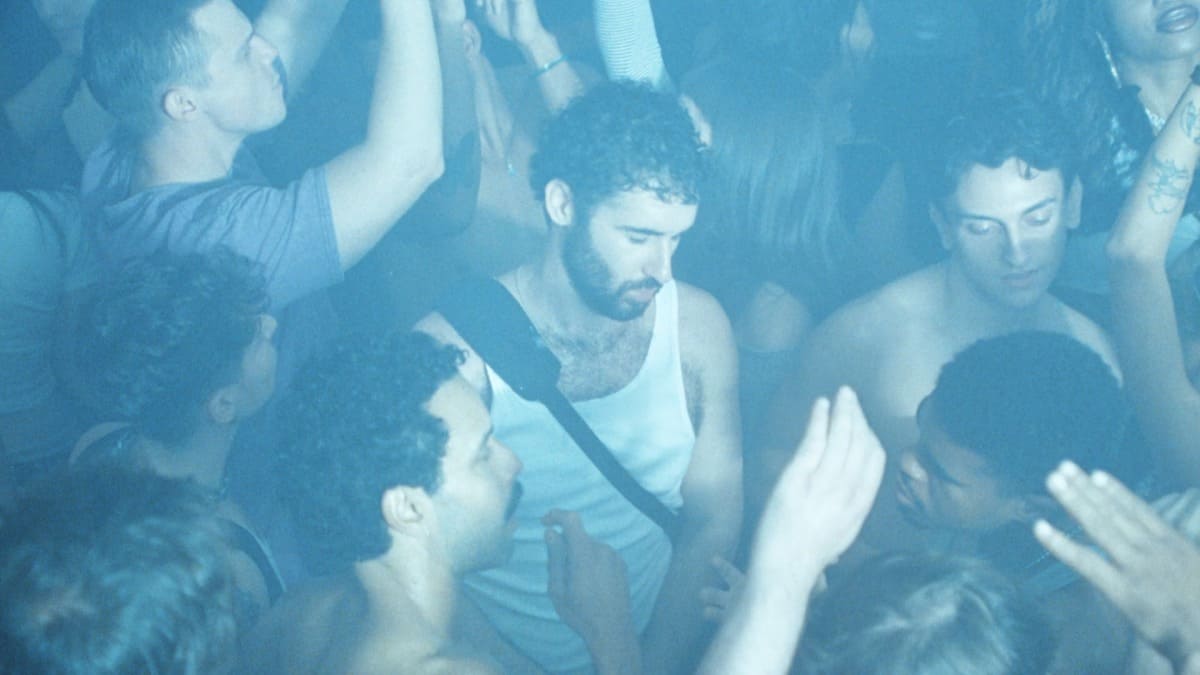
Firstman and cinematographer Adam Newport-Berra (who won an Emmy for The Studio) give Club Kid a chic, artsy look. Newport-Berra’s lens soaks in the neon of the lights, the chaos of a crowded dance floor, and the din of the club so that it looks like a party we’re sorry to miss. Once Arlo enters the picture, the appeal of the club shifts. It’s no longer the free-for-all playground from the start of the film. Now, it looks and feels almost dangerous, something Peter hasn’t really worried about before when party-hopping with his friends. The movie contrasts the loss of control at the club to the home Peter’s attempting to make for his son, observing the subtle differences between the two as these worlds continue to diverge.
As the sympathetic hero, Firstman writes Peter as flawed but good-hearted. He quickly shifts into caregiver mode, worrying about losing Arlo on a crowded dance floor and chiding his friends for keeping Arlo up too late. Quickly, the two learn to lean on each other; it’s them against the world. Peter even encourages Arlo’s interest in music, procuring a piano and letting the aspiring DJ play a set at his latest club. While the formula of “parenting forces someone to grow up” is a familiar one, Firstman has fun with those expectations and his spin on the scenario. He builds out Peter’s world with supportive friends, familiar faces that later become strangers when he cleans up, and even a cautionary Ghost Of Christmas Past in the character of Sophie (Cara Delevingne), Peter’s former business partner who spirals out just like he was on track to. Calva, playing therapist Oscar, appears in the story as if to finalize this new act in Peter’s life: He’s the gorgeous man of Peter’s dreams who has a real job, a sense of calm maturity, and an ability to make an apartment feel like a home, not just a storage space.
But Club Kid mainly works because of Firstman’s winning rapport with Absolom. At first, the two seem unsure of how to share the same space, but gradually they grow closer—like an older loud brother looking out for his quiet younger sibling. Peter’s sudden emotional growth spurt often pits him against his past life, so while he’s trying to figure out parenting nuances, like being mindful of his son’s dairy allergy, he’s also forced to sacrifice parts of his old self. Club Kid may have a well-trod set-up, but Firstman makes it his own, celebrating the city, its gay community, and the sacrifices of parents with a belated coming-of-age story about a man who many thought would never grow up.
Director: Jordan Firstman
Writer: Jordan Firstman
Starring: Jordan Firstman, Reggie Absolom, Diego Calva, Cara Delevingne, Kirby Howell-Baptiste, Colleen Camp, Vicki Pepperdine, Nigil Whyte, Eldar Isgandarov, Saturn Risin9, Miss Benny, Alaska Riley
Release date: November 6, 2026


 Keep scrolling for more great stories.