Disclosure Day contains more interesting friction than most movies by 79-year-olds. Despite its preoccupation with topics familiar to the director (aliens, the truth, wonder), Steven Spielberg’s latest movie has been a surprisingly divisive release from one of American film’s elder statesmen. The collision course of whistleblower techie Daniel Kellner (Josh O’Connor) and newly enlightened weatherwoman Margaret Fairchild (Emily Blunt) concludes with some of the most earnest imagery of Spielberg’s career, capping a conspiratorial chase movie with something big, broad, and deeply personal.
For all the film’s exciting set pieces and CGI animals, someone’s feelings about Disclosure Day can be summarized by their response to its big gamble of an ending, a Rorschach test for how bought-in you are to the film’s protective, hopeful stance around astonishment. Below, some A.V. Club staffers wonder if, after watching the Disclosure Day broadcast, their reactions would live up to Steven Spielberg’s expectations.
Jacob Oller: Being entrenched not only in digital media but in an extremely online social circle—where group chats are more common than in-person hangs and doomscrolling is the norm—has led me towards a pretty specific and cynical mindset when it comes to changing hearts and minds through journalism.
As much as I admire Steven Spielberg’s fantastical faith in the power of the news, I found it difficult to accept the diegetic reaction of the world population to the Disclosure Day broadcast, even granting that this is a pie-in-the-sky, best-case scenario that he’s dreamed up. The cheeseball wonder did more than pass me by; it made me sad, because in a media landscape where we’re constantly bombarded by unfathomable images, and that is now flooded by AI-generated or enhanced content, the burden of proof has become insurmountable. There’s been aliens this whole time? And we’ve been mean to them? We can barely get people to believe in the Moon landing, or get vitamin K shots for their newborns, or care about actual footage of actual dead children. You’ll have to forgive me if I bounce off the idea that the world stops in its tracks to ogle some unconvincing archival footage of UFOs.
This ending feels based not only in hope, but in history, where Allied troops filmed what they found as they liberated the German concentration camps to confront our collective conscience with the most direct record they could provide. But it’s hard to look backwards when the present is so loudly, markedly different. Aliens are the easy sell. The more out-there idea is that something could make the world sit down and listen to a single source—that something could unify an impossibly fragmented culture.
Saloni Gajjar: Admittedly, Disclosure Day‘s ending has a vast amount of wishful thinking, but it worked its charms on me. Maybe I’m susceptible to broad but necessary messages of compassion and communication, considering the world we live in. Or maybe it was Courtney Grace’s effective performance as the reporter who, like everybody else, is processing the unfathomable. Or maybe I just like the old-school notion of everyone tuning in to, gasp, the news when a paradigm shift occurs instead of scrolling on TikTok. Do I actually believe folks will stop everything to watch the archival videos of dead or injured aliens, when, in real life, most people have become numb to or tuned out actual footage of atrocities and war? No, but perhaps that’s why I want to buy into what Disclosure Day is selling. It’s also why I can understand the opposite reaction to it as well.
The movie isn’t entirely effective, but I can forgive Colin Firth’s infuriatingly cartoonish villain, a mildly sluggish pace, and some ridiculous chase scenes (like Kessler hiding from gun-toting guys on an open field) if the final result moves me. It’s not shocking that David Koepp and Spielberg (the latter, unsurprisingly, elevates the former’s script with his direction) end on a note of empathy. Still, two of my favorite scenes that instill the movie’s ideas are when Jane (Eve Hewson) is on the phone with Sister Maura (Elizabeth Marvel) to discuss faith and whether humanity could digest the fact that aliens exist, and Colman Domingo’s Hugo Wakefield talking to Noah Scanlon (Firth) about how a lack of empathy contributes to our downfall. Along with all things Emily Blunt, they make for a great build-up to a climax that pleads us to look inward and, well, listen.
Drew Gillis: I agree with Jacob—the idea of a television news broadcast in the present day being something that gets everyone around the world to stop what they’re doing and to focus on a single, uniting event felt too naïve and too unrealistic to convince me at all. I found myself thinking of the third act of Sorry To Bother You, when Cassius Green (LaKeith Stanfield) is able to get video proof of mutant horsepeople broadcast on the news, only for everyone to not do anything differently and to continue on with their day-to-day lives. Knowledge is power, sure, but I’m perhaps too cynical that the mere knowledge that aliens exist and they’ve visited our planet would be enough to stop what we’re meant to understand as World War III. We see real atrocities broadcast every day, and it doesn’t do much to stop them.
Part of me thinks, however, that I would have had a better time with this if it hadn’t been the final scene of the movie and had come closer to the middle. How do people react to this information once the news broadcast is over? The movie is clearly interested in these themes of science vs. religion, faith vs. knowledge, but I don’t think it goes far enough, ultimately leaving me a bit cold.
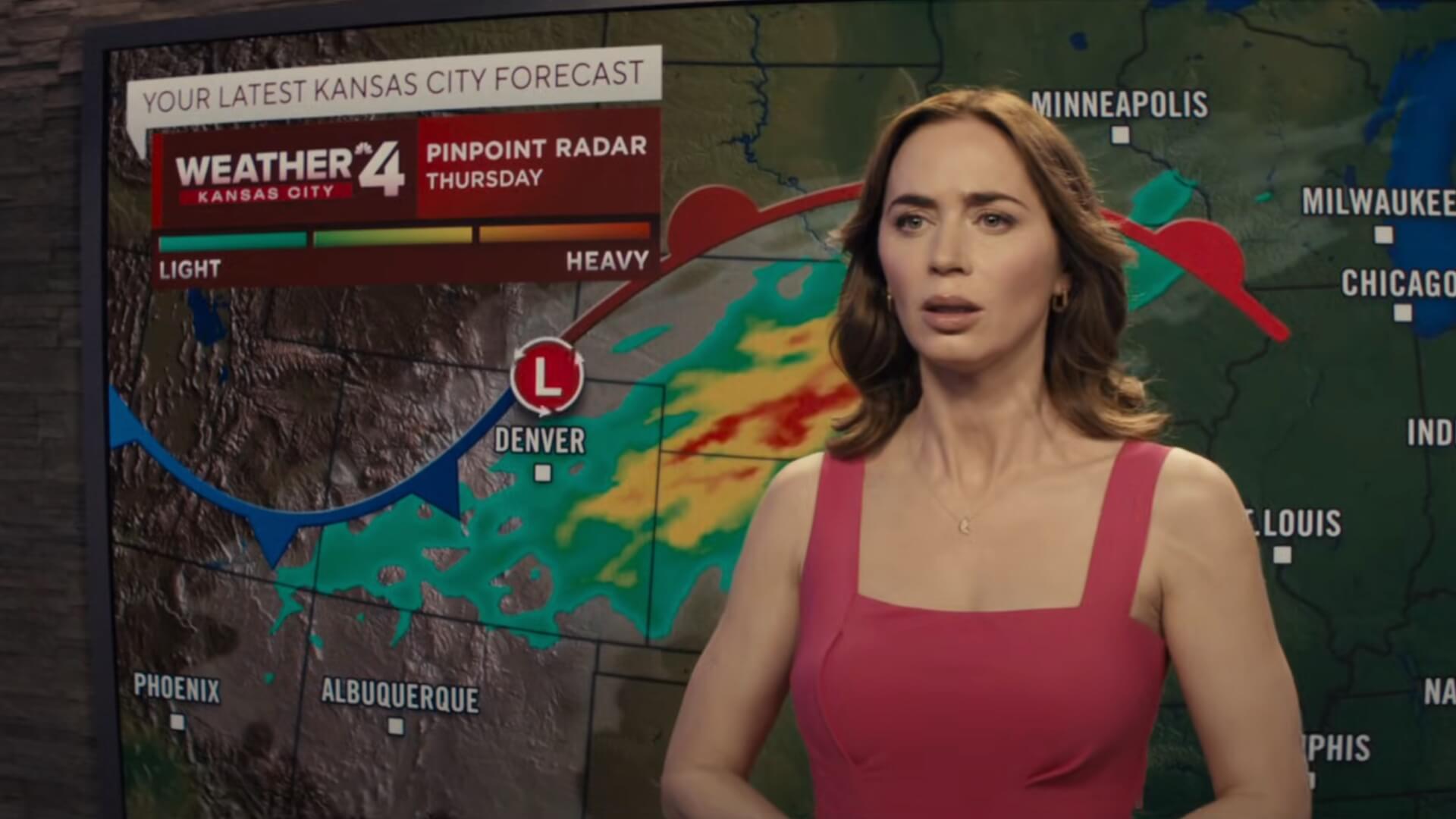
Monica Castillo: I’m decidedly mixed on Disclosure Day, and I thought the ending was one of the weaker sequences. That clandestinely provided footage would go to international air pretty quickly without much of a verification process on a major news outlet—in the age of AI no less! I know speed is the name of the breaking news game, but it’s fascinating to think that no one in a control room would hesitate broadcasting unedited footage like that, or that some competing news outlet wouldn’t try to spin this into some sort of debate topic. (Or maybe that came later, and was blissfully not addressed in a movie advocating that we should all come together and have a little more empathy.) Having watched my share of anchors and field reporters process and report news in real time, I thought the film did Grace a disservice by focusing on her so much as she slowly breaks down from the information overload. It was more awkward than moving, and I felt bad for her! In a profession that (mostly) still values stoicism, no journalist wants to be the anchor who cries on air, especially in the face of difficult news.
Perhaps after all the chase sequences and tense use of alien technology that drains its users, the fact that Disclosure Day kind of peters to a halt with a sluggish montage of footage of little grey men is something of a letdown. Seeing is not always believing, as unfortunately, we’ve seen with various “truthers” out there who doubt actual events. Putting one’s faith in the moving image feels almost as old-fashioned as some of the clips purported to be, a callback to a time when everyone watched things simultaneously and didn’t have to question their veracity, because they could believe the news and didn’t worry if there was an ulterior motive behind it.
Erik Adams: I have my nits to pick with Disclosure Day—beginning with that clunker of a title, which feels like it’s meant to be a weighty, meaningful phrase viewers already recognize when Margaret says it in her preamble and when it eventually becomes a news chyron, yet also comes across as two words that no one had ever joined together until David Koepp jotted them down. (I guess what I’m trying to say is that it’s trying to make “fetch” happen.)
But this is not a movie where Spielberg or any of his regular collaborators are working in finer details: It’s Janusz Kamiński going ape with the lens flares, it’s Sarah Broshar taking the baton from Michael Kahn and cutting the play-by-play of relaying Wardex’s secrets from Kansas City to New York to the entire world into a legible, infectious frenzy. It’s also John Williams dodging retirement yet again to deliver an instrumental score whose main theme, while neither grand nor stately, is still sticky enough that I could hum it as soon as I left the theater—and I can’t remember the last new release I could say that about. The ending is pure maximalism, down to the way it seems to, as Monica points out, go on and on; it’s probably the one spot where Broshar and Spielberg lose their grip on the pacing. But even if it bobbles some of the smaller things, I still think the scale of it all articulates what Spielberg does better than pretty much everyone who came before him, and anyone who’s come after him. Through a synthesis of collective technical proficiency and passionate drive, Disclosure Day‘s ending communicates and illuminates fundamental truths about ourselves and our universe in a way that’s capable of stopping the masses in their tracks. Why we don’t see anyone within those masses turn to the person next to them to say, “Can you believe this,” I don’t know—but again, I’m trying to focus on the bigger picture.
Matt Schimkowitz: Much of Disclosure Day really worked for me, and what I liked and disliked are certainly present in the finale. Of course, Spielberg made a meal out of every shot and set piece, generating enough forward momentum to speed past Koepp’s p(l)otholes. It wouldn’t be the first time Koepp’s blunt-force dialogue and economic shortcuts hurt a blockbuster. The script rattled off explanations for how everyone on Earth could believe the footage of Nixon introducing Jackie Gleason to an alien (“Our AI checkers say its real!”), but Spielberg makes a masterstroke and introduces audiences to a big, gray alien inside some kind of embryonic wheelchair.
For as cliché as the gray alien has become in pop culture, this may be their most significant role since Paul. It was a sight to behold, one that inspired a final Spielberg face, in a film filled with them, out of me. Moreover, Spielberg leaves audiences with such a tantalizing question. We know the footage in the broadcast is real, as that’s what Kellner and Margaret spent the movie trying to reveal. But will it amount to anything? In the world of the film, will Disclosure Day even matter? Will people listen, as they’re asked to? The cynic in me says, “No, they won’t care.” But I love that Spielberg brought a little Amblin optimism to his 2000s sci-fi thrillers, which have thus far leaned toward darkness. In a summer where Obsession is king—and that film’s ending is about as grim as endings get—it was nice to get a little faith in humanity as a treat.


 Keep scrolling for more great stories.