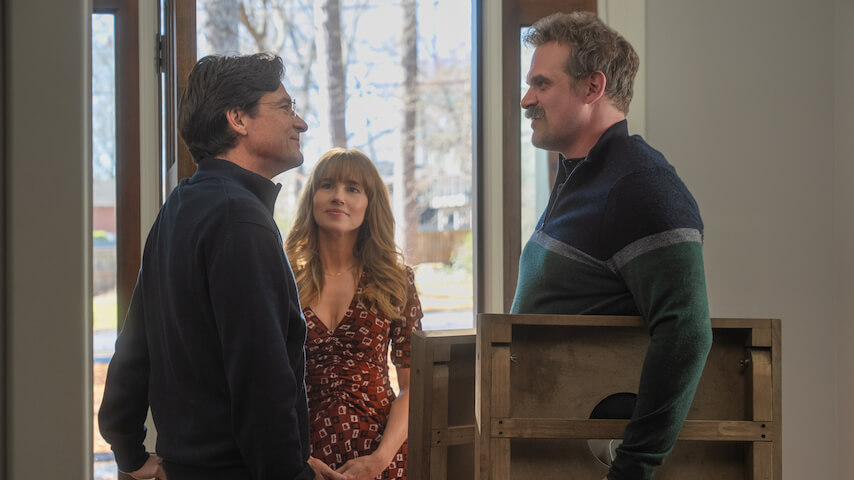
With the investigation into Floyd Smernitch’s (Harbour) murder ramping up in the present day, flashbacks in “The Go Getter” shed light on the affair between his wife, Carol Love-Smernitch (Cardellini) and new-ish BFF, Clark Forrest (Bateman). As for Floyd, he embarks on a potential escapade by meeting someone from the show’s titular hookup app. However, this person turns out not to be a woman, as Floyd believed, but an endearing man (played by Peter Sarsgaard) using David Bowie as his profile picture. Floyd doesn’t abandon him in anger or disappointment, though. Instead, the two share a meal, a heart-to-heart, and end up French kissing in the parking lot. Floyd may opt to swipe right and cheat, but he also proves himself to be an oddly nice guy. Harbour says that, for him, this illustrates Floyd’s genuine joy about having a positive effect on someone. “He’s in a lonely place in life and just wants to feel something visceral for once. In the later episodes, you’ll see how he also starts to bring up things about guys getting boners because, again, it’s exciting to him to think he’s having a real impact on someone.” He continues, “Floyd is also a protector, as seen with how he’s sensitive to his stepson, so I love that we subvert expectations about how he might react to the reveal that it’s Peter.”
Another reason Harbour touts this scene’s importance is that it sets up a Clark-centric confession later on. When he’s being questioned by detective Donoghue Homer (Richard Jenkins) and special crimes officer Jodie Plumb (Joy Sunday) in “The Go Getter,” Clark explains his friend is just too nice, and that’s why he made out with a stranger. Clark then elaborates on the connection he had with both Floyd and Carol, saying of the former: “Like the sun when you’re cold, like water when you really need water…I loved Floyd.” But the conundrum is whether Clark means it, or if he’s pretending to avoid being blamed for the crime. Bateman won’t clarify either way, partly because he wants the audience to keep guessing and partly because he’s still gauging the depths of this fictional friendship himself. “It’s hard to say if Clark’s going through any questions about his own sexuality in that moment, or if he’s just looking at what this [friendship] actually meant to him,” Bateman explains. “He is looking to fill a void because he’s desperate, but with which of them? Trying to figure that out episode by episode was a lot of fun.”
“The Go Getter” also raises doubts about Carol’s true purpose behind toying with both men. She sincerely seems to love her spouse, tearing up at seeing him go wild on the stage in episode two. But she has no qualms about sleeping with his pal or manipulating Clark into getting Floyd to buy life insurance. Episode three casts her in a suspicious light, but Cardellini says that Carol’s prime motivator is clear by the end of this outing, when she speaks to her young son, Richard (Arlan Ruf), and reminds him that she’ll do whatever it takes to keep them afloat. “That scene serves many purposes within the structure of our story,” Cardellini says. “Everything in her life feels out of control, and she’s trying to find some power. It’s why she’s always listening to those audiotapes as well. She’s trying to find a way to survive in a way that she can thrive with her family, but it’s difficult to do because she’s not the most openhearted person.”
It’s this kind of complexity that initially drew Cardellini to the role. “Carol’s not the likable woman in the middle of these two guys. She’s got her own things going on, and you don’t really understand her fully until later in the show’s run. I loved that about the writing and about the idea of getting to play someone different.” Bateman, for his part, admits that he agreed to sign on before even reading the script just because he wanted to work with Conrad. “I’ve been a fan of his for 20-some years, so I was excited to get the call from David about this project and at the possibility of starring in it. Everything else, including the character, was secondary to having a chance to work with all of these people.” This enthusiasm raises the question of whether DTF St. Louis has more story to tell after these seven episodes. Harbour says, “Steve put his heart and soul into writing this, and it shows, so we’ll see,” joking that “my character dies like 10 minutes in, unfortunately, so there may not be a season two for Floyd Smernitch at least.”
Saloni Gajjar is The A.V. Club‘s TV critic.


 Keep scrolling for more great stories.