But I can think of a couple explanations. At the past four Creative Arts Emmys, Outstanding Picture Editing For A Single-Camera Series was dominated by the more stylish likes of Barry and The Studio (the latter of which relies on cutting-room sleight of hand to achieve its signature long takes) and the “best editing=most editing” flash of The Bear. But also: The last mockumentary to win this award, along with its British predecessor, developed a whole playbook for how this type of show shapes its stories and jokes in post-production. The hard cut to the talking head contradicting a character’s off-the-cuff statement. The sincere voiceover juxtaposed with footage of someone making a fool of themselves. The switch to the camera angle that finds Tim Canterbury, Jim Halpert, or one of their many spiritual successors giving a glance to the offscreen documentarians that says, “You’re getting this, right?” The kind of thing that onscreen documentarian Arthur Tobin (Daniel Radcliffe) describes, in the pilot episode of The Fall And Rise Of Reggie Dinkins, as “piercing the artifice that people want to show to the world”—shortly before a line from retired, also-ran NFL placekicker Rusty Boyd (Bobby Moynihan) intrudes on Arthur’s close-up and pulls us into a medium shot where Rusty pierces the artifice of the movie-poster backdrop the pretentious filmmaker has built for himself.
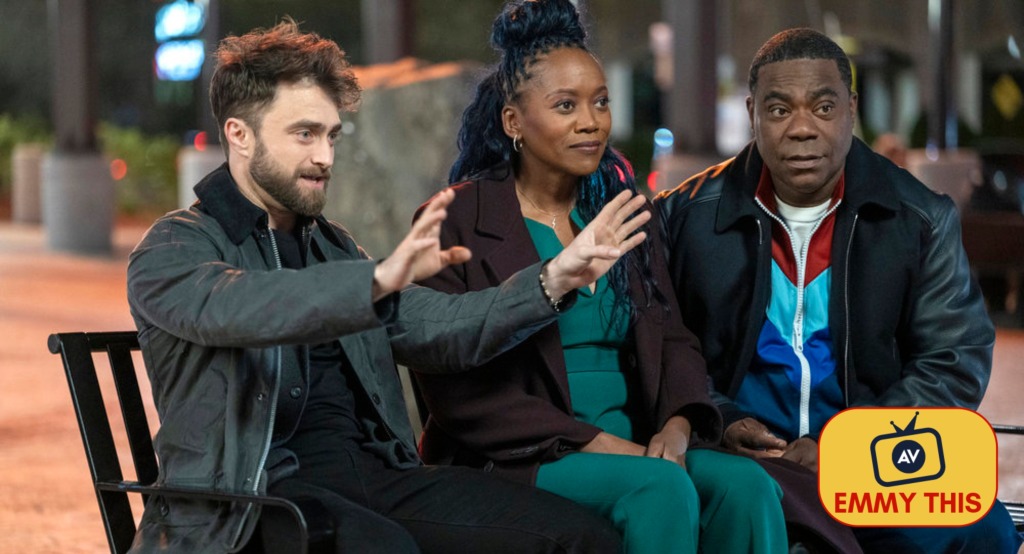
The Fall And Rise Of Reggie Dinkins doesn’t completely reimagine the playbook for mockumentary editing; Arthur’s attempt to rehabilitate the public image of football pariah Reggie Dinkins (Tracy Morgan) gives Radcliffe, Morgan, Moynihan, and their castmates plenty of reasons to fire off a fourth-wall demolishing look of disbelief. (The task most often falls to Erika Alexander as Reggie’s ex-wife and loyal agent, Monica, the levelheaded Ben Wyatt to his starry-eyed Leslie Knope.) But the specifics of its rhythms and timing tweak the formula just enough to bring something novel to the genre, and give it its strongest editing contender since the early seasons of What We Do In The Shadows.
I think it comes down to the way The Fall And Rise Of Reggie Dinkins successfully marries the conventions of the mockumentary with the densely packed, joke-a-second style creators Robert Carlock and Sam Means previously practiced on 30 Rock, Unbreakable Kimmy Schmidt, Great News, and Girls5eva. In the pilot episode (the show’s submission for Outstanding Picture Editing consideration), editor Kyle Gilman pulls the rapid-fire cadence of Carlock and Means’ dialogue into the faux-realistic flow of Arthur’s documentary; as in the Radcliffe-Moynihan moment mentioned above, you’ll often hear a character initiating a setup while the camera is still on the character who just finished speaking, preserving the illusion of natural conversation before the cut to the next shot emphasizes the punchline. The format’s a natural fit for 30 Rock-style cutaway gags, too, with Reggie’s desire to commission his own version of The Last Dance from Arthur provides ample opportunity to drop in flashbacks to past triumphs and catastrophes (though, pointedly, none that occurred during an NFL game). As the pilot pivots toward its final act, those catastrophes include the career-ending, on-set embarrassment that sent Arthur crawling to Reggie in the first place.
And there you’ll find the subtler, not-strictly-comedic accomplishment of the pilot’s editing. Amid all of the jokes and freeze-frame-worthy sight gags (look up the “feat.” credit on the cover of Reggie’s unreleased rap album and thank me later), The Fall And Rise Of Reggie Dinkins coherently lays out three parallel comeback stories within the span of 21-and-a-half minutes. Reggie’s bid for the Pro Football Hall Of Fame, Arthur’s stab at returning to the upper echelon of documentary film, and Monica’s desire to grow her client base beyond her disgraced ex, a kid who plays Fortnite, and Geena Davis (archery only)—they all get sufficient air time, moving between the foreground and the background of the episode with impressive grace. That economical skill applies to the characters with less story in the episode, too: Reggie’s fiancée, Brina (Precious Way), establishes her relationship with Monica in a matter of seconds thanks to a vintage cut-to-talking-head move. Turns out the old playbook still has some juice in it.


 Keep scrolling for more great stories.