Is there a moral to Fallout? And if so, is it “Never attend a wedding in Vaults 32 or 33”? Admittedly, the nuptials between Chet and Steph Harper at the tail end of tonight’s episode don’t go as poorly as those between Lucy MacLean and Monty The Psychopathic Raider did back in the show’s premiere—for hopefully obvious reasons—but I’d argue that something has still gone pretty wrong when your runaway bride isn’t fleeing from cold feet so much as mob justice.
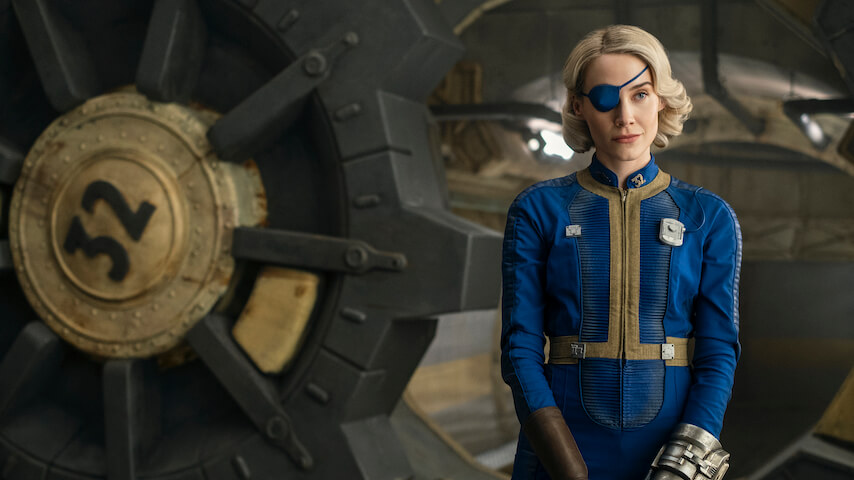
But maybe the moral should actually be “Never get in the way of a pissed-off Canadian with nothing left to lose,” as this week’s episode goes in hard on the backstory of Steph, who we learn was pretty crazy even before she became a member of Bud Askin’s infamous Buds. We open tonight on Vault 32’s Overseer having a pre-War flashback, remembering her and her mom escaping from the “Uranium City Internment Camp” up in what an expansionist American government had redubbed “The Big 51”—i.e., the entire country of Canada. Confronted by a “hoser”-spewing soldier in power armor, Mom Harper is fatally wounded when the goon is taken out by a suicide bomber but not before imparting a new religion to her traumatized daughter: Survive at any cost. The scene itself—intercut with some meaningfully brutal teeth brushing and a lot of head-on looks at Current Steph’s empty eye socket—is too short to give guest star Natasha Henstridge a ton to do. But she does get one absolutely killer line: “Don’t think of them as human beings,” she says of the people Steph will be infiltrating in her efforts to stay alive. “Think of them as Americans.”
I’m on the record as liking Steph, with Annabel O’Hagan giving a performance that walks the line between Fallout’s comedy and drama halves better than many of her fellow Vault Dwellers do. And I like what this episode does with her, threading the character’s literally cutthroat need for survival through both the show’s past and its potential futures. But the existence of this episode as, essentially, half a spotlight for the character does make me a little sad about some of the things Fallout sacrifices with its “move every portion of our plot forward six inches every episode” approach to storytelling. An episode fully focused on, and built around, this character—showing how she’s been lurking in the shadows throughout the series, a little chunk of the pre-War madness that helped build the Vaults festering into the future—would have made for fascinating TV. But Fallout isn’t equipped to do that, because, at just eight episodes per season, it’s not allowed the kind of indulgences that make for formally interesting TV. As is, we get sketches of Steph’s desperation and malevolence without truly being able to luxuriate in it.
Given that that is our structure, though, let’s take things in turn: Lucy is still trapped down in Hankland, apparently being seduced by not just her dad’s pitch on building a better Wasteland through brain stapling but by the resurrection of their paternal bond. Kyle MacLachlan has been fantastic all season as Hank, but he’s an utter delight here, letting the older MacLean indulge himself in the nostalgic pleasure of teaching his daughter how to drive a golf cart through the deserted hallways of the secret Vault-Tec facility while still keeping up the ongoing sales pitch. (In a telling moment that’s a reminder of how far off pre-War dad and Vault-born daughter actually are, he wistfully wishes he could have given her a normal childhood—only to be reminded that, from Lucy’s point of view, he did. “You wrecked it.”)
All of this is accompanied by more exposition on what the brain chips are actually doing to their “users”: Turns out the system isn’t straight-up mind control so much as a sort of programmed amnesia, wiping out years of traumatic Wastelander memories and replacing them with “good thoughts” and directives from a “mainframe.” The suggestion that this is less scary than just full-on people puppets is undercut efficiently when Lucy interviews Biff, the former NCR ranger who saved her life after her crucifixion a few episodes back (who no longer remembers her or the NCR itself). Hank’s dismissal of both her concerns about this and the New California Republic seems to solidify Lucy’s plans (while also allowing Fallout to get more pointedly political than it usually does), as she seemingly undoes his handcuffs—only to then re-chain Pop to his own oven. Turning up her nose at her dad’s “You’ll understand when you’re older” bloviating about how the NCR’s high taxes and inefficiency are, in their own way, just as bad as the Legion’s sins, she lobs out her own moral in the spirit of his own “Perfect is the enemy of good”: “One side is murdering people, enslaving them, crucifying them, and the other is just vaguely problematic.” (Lucy MacLean: Center-left hero, apparently.)
Meanwhile, down in the Vaults—this show requires the use of a lot of “meanwhiles,” have you noticed?—Steph engages in skullduggery of various shapes, including inelegantly disposing evidence that she had Woody murdered for catching her talking to Betty a few episodes back. (I get that evidence disposal is probably a tricky concept when you’re living in a self-contained survival system, but, still: The garbage disposal? C’mon, Steph, you’re a more accomplished murderer than that.) She successfully puts Betty over a barrel, trading her necessary water in exchange for Hank’s Mysterious MacGuffin Box while demurring on the concept of long-lasting peace between 32 and 33. But things go less well at her press-ganged wedding to Chet, who finally manages to find a spine and outs her to the assembled dwellers of 32. (On a cute/xenophobic note, they’re less concerned about the alleged Zach Cherry murder than the proof that their leader has been secretly Canadian the entire time.) I got a little leery when I saw this episode’s “Previously on” going hard on Vault stuff—it’s almost always a Fallout episode’s most hit-or-miss material—but this version of it at least moves the story along at a fairly brisk pace.
Slightly more meandering: The Ghoul’s team up with Maximus and Thaddeus, who raid an old NCR armory to prep themselves to fight the Deathclaws prowling the Vegas Strip so that they can then break into Hank’s bunker to rescue their various loved ones. There’s some decent back-and-forth about Max’s obsession with giving Cold Fusion to his favorite Good Person, Lucy—a plan that gets short-circuited because he can’t stop fidgeting with the world’s most priceless relic in front of a man who’d cheerfully kill him to accomplish his goals. God bless Johnny Pemberton, though, who leans hard here into his role as comic relief (non-odious version) as Thaddeus attempts to bond with The Ghoul over their shared ghoulishness—only to realize that whatever the Snake Oil Salesman gave him last season might actually be a lot nastier than the basic “noseless zombie” treatment. (Later on, this’ll generate a great comedy beat when The Ghoul assigns him to sniper duty—only for Thaddeus’ arm to fall clean off.) The show once again tweaks my “Hey, does this actually make sense?” brain when the people of Freeside are in jaw-dropping awe of Max in NCR power armor—the group seems to be viewed more as folk heroes than an actual functional military or government in this reality—but at least we get a pretty fun action sequence out of it, as Max attempts to go toe-to-claw with the (very polite) Deathclaw pack with some fancy blades attached to his arms.
As is often the case with this series, though, the best scenes take place in the past, as pre-War Cooper—having brought Barb back to his side and extracted Cold Fusion from Hank MacLean’s neck last week—goes looking for someone safe to pass the technology on to. He eventually settles on Representative Welch, who’s been popping up throughout this season as a background presence in the pre-War material. I noted back when Welch first showed up that she seemed like a waste of a perfectly good Martha Kelly performance; and the payoff arrives here, as Kelly’s matter-of-fact, slightly bland command of goodness stands out refreshingly against the chaos. (When asked by a frustrated Cooper why she can’t bullshit people better in the service of good, Kelly deftly lobs the irony back in his face with a dry, “I don’t know. How’s that worked out in your experience?”) Cooper’s decision to trust Welch when she offers to put him in touch with the President Of The United States—a welcome guest spot from Fallout games alumnus Clancy Brown—is sweet in the moment but ominous for anyone who knows the franchise’s history. There is, after all, a reason that little diode was floating around in Enclave hands when Siggi Wilzig decided to make a break for freedom 200 years later. But the deft way the show contrasts Cooper and The Ghoul—and also Cooper and Maximus, who both believe that there’s a “right” person to hand this sort of power to—demonstrates the kind of rhyming Fallout could be doing regularly, if it weren’t hamstrung so much by its own structure.
I know I keep harping on this point, but it really came into focus for me here: One of the key issues with the disconnected nature of Fallout’s various plotlines is that it makes it exceedingly difficult for the show to use these stories to comment on each other, to build something more cohesive out of its haphazardly assembled parts. Take each of the show’s various plot silos—Hank’s story this season, the stuff in the Vaults, Norm’s Odyssey—and re-cut each set of scenes into individual episodes, and you wouldn’t actually lose all that much, because you’d just be completing the project the series is already halfway to creating. There’s a reason that Fallout’s flashback sequences are often some of the show’s best offerings: Because they put so much energy into contrasting the Cooper Howards of 2077 and 2296, they’re able to comment and reflect on each other in ways that the series is seemingly otherwise incapable of. It feels weird, for instance, to praise a show for something as simple as quickly cutting between multiple scenes to give a sense that disconnected events are happening simultaneously, as it does at the climax here, with two Coopers handing the world’s most powerful technology off to two very dangerous men while Lucy MacLean stumbles on to the grim fate of a “good” person in the hands of the masters of the world. But those simple cross-cuts imbue Fallout with an energy and weight that it frequently lacks, reinforcing that we’re watching one story instead of six. That final gasp of momentum—and the genuinely gnarly reveal of what Hank’s “mainframe” actually is—has me holding out hope for next week’s finale, as all of our various trains hopefully, finally pull into the station at the same time. But it also makes me wish we’d taken more elegant routes to get there along the way.
Stray observations
-
- • Norm is also in this one, for exactly as long as it takes to send out a radio message and get his head bashed back in by Rajat Suresh. See ya next week, Norm.
- • The “O Canada” version of the title splash was cute.
- • I love Hank’s embrace of teachable moments and how easily Lucy falls back into his rhythm. Her trying to improvise explosives to blow up his lab, and him quizzing her on potential alternatives, is such a great example of the relationship they wish they still had with each other.
- • This is game nerdery, but I’m starting to think the Snake Oil Salesman dosed Thaddeus with F.E.V. The gnarly mouth on his shoulder, and the fact that his arm just falls clean off, makes me wonder if he isn’t mutating into a Centaur.
- • I roll my eyes a bit at how easily characters tend to pop up both pre- and post-War, but the reveal of Steph as the hotel worker sneaking Hank out of Cooper’s hotel room is a nice touch. (I do wonder how much of it is meant to be thematic versus just trying to short-circuit questions about how she could go from Canadian refugee to Vault-Tec junior management in such a short period of time—and hope we get to see more of her “scaring” her fellow Buds, per Betty tonight.)
- • “Showers are outlawed. And so is flushing the toilet.”
- • Fallout game-lore corner! As I noted last week, the mysterious Enclave is actually just the remnants of the existing pre-War United States government, so Cooper handing off Cold Fusion to them is probably not going to turn out as well as he hopes. (The bombs still fall, after all, even though he’s apparently screwed Vault-Tec out of buying them.) I’ll also note that, while it tries to stay in line with game canon, the show is ignoring one really huge aspect of Fallout: New Vegas, presumably because it would make Cold Fusion less special: the existence of the still-running, still-generating-boatloads-of-electricity Hoover Dam, which is the main prize the NCR and the Legion were fighting over in that game. Oh, and while the show tries not to comment on New Vegas’ endings, it sure does look like the shoot-out in House’s penthouse—which happens in any timeline where the player doesn’t side with him—ended up happening.
- • “I just seem to be having a sort of medical episode here.”
- • It’s a cheap joke, but the gasps of horror at “She’s Canadian!” got an actual laugh out of me.
- • The Ghoul doesn’t say thank you, but he will touch his hat brim in a way that speaks volumes.
- • Aaron Moten tends to get overshadowed a bit when Fallout gets loud, but I love his delivery of “Ohhhhh…noooooo…” when the Deathclaws break into Freeside.
- • I wish the reveal of a revived House on the 38’s big computer screen hadn’t been blown in the trailers, because it’s otherwise very neat.
- • That said, I love how much time and energy this show spends on creating severed heads for well-loved character actors.
William Hughes is a staff writer at The A.V. Club.


 Keep scrolling for more great stories.