The existence of “good” people is one of Fallout’s primary obsessions. Lucy MacLean is a good person, for instance—which is to say she only kills people when she has a good reason to, or by sheer unfortunate happenstance, or when she’s very high. And Lucy MacLean holds to a moral code, which strictly defines her behavior—as long as nobody’s getting a stapler slammed into their brain. She believes in justice, too—so long as nobody asks too many tricky questions about what the hell justice actually is. But still, Lucy MacLean is a good person. Right?
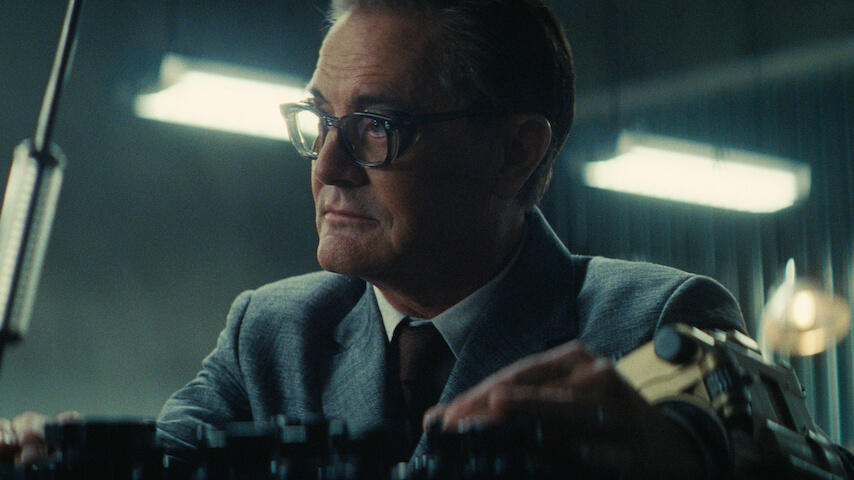
This is all a slightly snide way to note that nobody comes out of this week’s Fallout with their moral inventories unrifled, as the show launches its latest energetic, if somewhat unfocused, examination of morality at the end of the world. Lucy gets it the hardest, as Ella Purnell and Kyle MacLachlan make a meal out of a long-in-the-works MacLaine family reunion. Hank, see, has been a busy boy, jamming enough chips into enough Wastelanders’ brains that he now has a perky little workforce of former cannibals and rampant murderers working in the secret Vegas Vault-Tec bunker, assembling yet more brain-jacking devices to disseminate as needed. In between trying to reignite a father-daughter book club and getting a pair of scissors held to his throat for his trouble, Hank lays out a surprisingly compelling case for better living through mind control: As with the Snake Oil Salesman last week, the various raiders, Legionaries, and people cookers he’s captured in his secret corporate paradise were living such wretched lives that they seem genuinely happy to have all that trauma wiped out of their brains and replaced with a chipper lil’ dose of sunshine and an inner Kyle MacLachlan. (I can, if I’m being honest, relate.)
Hank makes for a compelling cult leader, especially as MacLachlan shades the former Overseer’s obvious and unquestionable love for his daughter through any number of lenses of self-interest. The tricky thing about Fallout’s latest trip to the morality mines, though, is that it’s forced to share space with the show’s fundamentally cartoonish treatment of pretty much all of its secondary Wasteland characters up until this point. For two seasons now, this series has only intermittently treated Wastelanders as people, instead defaulting them to either threats or fodder for what were essentially short-form comedy sketches. The result is to make these big, weighty conversations about human nature feel a little facile; it’s hard to take the inherent right to self-agency seriously, for instance, when it’s being filtered through a character we first met as the punchline to an extended chicken-fucking joke. Certainly, it puts possibly unintentional weight on Hank’s arguments that Wastelanders are genuinely better off being chipped, even as the show tries to argue—in a nice little scene between Maximus and Thaddeus elsewhere this week—that the violent weirdness of the vast majority of its characters is fundamentally a function of deprivation. (Which, in turn, swings the whole thing back around on Hank, who’s personally responsible for the destruction of Shady Sands, apparently the Wastes’ sole bastion of both resources and basic human decency.) It’s one of those spots where the show’s comedy/drama hybrid nature undercuts it, because it’s hard to have serious moral arguments about a class of people who you’ve been playing as pitch-black jokes since the show’s very first episode. It’s a bit like trying to have in-depth ethical conversations about the spiritual nature of, like, Minions.
These high-minded arguments land harder, as always, the higher we get on Fallout’s call sheet—and the further back we go in time. Which is a roundabout way of saying that, after 13 episodes of viewing her from the outside, we finally get a title card for Barb Howard and a chance to spend some time in the perspective of the only apparent non-psychopath working at the Vault-Tec corporation. That starts right from the jump, too, as we open with what is, low-key, one of the funniest scenes of the episode, as Barb is forced to sit through what are essentially marketing meetings for the end of the world, mushroom clouds (a.k.a. “a cacophony of puff-clouds”) reflecting in her eyes while her co-workers chow down on burgers and casually talk about the preferred aesthetics for nuclear annihilation. Here, Fallout’s special cocktail of darkness works, as Vault-Tec’s blithe evil lands for both comedy and horror, with Frances Turner ably conveying all the ways it’s killing Barb to indulge in this monstrousness for what she views as the protection of her family. Among other things, it contrasts nicely with the semi-simultaneous argument we’re also watching Barb and husband Cooper have in their Las Vegas hotel room a few weeks later, with the righteous husband finally unleashing the heartbreak he’s been harboring ever since he heard the woman he loves waxing hopeful about the “opportunity” of killing several billion people.
Here, though, is where we run into my other big issue with this episode: its status as a big ol’ lore dump, served with a hefty dose of retcon, as we find out Barb’s hard sell on Armageddon back in that first-season finale didn’t actually come from her but from a man who politely accosted her (after staying ominously off-frame for a long beat) in a Vault-Tec elevator. Not Robert House, as you might be expecting, given how often he’s been popping up in Flashbackland this season. No, it’s Dr. Siggi Wilzig, the Enclave scientist who will one day defect and smuggle the Cold Fusion tech out of a high-security laboratory, but who’s both toeing, and providing, the company line with Michael Emerson’s effortless, chilly calm. And, yes, it’s wonderful to get Emerson back for a scene—great casting being something that this bit of obvious lore-welding shares with the other major perpetrator this episode. But not, I’d argue, if it comes at the cost of weakening that critical first-season reveal. Later/earlier—the timeline of the flashbacks jumps around in a way that can feel a little incoherent—Cooper Howard will ask his wife what kind of monster she is, a genuinely fascinating question we’ve been wrestling with pretty regularly of late, as the show floated big, heady ideas about the extremes one person could go to to keep the people they genuinely care about safe. But no: It was actually the Big Bad putting words in her mouth, and Barb’s been a “good person” all along, ultimately helping Cooper steal Cold Fusion from a knocked-out Hank after he gets the toady smashed at a Vegas bar. All that bad stuff, that incredibly complex moral calculus? That was all actually the shadowy bad guys’ fault.
But you know what they say: The only thing that can stop a bad guy with a lot of shadowy plot obscurement is a good one with a lot of shadowy plot obscurement, as the episode continues its running theme of interrupting Walton Goggins while he’s acting the hell out of a scene so that it can run some exposition delivery instead. Back in modern times, see, The Ghoul is still impaled on that metal post Lucy knocked him onto last episode, with the people of Freeside hilariously oblivious to his plight. Going feral—and heartbreakingly reminding himself, “I’m a human being. My name is Cooper” in an effort to keep his mind—The Ghoul is eventually rescued by a shadowy, lumbering figure who casually snaps the solid metal bar in half and then drags him off to some kind of church. Faster than you can say, “Oh, hey, I recognize those hanging sacks of human meat from Fallout 3,” this savior is revealed to be a green-skinned Super Mutant, who heals Cooper with some brightly glowing uranium, before extending him an offer to battle The Enclave himself.
In case it wasn’t clear: Absolutely nothing about this feels organic. Not the simultaneous reveal that that same Enclave was pulling Vault-Tec’s strings; not the way this unnamed character appears out of nowhere to deux ex machina The Ghoul while laying out some much larger meta-plot; not the way the scene literally ends with our favorite jerkied killer going “Hey, no thanks” and being summarily deposited back into our previously interrupted story. Is it cool to finally see Super Mutants pop up on the show and especially to see long-time Fallout game narrator Ron Perlman playing one? Obviously. And my first time through the episode, I couldn’t help but vibrate a bit at the Fallout of it all. But this is clunky plot movement papered over with obvious fan-service, and it’s hard to treat it as anything else.
And, gosh, you might be thinking: That sure is a lot of stuff in this episode. Surely they didn’t have time to also include an imaginary, highly extraneous Vault Dweller musical sequence? But no: We also spend a decent chunk of time back in Vaults 32 and 33, a stretch that includes a fantasy sequence set to Elton Britt’s “Uranium Fever.” (This show will needle drop every single song from the Fallout 3 soundtrack or die trying.) I actually like big chunks of the conflict between Overseer Betty and underdog Reg, who face off over the ongoing snack budget of the Inbreeding Support Group. That goes double for Reg’s fucked-up but accurate point that the entire philosophy of Vault survival is predicated on the nearsighted self-indulgence he’s stumping for: “Our ancestors put themselves first! And you know what? That worked out for them.” (It dovetails nicely with the episode’s overall arguments about the way comfort plays into kindness or a lack thereof.) But whoever in the show’s writing department thinks I care about Chet being forced to marry Overseer Steph over in Vault 32 has vastly overestimated how interesting these dweebs’ interpersonal lives can be. It has no value as drama, so it’s presumably intended as comedy. It’s not funny, either, so your guess is as good as mine.
What we have here, all told, is a big, messy episode of Fallout, one that stumbles in part because it’s trying to do so much. This has never been a show that’s very elegant about moving its parts into place, and you can definitely feel the machinery shudder as it tries to, say, get Thaddeus, Maximus, and The Ghoul together for some kind of big finale push or lay track for bigger, scarier reveals down the line. The performances, as always, are superb—Goggins has maybe his best episode of the season so far, while Kyle MacLachlan shines as he walks the line between proud, loving father and smugly condescending piece of shit via Hank’s interactions with Lucy. Thematically, it’s actually more cohesive than many episodes this year have been, circling the drain in interesting ways on the basic question of what makes a person good and finally dialing in hard on the ethics and ugliness of “The Automated Man” tech that it’s been seeding all season. But as a story it creaks, bouncing around in time unsteadily and undoing a few of the show’s most fascinating character moments. With just two episodes left this season, some table-setting is understandable. But I’d love to see something significantly more focused from the series as it cruises into its sophomore finale.
Stray observations
- • All the food stuff in the opening scene is nicely gnarly, with the Vault-Tec true believers chowing down on burgers while Barb picks fitfully at her salad.
- • Vault-Tec knew which vaults were getting faulty water chips, because of course they did.
- • The “Vault Of The Future” art in the back of the Vault-Tec conference room comes with a slight variation straight from the original Fallout.
- • It’s kind of funny that the show pays to de-age Kyle MacLachlan for the past sequences but just hired a different actor (Princess Bey) to stand in for Leslie Uggams as Betty.
- • “You know the thing that I can’t figure out? Were you a monster back then, or did you become one later?”
- • Ella Purnell is mostly in reaction mode here, but I appreciate the complexity of emotion she carries when Lucy sees her dad again for the first time.
- • MacLachlan has about two dozen really phenomenal line readings this episode. “I saw the same thing up on the surface. People fighting over the most petty things—like bottlecaps.” And “It’s crazy, the war instinct, hm?” And then “For a second there, I thought the Wasteland had changed you.” All around, it’s a really wonderful example of an actor playing to their strengths.
- • “Jeez… You know, if that isn’t a sacred remnant, I don’t know what is. We gotta sell it, huh?”
- • Johnny Pemberton gets to sketch out some more human parts of Thaddeus, who, we learn, was born in “The Boneyard, the shithole side of The Boneyard.”
- • There’s something incredibly affecting about hearing The Ghoul call himself “Cooper Howard” for the first time in the entire series.
- • “Triple cousins” is no longer good enough to get you into the Incest Club, sadly, but the red-headed twins from the premiere are still able to swan their way in.
- • Slogans for the Inbreeding Support Group now include “Keeping it all in the family—efficiency at its finest!” “Inbreeding is not a crime,” “Kissin’ cousins 4 better lovin’” and the simple “Hip hip hooray! 3 cheers 4 the inbred!”
- • Woody’s gone missing after crossing Steph in Vault 32.
- • Fallout game lore corner! Okay, so Super Mutants are one of the recurring dangerous factions in the Fallout games, as well as what happens when human beings get exposed to the Forced Evolutionary Virus that Norm stumbled over last week. (There’s no Norm this week, by the way, as the Fallout Plot Juggling Act gives him and his crew a break.) Some Mutants are dumb, some get scary smart, a lot of them at least try eating human flesh, and, about 130 years before the show, a whole army of them tried to conquer all of California under the leadership of a mutant known as The Master. The Enclave, meanwhile, is even scarier: The remnants of the Pre-War government of the United States Of America. Highly secretive, highly xenophobic toward anything it considers genetically impure (i.e., anybody who’s spent basically any time living out in the Wastes), and massively technologically advanced, it’s a recurring threat in the games, equipped with pre-War tech that’s been enhanced by 200 years of steady development since.
- • Hank’s brain-jacked recruits include Marjorie (“kind of a murderer”), Sherman and Gregory (opposing tribesmen), and Rita (“She used to cook people for the Legion!”). Oh, and I think the Khan played by Jared Bankens in the premiere, credited as “Nick The Prick,” is the same guy who says “It’s dangerous out there” when Lucy proposes freeing them all. Like I said, Hank’s been a busy boy.
- • Not even a brainwashing chip can keep the Snake Oil Salesman from being a bit of a creep, referring to the latest two recruits as “two males” who “haven’t been fixed yet.”
- • Jon Gries is not having an easy time of it this season, huh?
- • In case you haven’t seen them: I wrote up Jon Daly’s extremely funny and weird promo series for the show, Fallout Fake Talkshow, which I highly recommend if you like to see Fallout stars get the Eric Andre Show treatment.
William Hughes is a staff writer at The A.V. Club.


 Keep scrolling for more great stories.