Theme parks love basing attractions on movies. In fact, it’s almost unheard of today for Disney or Universal to open a new ride that isn’t themed after a big movie franchise, or character, or some other popular IP. Not every movie-based ride is built the same, though. There are basically three main subcategories, based on how the ride approaches the material. Some, like the Peter Pan and Little Mermaid rides at Disney parks, retell the story of a movie, a tactic often decried as “book report reviews.” Others add on to the movie’s story, using the same characters and setting but with an original narrative; Mr. Toad’s Wild Ride, Disney’s Princess & The Frog log flume, and most of Universal’s Epic Universe rides walk that path. And a third group go purely for vibes, borrowing a movie’s setting or general aesthetic without using any of its familiar characters or plot points, as seen with Disney’s Avatar and Tron rides. No matter what approach a movie-based ride takes, though, the most important thing is that it feels like the movie it’s adapting in some fundamental way. If it can’t nail that basic goal, people aren’t going to like it. The spectacular failure of a relatively recent addition to Universal’s parks proves the point.
In 2018, Universal Studios Florida opened Fast & Furious: Supercharged, an attraction based on the popular franchise about a family that plays car pranks with each other. Given the name and the primary thrust of the 11 movies (and counting) in this series, you’d probably think Supercharged was fast. You’d be wrong. This ride was not fast. It barely moved at all. Supercharged was basically a motion simulator ride, something Universal is very fond of; guests sat in a large vehicle (purportedly a specialized “party bus” created by Ludacris’ mechanic-turned-astronaut Tej) that slowly moved into a room with a hydraulic base and a wraparound screen, and then got shaken up a bit alongside a movie-style action scene starring actors like Vin Diesel and Michelle Rodriguez and some truly poor CGI.
That hydraulic base and the screen tried their best, but it was clear you were just spinning your wheels on Supercharged. Even the most finely-tuned and well-calibrated motion simulator lacks the sensation of real forward momentum. Reviews of Supercharged were scathing, and Universal Creative’s then-Senior Vice President called it the worst mistake of his career; he’s no longer with the company. Despite opening just eight years ago, Supercharged has already closed permanently, with an announced closure in 2027 being unceremoniously accelerated to August 2026. Unlike many defunct theme park attractions, its passing did not inspire fan outrage or “save this ride” campaigns. It mostly just inspired a bunch of jokes.
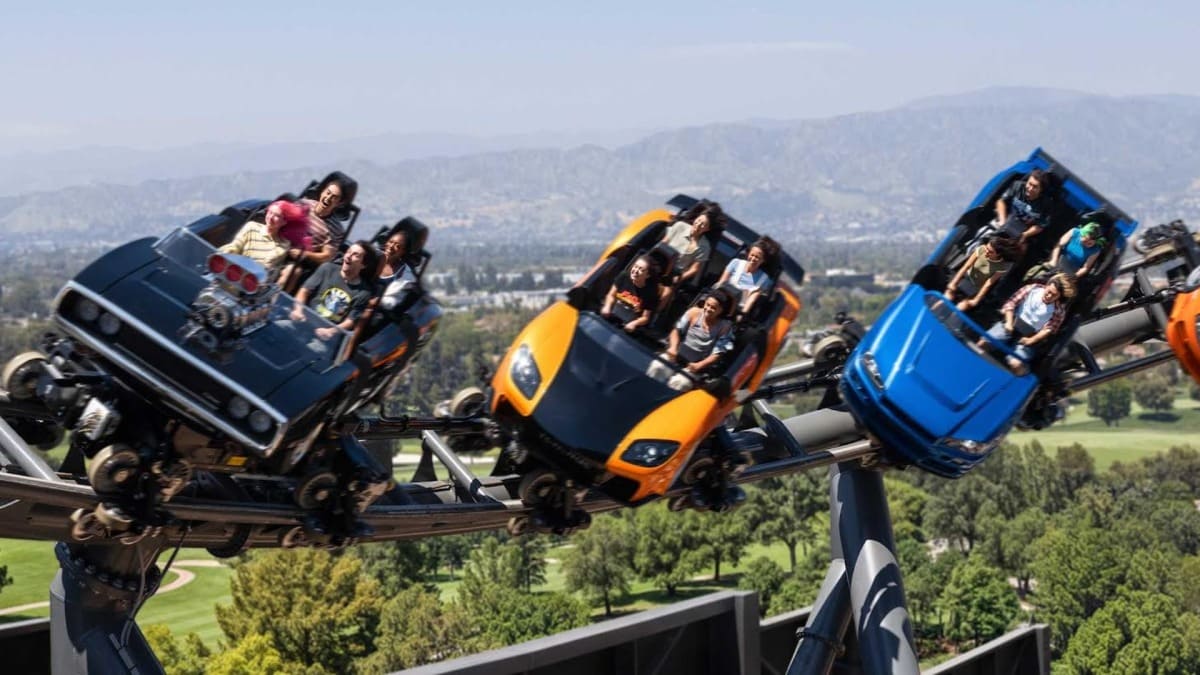
Supercharged was a standalone ride in Orlando. At Universal Studios Hollywood, the same basic concept was part of the backlot tour—a short digression from driving past the shooting locations of classic Universal movies and shows. That shorter precursor to Supercharged also closed permanently in 2025, just a few months shy of a decade-long run. Again, people were pretty okay with it going away, not just because it was a generally unloved addition to the backlot tour, but because it was being replaced by a new Fast & Furious ride, and this time one that does actually go pretty fast: a spinning roller coaster subtitled Hollywood Drift. The new coaster opened at the Hollywood theme park this September, and a version is currently being built at Universal Studios Florida.
The California version of Hollywood Drift doesn’t go especially fast by highway standards, topping out at 72 miles per hour. Still, that’s a full 70 mph faster than Supercharged’s peak speed. The ride vehicles look like Dom’s 1970 Dodge Charger, and have a swaying, spinning motion that kind of captures the spirit of a car drifting during a street race. It’s officially been running for just a few weeks, if you count testing and previews, but it’s already far more popular than the earlier Fast & Furious attractions ever were. It helps that the tiny Universal Hollywood is starved for intense coasters, along with, well, almost everything—coasters in general, new rides, rides in general—but the Florida version will almost definitely also be a hit in a park that’s full of fun things to do.
The quick hook for Supercharged underlines how not all movie-based rides are built the same. It’s not enough to look like a movie. Supercharged starred most of the family in on-screen roles, with the kind of car chases, explosions, and over-the-top action the movies are known for. It didn’t go fast, though. It looked like the movies (or at least like a weirdly glossy CGI version of them—like AI before AI became powerful enough to make really terrible and plastic-looking videos) but it didn’t feel like them, which meant that it became a huge failure.
Hollywood Drift doesn’t try to hide the fact that it’s a roller coaster and not a car speeding along the highway. It doesn’t try that hard to recreate how the Fast & Furious movies look. But it captures the most important things about them—the speed and the fury—which means it’s drastically more successful at being a Fast & Furious ride than Supercharged, and far more popular. That’s a lesson those working in adaptation, especially theme parks designers, and especially the ones working at the IP-dominated Disney and Universal parks, should learn. Whether you’re building a slow, all-ages dark ride based on a beloved family classic, or some punishing hypercoaster themed around an action franchise, it needs to feel like the movie it’s based on—or it won’t make people feel anything at all.


 Keep scrolling for more great stories.