If you played video games in the 1980s and ‘90s, then you’re probably already familiar with full-motion video (FMV), which was a way of telling stories using pre-recorded video files instead of the typical sprites or 3D models typical in games. While some games used FMV for cutscenes, others used the technique for the entirety of the gameplay experience, to the point that games of this nature are sometimes referred to as “interactive movies.” The use of pre-recorded footage in games can span the spectrum of live-action, CGI, hand-drawn animation, and green screen to fully convey the adventure developers are hoping to immerse their players in.
In most other popular visual art forms (photography, film, television, etc.), live-action is of course the logical default. These are mediums used to portray our physical world, staged or otherwise, and so real footage is used implicitly. Games, on the other hand, require extreme technical and financial resources to achieve verisimilitude with cinéma vérité. Making video game graphics and character performances in cutscenes appear lifelike is difficult and expensive. The best recent example is Death Stranding 2, which is only able to achieve this because Hideo Kojima is scanning celebrities in his free time and using mocap performances to put them in his games.
With full-motion video—and live-action by extension—having largely gone out of style with the improved technological capabilities in games, the inclusion of the material realm now feels radical and ambitious in the context of this digital medium. Every single one of us witnesses our tangible reality in our day to day, and in many of the aforementioned art forms where it is normal to capture such things, but in the context of games it creates a meta experience for the player. When it doesn’t work, you wind up with the uncanny valley effect, where the increasingly smaller visual gap between real and virtual worlds more vividly highlights the artificiality of the latter. When it works, though, photorealism in an interactive art form can bring players closer into the action, entangling them more deeply with the narrative itself, and thus adding another layer of immersion through this meta-narrative. Some of the best games of recent years have opted to try their hand at this stirring technique, leading to something aesthetically distinct and thematically resonant.
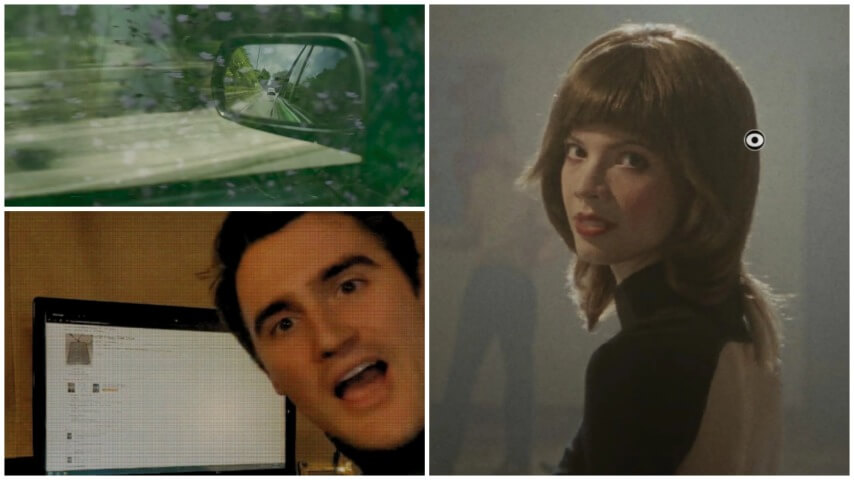
One way recent games have used the real is to unsettle the player, most recently in the controversial horror game Horses. Ironically, in these worlds composed of pixels, seeing flesh and blood on our computer screens is what creates a feeling of uncanniness after suspending our disbelief in the digital for so long. Immortality is one such example; it’s a full-fledged FMV game (a signature of developer Sam Barlow) that tells a mysterious story surrounding a fictional actress named Marissa Marcel, bringing the actual player themselves into the celluloid’s fold. In the game, you are tasked with scrubbing through unreleased recordings across three lost films in Marissa’s career. What is revealed is that some sort of supernatural phenomenon is taking place that allows strange beings to possess the bodies of humans as hosts. In the ending to the game, one of these beings stares straight at the player and says, “I’m part of you now,” which indicates that they (you) are now a new host. The fact that all of the FMV footage is live-action adds to the both alarming and intimate effect of the story, creating this sense that this is all happening to the player directly. Throughout the game these beings look directly into camera, but are speaking to you.
Inscryption accomplishes something similar using brief FMV sequences within the narrative. The game starts as a roguelike deck-builder, but quickly mutates into a metafictional story that must be unraveled using the found footage of Luke Carder, a YouTuber who specializes in making videos about collectible card games. In-game, you turn out to be Carder’s player character, who has discovered a video game version of Inscryption alongside the physical card game. The story plays out that sentient beings within the game are attempting to upload Inscryption to the web using your internet connection, and now you have to stop it.
The developers behind Inscryption also took this real life aspect of the game one step further by turning it into an ARG, or alternate reality game. At the end of a series of cryptic clues decoded by fans is a short video that serves as an epilogue to the story, showing that the sentient character P03 was able to upload themselves to the internet after all. The connotation of all this is that the version of Inscryption currently available to purchase and play in our real world is the cursed copy that was meant to be eradicated within the story of the game. Allowing these games to jump out of the screen, and have what feels like a true earthly presence, is chilling.
While these recorded scenes can be a means in games to reach disturbing ends, they can also haunt players in more cherished, sentimental ways. In chapter 7 of 1000xRESIST, Iris (aka the ALLMOTHER) holds a communion with her sisters, clones of her who are assigned to specific tasks within this community of duplicates. These “communions” are a way for an individual’s memories to be witnessed and experienced by others. Iris asks her sisters to settle down, and says, “I want to share a memory with you. Something special to me… something special to.. My mother. A place from a long time ago.”
What follows is a nostalgic montage, video recordings of Hong Kong played in forward and reverse. We see greenery and cityscapes, moments looking out the windows of cars and buildings, all layered atop one another into a brief blend that tries to capture the real memory of a place that was once a home. The backstory to the game itself uses the real world 2019-2020 Hong Kong protests as a key inflection point, which caused Iris’s parents to flee and start a new life in Canada.
Throughout 1000xRESIST, we play as the character Watcher, whose job is to bear witness to the past through these communions, inheriting the personal histories of Iris and her family through a kaleidoscope of memories. By playing as Watcher, we become watchers ourselves, remembering Iris and her story to take into the future just like the characters of the game.
This brief sequence of images from Hong Kong—which comes from the personal archives of the developers of the game, shot in 2017—makes this theme of remembrance concrete, by allowing multiple generations of experience to cross over from the characters made of computer graphics, to all of us: the real people who either created and observed them. We are asked to absorb the weight of history into our corporeal selves, and seeing this tangible place makes the act all the more human.
The use of live-action video might feel like an aesthetic antique from an era of gaming’s past, when it was done primarily due to the constraints of what was possible, but this new generation of incredible independent developers are proving that there’s still a lot left to explore with these techniques. Whether it’s to frighten or endear us, the use of FMV within the interactive medium of games helps us engage with our actual existence in a way unlike any other art form.



 Keep scrolling for more great stories.