In the years that the filmgoing world has tried to pin down the secret to animation giant Pixar’s success, a few frontrunners have emerged as possibilities. First, there’s the Brain Trust, the company’s collaborative, rigorous development process that lets senior creatives periodically contribute to their peers’ ongoing projects. Next, there are its 22 Rules For Storytelling, each one a satisfying and sensible maxim for narrative design that helps partially explain why Pixar’s first run of films were so overpoweringly likable on a plot level. Or perhaps it’s all due to Pixar’s unique work environment, a campus of Silicon Valley-like flexibility, comfort, and imagination where accountants can take film courses and there are groovy hideouts behind secret doors, as highlighted in a 2011 New Yorker profile that dubbed the studio, “The Fun Factory.”
Clearly, things have changed for Pixar and its reputation since 2011. Movies have bombed, sequels have proliferated, and formulas have emerged—more alarmingly, allegations of sexual harassment were raised against once-lionized chief creative officer John Lasseter. But a major factor contributing to the disillusionment with the Pixar incubator has been the celebrated animation directors who have fumbled their chance to translate Pixar’s wistful, wide-eyed humanism to live-action films.
Andrew Stanton, the filmmaker behind Finding Nemo and WALL-E, has just premiered his second live-action feature, In The Blink Of An Eye, on Hulu. (His first, John Carter, failed so badly at starting a space opera franchise that Disney promptly bought Star Wars.) His new sci-fi has an epic scope, telling a story spanning thousands of years from the days of cavemen to those of future humans settling on a new planet, but the film is fractured into a triptych form that better suits the range of its small budget. To Stanton’s credit, he has been working consistently since John Carter, first on Pixar’s Nemo sequel, Finding Dory, and then directing episodes of Stranger Things, Better Call Saul, For All Mankind, and 3 Body Problem. In The Blink Of An Eye looks and moves like one of these modern television episodes: lightweight, unflashy, and driven by character drama. Instead of crosscutting between its three storylines in the past, present, and future, the film is easily reimagined as three chronological episodes of a drab, disposable anthology miniseries.
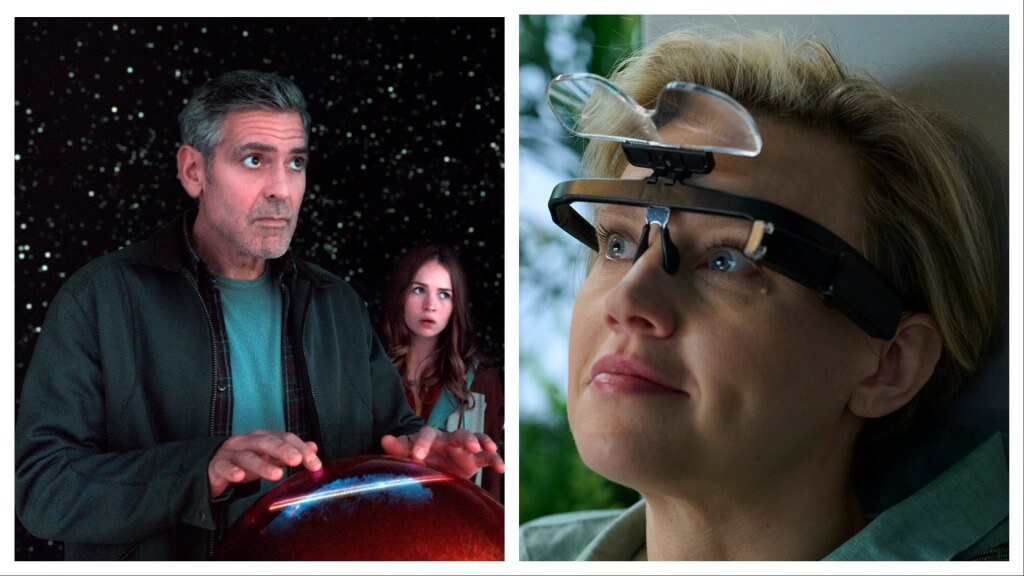
In The Blink Of An Eye follows present-day anthropologist Claire (Rashida Jones), who’s juggling work, family illness, and her desire for connection with her occasional fling Greg (Daveed Diggs). Thousands of years earlier, an isolated Neanderthal family tries to stick together in the harsh wilderness, and far, far in the future, a spaceship full of human embryos is piloted by Coakley (Kate McKinnon) and an onboard computer system (Rhona Rees). Each thread contends with the fragility of life, the suddenness of change, and our inherent impermanence, all landing on the idea that it’s beautiful that life continues beyond us. Each story is so simplified that they don’t so much feed into one another; rather, the past and future exist only to elevate the mundane and mawkish contemporary relationship drama—it comes across as, “Look how thoughtful we are looking for our meaning in the past and future. Bet you didn’t think of that, did you?”
In The Blink Of An Eye is obvious and sentimental in a way that Stanton’s animated films deftly sidestepped, amateurishly forcing an approximation of delicate wonder and pathos onto the screen. The fish, insects, and robots of Stanton’s animated work feel far more human than the characters of his humanist sci-fi story—they aren’t made to be hackneyed stand-ins for truisms about the unpredictable lessons of life. No, Stanton didn’t write In The Blink Of An Eye. Colby Day’s script has been floating around the industry for a while, and was featured on the 2016 Black List of unproduced screenplays. But the clumsy, cringe-inducing way Stanton stages its Tree Of Life-lite ruminations echoes that of another Pixar director, whose history with a studio both beloved and mythicized pushed him towards preachy sci-fi.
Following his hits The Incredibles and Ratatouille, and a well-received leap to live-action with the fourth Mission: Impossible movie, all eyes were on Brad Bird for his Disneyland-inspired sci-fantasy Tomorrowland, which depicted an interdimensional utopia—populated by the smartest, most gifted and imaginative humans—on the wane after cynicism and technopessimism infiltrated their perfected world. Inspired by Tomorrowland’s robotic child recruiter Athena (Raffey Cassidy), a teen technooptimist Casey (Britt Robertson) joins forces with jaded Tomorrowland exile Frank Walker (George Clooney) to return to the mythical city, where they go head-to-head with the embittered Governor Nix (Hugh Laurie) for the future of their “world beyond.”
Tomorrowland is a poor adventure film, front-loaded with setup and filled with dry conversations in cavernous CG rooms when we get to Tomorrowland in the third act, and Brad explores the rift between optimism and cynicism in his characters with a similar didacticism to In The Blink Of An Eye: Frank was exiled after inventing a prediction machine that showed when the planet would die, and Casey realizes the big interdimensional antennae in Tomorrowland warning humanity that the end is nigh is actually pacifying them with fatalism. Instead, broadcasting hope for the future will be society’s salvation.
If the solution of “transmitting positive thoughts” isn’t feeble enough, the fact that it’s coming from exclusionist geniuses who gesture vaguely at the obstacles of bureaucracy and politics as justification for separating themselves from the lessers of humanity reads as clumsily patronizing—even though Casey and Frank reform Tomorrowland by opening its gates at the end, they are still selectively recruiting “special” humans rather than bringing their technology to the innocent masses of Earth. Tomorrowland adds another sprinkle of tastelessness to its fantasy: Footage of real natural disasters and protests feature in Frank’s fancy, retro, sci-fi machine, telling us that we are responsible for our own doom.
Tomorrowland presents a separatist utopia of tech-obsessed “imagineers” (in other words, a Brain Trust) that ickily affirms the fallacy that the world would be better if our most gifted made the leap to a land free from grubby governmental interference. Unlike Ayn Rand’s fiction, to which Tomorrowland has been compared, Brad’s film uses a tone of bright-eyed wonder and a retro-futuristic aesthetic to suggest we must look back—to childhood, to nostalgia, to a clearer moment in political history—in order to look forward. It’s far more muddled than Bird’s pre-Disney animated film, The Iron Giant, which used its Cold War setting to demonstrate that America’s resistance to technological progress was grounded in austere, specific political motives, and not part of a vague battle between “special minds” and the faceless, voiceless masses.
Tomorrowland is much more akin to In The Blink Of An Eye, which grounds itself in a slim, sentimental understanding of human nature; the film’s interest in Neanderthals argues—courtesy of literal anthropology lectures from Claire—that looking back will explain, with incredible legibility, why the human race is prone to isolate ourselves, be hesitant, and pang for connection in trying moments. In The Blink Of An Eye has more reflection than momentum, but both it and Tomorrowland interpret the world from a position of all-seeing authority that brings past and future together—one more pacifying than soothing.
We can’t think of these films as pure successors to the Pixar Brain Trust—Colby Day is not a Pixar alum, and Bird had just as many non-Pixar movies under his belt as Pixar ones by the time he made Tomorrowland. But the ease with which both live-action films drift to lofty, pithy conclusions about the human condition is almost eerie, with prominent images of sci-fi explorers stepping with bold trepidation into a land of infinite promise. While Tomorrowland makes a call-to-action for humankind to “come together” in the name of progress, In The Blink Of An Eye aims for a more reflective treatment of unity, placing three distant (but in the end, not so distant) timelines together to mindfully underline the shared crises and purposes of all of humanity. That “coming together” is so central to both sci-fi films is partly why they’re so insipid—their joint discovery that that we need unity feels less like a result of singular artistic expression and more like inoffensive social analysis that befits a story within the confines of a mawkish, moralistic parable—a way of making sense of the world that boils down to the “everything can be okay” conclusion that all-ages animated films must land on.
Without the earnestness and levity of their animated work, Bird and Stanton’s films feel grandiose in a way that’s instinctively off-putting, like how tech gurus expound upon the essences of human nature that can be implemented into their deeply dubious worldviews. In its heyday, Pixar’s campus sounded identical to the trendy, unconventional offices of new-wave tech giants like Google: a special building in which to do special work. But In The Blink Of An Eye and Tomorrowland argue that Pixar’s reputation appears to have acted as a feedback loop: After making films that were adored by families, connected audiences of all ages, and became the medium’s gold standard, these directors made films about how special it is to connect human beings—about how meaningful it is to be brought together by innovation and emotions.
This has an accidental self-aggrandizing effect that makes In The Blink Of An Eye and Tomorrowland feel like the products of a Brain Trust gone bust, the work of filmmakers whose experience with creative collaboration has elevated that sense of unity to an almost spiritual ideal. But the rigid sentimentality of these films isn’t spiritual, but mechanical. They are films with an ingrained sense of genre seriousness and myopic idealism, like Stanton and Bird have taken to heart the mythmaking that creatives and audiences alike used to distinguish their unorthodox animation studio, without any of the rigor or humor that earned the studio that reputation.
Pixar’s animated films require utter clarity to their storytelling. They have unstable relationships that pinpoint their exact dysfunctions, goals and lacks that gain complexity after being established as fixed, pathos that is only so heartbreaking because the stakes and cost are so obvious. Pixar’s best movies contain such little superfluous material—the jokes funny, the set pieces tightly engineered, the characters hungrily in pursuit of their goals—thanks not just to the fractured and detail-focused production method of animation, but also the sincere belief that everything good about a film derives from the strength of its story.
This crystalline clarity works well with stories of cartoon dreamers and worriers, but Stanton and Bird both mistake making animated films with a universal appeal for confirmation that they should approach all their material with this kind of mindset. It’s not that you can’t make a movie about humanity’s collective hopes and futures in live-action, but that these filmmakers are approaching their expansive, complex material with a self-assuredness that comes across as pandering simplicity, even when padded with the pleasures of Tomorrowland‘s bright and zippy adventure sequences. When Nemo or Remy or WALL-E navigate their adventures, we may more subtly recognize something we’ve felt or been afraid of in our lives. By trying to be about humanity, Tomorrowland and In The Blink Of An Eye directly instruct their audiences to see something essentially and aspirationally human in their characters. If Pixar functions like a tech company, then Bird and Stanton are just following in the footsteps of industry gurus who want to keep iterating and expanding on their product by trying to interpret the entirety of society through the soft, solution-oriented arcs of Pixar movies.
It doesn’t feel like Bird and Stanton make conceited, humanist sci-fi in order to reject their years with Pixar; their trajectories actually seem to match the direction the studio itself took after their first live-action films. Inside Out and Soul pointedly play with psychology, philosophy, and spirituality to spin stories that take place in spaces underneath, alongside, or hidden from normal reality, not unlike the dimensionally-sequestered Tomorrowland or In The Blink Of An Eye’s millennia-skipping timelines. The Pixar efforts were very successful, but they signaled an imaginative shift that, like the live-action work of the studio’s alumni, signaled a desire to graduate to stories concerned with the sublime, where the special and ordinary elevate each other in a calculated way. Tomorrowland and In The Blink Of An Eye are genre films because the filmmakers so value imagination, but they stunt their own reach by repeatedly affirming that having imagination—being able to see wider and further than we are normally afforded—is an end to itself.


 Keep scrolling for more great stories.