What exactly makes someone a hero? Is it wielding a mythological, god-given might that can smite evildoers? Is it an intrinsic quality or something that’s earned? As Frieren’s latest episode, “The Hero Of The South,” would attest, heroism is defined by doing the right thing regardless of the personal cost. It’s a willingness to forge a better future that you’ll never personally see.
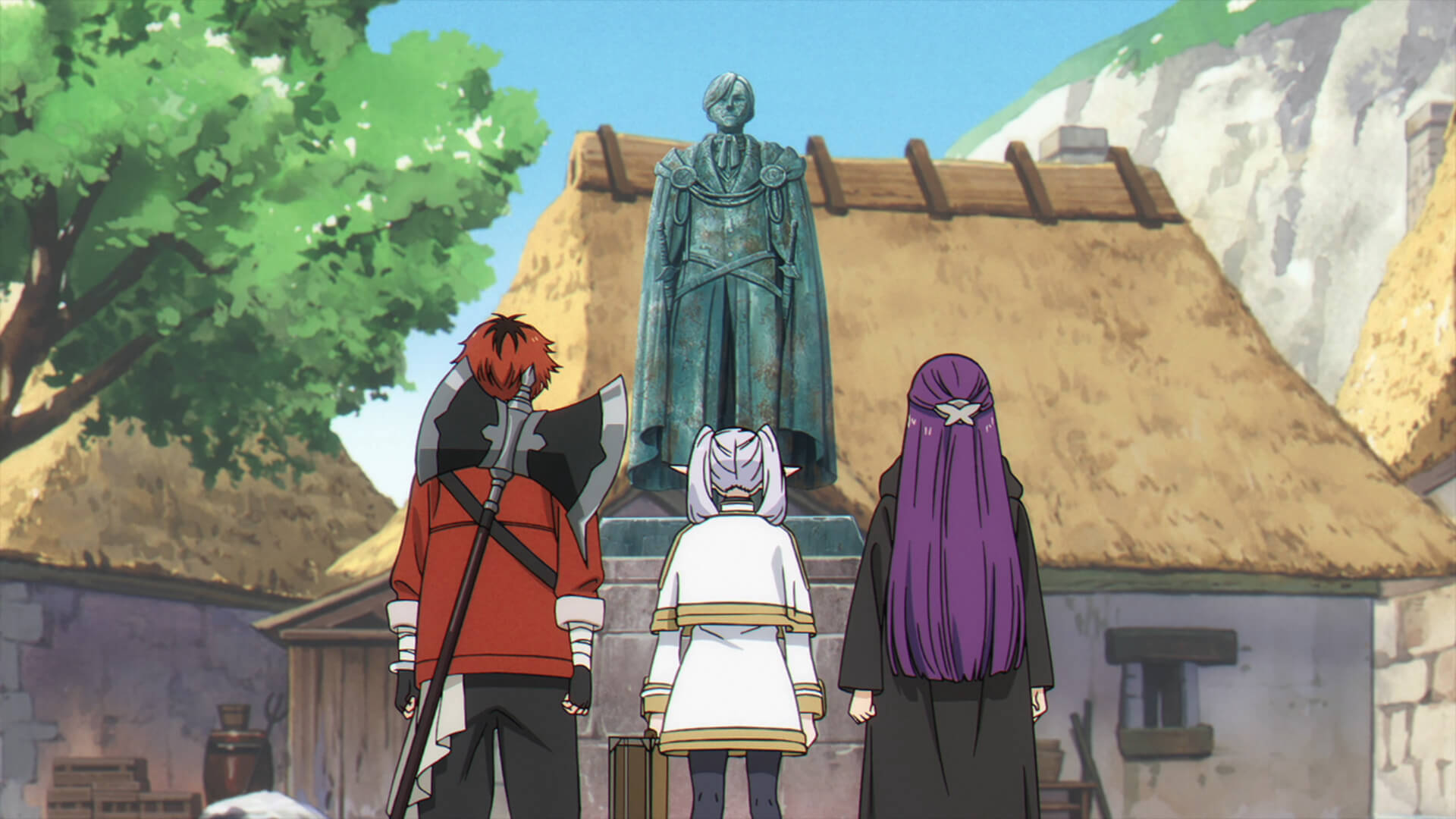
Events begin with Frieren and friends arriving in a nondescript town in the northern lands, where an old man gives them a familiar side quest: clean a bronze statue of a hero. It’s a fairly direct callback to the second episode of the first season, “It Didn’t Have To Be Magic….,” where Frieren tried to beautify a rusty rendition of Himmel with a field of his favorite flowers. Remembering this, the party is convinced that this task will be a case of déjà vu. But when they arrive at the statue, Stark and Fern are surprised to see an unfamiliar face.
Frieren is less surprised. Ah, the “Hero Of The South,” she remarks. Exposition time! Frieren explains that while Himmel is the most famous hero from the war against the Demon King, he wasn’t the only champion of that era, and in these parts, it’s this dual-wielding gentleman with pencil-thin facial hair who receives most of the praise. He was apparently considered “humanity’s strongest” warrior, which seems strange given that Frieren’s own party is the one that bested the Demon King.
According to legend, this man singlehandedly plunged deep into demon territory to reach the heart of their supply lines. But that’s not the most impressive part. When the Hero Of The South arrived at his destination, he was forced to fight the Demon King’s advisor, Schlacht the Omniscient, who could see 1,000 years into the future, and the Seven Sages, this army’s most powerful fighters. Despite the awful odds, he managed to kill three of the Seven Sages and Schlacht. While he lost his life in the process, his efforts significantly weakened the Demon King’s forces and freed parts of the northern lands, including this village that built a statue in his honor.
When we first hear the story, it sounds like an exaggerated folktale, a feeling doubled by the marionette play that unfolds while the story is told. The sequence cleverly masks the bluntness of this exposition while also capturing how this legend persists decades later as an essential part of local culture, still extolled in town squares. After this initial telling, which represents how the hero is remembered, we see the truth of the situation from Frieren’s perspective.
Somehow, the reality is even more impressive than the stories. Before setting out on his crusade, the Hero Of The South met with Frieren to request her help in defeating the Demon King. She refused. As always, seeing her former stiff demeanor and lack of faith in the possibility of winning this battle underlines just how far she’s come and how much optimism and warmth she’s gained from her comrades. Confident that Frieren will keep his secret, the hero tells her the secret to his prowess: Like Schlacht, he can apparently see into the future.
On the one hand, this explanation should feel a bit silly. A minute ago, we just learned that some evil dude we’d never seen before also possessed this seemingly unique ability. However, there isn’t time to ponder the logistics and lore specifics, because we’re quickly confronted with the far more interesting moral dimension of this power. Despite knowing that he’d die a bloody death if he faced the Demon King’s forces, the Hero did so anyway, understanding that his sacrifice would help pave the way for Frieren and her allies. He may not be able to see his quest through, but at least someone would. We witness his final sacrifice and a broken sword in the snow, a resonant moment that ties into the series’ nuanced ruminations on heroism that have consistently gone beyond classic Arthurian warriors and chosen ones.
It’s worth remembering that Himmel The Hero was explicitly rejected by this world’s Excalibur equivalent, instead winning the day with a fake copy of that legendary blade. Eisen the dwarf, who was essential in helping Himmel accomplish this mission, is a self-admitted coward, as is his disciple Stark. Despite their fear, they still fight. In this context, heroism isn’t some inherited quality bestowed by a higher power or a chosen blade, but the result of actions, of choosing to help others despite the personal cost. To Frieren and the audience, the Hero Of The South earns his title by doing the right thing, even when he knew he would pay the ultimate price.
This thread regarding heroism and self-sacrifice continues in the second half of the episode, as Frieren’s crew travels to another city on their way north. Upon arrival, our several-thousand-year-old elf is uncharacteristically self-aware about the passage of time, something that puts Stark and Fern on high alert. We eventually learn that Frieren wants to leave because the last time she was here, the local lord forced her party to retrieve a magic sword that was stolen by demons. It turns out that the sword has been taken again, and the modern leader of this community wants Frieren to do what she did last time.
After a cute montage, the gang’s search leads to a destroyed village, one that’s clearly been leveled by the demon who stole the sword. A not-at-all suspicious priestess greets them and affirms that the swordwielder they’re looking for destroyed this place. She asks them to pray for the deceased, and as Stark and Fern are about to close their eyes, Frieren fires a warning shot at the “Holy Woman.” If her blank, sociopathic gaze didn’t already give away her true nature to the audience, she removes her hood to reveal demon horns.
They fight, and, unsurprisingly, Madhouse pulls out all the stops for this brief battle: The demon twirls her sword into a ready posture before dive bombing into the fray, rolling and slashing as she tries to press her advantage in a convincing barrage of weighty animation. There’s a nice bit of teamwork as Stark slides in to guard Fern and Frieren goes into Slayer mode, finishing things with a definitive blast of magic.
Having retrieved the sword, the party reflects on what the deal is with this blade. Stark assumes that this noble family guards the heirloom out of blind tradition, but Frieren sees it differently, explaining how it would be a disaster if another demon got their hands on it and carried out more mass murder. We eventually see that this town, with its many guards, has built up an identity around protecting the demon sword, once again foregrounding notions of heroism and self-sacrifice. This community takes the brunt of these demon attacks to save other villages from a worse fate.
Ultimately, Frieren’s “great reward” for completing this retrieval mission is a useless grimoire that allows the user to turn a red apple into a green one. While she claims she was in it for the loot, the terrible prize makes it clear that this isn’t fully the case, and when contrasted against how emotionally adrift she was in the earlier flashback, we once again see how she carries on Himmel’s will in her actions. Because in the view of this series, heroism isn’t an innate quality but something that everyone, from an immortal elf to an average townsperson, can aspire to embody. Well, except demons. But that’s a thorny topic for another time.
Stray observations
- • Okay, I know I literally just said the whole demon thing is a topic for another time—and it will be—but let’s quickly jump into it, because, as per usual, this portrayal is the main flaw with the episode. In short, their presence undermines the show’s commitment to challenging fantasy tropes. There needs to be a bad guy to make this story about heroism work, but it would be much more effective if the demons represented a warped ideology rather than being inherently sociopathic creatures that evolved to trick and eat humans.
Elijah Gonzalez is The A.V. Club‘s associate editor.


 Keep scrolling for more great stories.