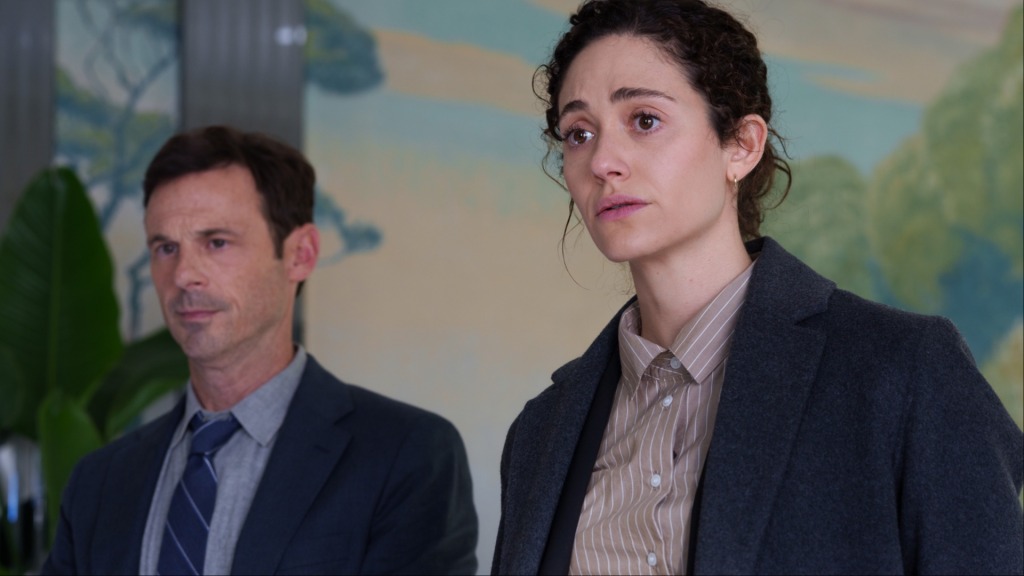
Agent Black spends her days manning the phones of the FBI’s call desk, largely dealing with crank calls and tinhat lunatics while her colleagues play cruel jokes. Seemingly the only woman in her department, she has no qualms about being the unpopular one, including with her boss, who keeps telling her to stay in her lane and do a snack run for the boys. A reprieve comes when her old precinct partner, Danny (Scoot McNairy), requests her assistance on the overdose investigation. It takes her zero time to clock that this was a setup, and that the case bears an uncanny resemblance to another one from several years prior. Both men were rich and well-connected. Both died of overdoses despite no prior history of drugs. And both men were seen with a mysterious girlfriend who nobody can name, describe, or locate.
She is Catherine. Or maybe she isn’t. Her name changes whenever she picks up a new identity. She’s a savvy predator, one who views everyone as prey or a means to an end. To attain her latest identity, she’s not above stealing from an unhoused person, lying to a battered woman’s shelter, and seducing one of its workers. Switching from hysterical tears to calculating stares, there’s a ruthless efficiency to her work that is equal parts admirable and kind of repugnant. Like a classic noir femme fatale crossed with Amy Dunne and with a touch of Promising Young Woman, she is machine-like in her noble if misguided agenda. Hero or villain? Does it really matter?
Alice remains determined to do the right thing, to find justice in a serial killer case where the victims seem to be very bad men. Going against her FBI boss’ wishes, she delves further into the case, meeting with Nora (Quincy Tyler Bernstine), the nihilistic head of the sex crimes unit. The world-weary cop who’s seen it all is a well-worn trope, but Nora’s matter-of-factness over the pointlessness of her position hits like a fist to the face. She would rather drink to forget everything she’s seen, from images of child abuse to the corpses of trafficked women, than remember their pain. But go on she must, even if it means becoming the bad guy to the people she wants to protect.
Rape revenge stories are a treacherous genre to explore, especially in 2026. Most of the classic ones were made by men and often seemed like a cheap excuse to gawk over a woman’s pain. Many are more interested in the “babe with a gun” trope than anything of emotional nuance. With Furious, the stain of victimhood is impossible to avoid, or at least it is if you’re a woman. It’s an endless cycle of triggers and taunts. Even the shower feels like a prison to Alice, a survivor of domestic abuse whose cop ex-boyfriend faced zero repercussions while she was ostracized by her colleagues for daring to speak out. She and Catherine operate in the same stifling system, one with a rigid hierarchy and zero consequences.
While Meriwether keeps in some dark jokes, the kind made by people who have seen way too much, the tone of these episodes is one of tired rage. These are women stuck in a Sisyphean torment of violence with increasingly few options to rebalance the scales. Meriwether’s writing is taut and often caustic, with Nora offering a stark reminder in the pilot that society hates victims more than perpetrators. Trafficked girls get put in jail, and the men who bought them are “sentenced” to classes telling them how bad it is to traffic kids. To add insult to injury, it turns the latter into “unlikable” women, making it all too easy to turn against them. “Being a victim of violence just makes you colder,” she tells Alice. Nobody likes the imperfect victim. They far prefer the dead ones.
That’s the point that rings in your ears whenever you see our killer growing crueller and more single-minded. There is a kind of sick pleasure to be enjoyed in seeing Catherine’s methodical targeting and ensnaring of her victims, but you cannot help but wince when she is equally as merciless to the women around her. She has zero qualms about blackmailing a former lover or toying with a victim’s teenage daughter, plying her with alcohol and making escape impossible. While seducing one target (Rob Delaney, playing against type as a coke-addled rich boy scumbag), she puts on a sexy little girl act that is wince-inducing. Why is she tougher to root for when we’re usually so gung-ho about a woman taking down nefarious villains? We’re still so wedded to the idea of niceness, and Furious demands that you confront that mental roadblock.
If this makes Furious sound like a drag to watch, I promise that it isn’t. For all its bleakness, it still zips along at an appealing pace, a tight thriller with a procedural slant that lets us into the minds of both killer and cop. The first three episodes set up our cat-and-mouse game, and the stakes are high, not just for the women but for the concept of justice. If only it weren’t all so horribly relevant.


 Keep scrolling for more great stories.