
Sequel Control Resonant tries to be more than the sum of some extremely boring parts
The follow-up to 2019’s Control hides a more interesting game inside rote open-world exploration of a ruined New York.
Control Resonant, Image: Remedy Entertainment
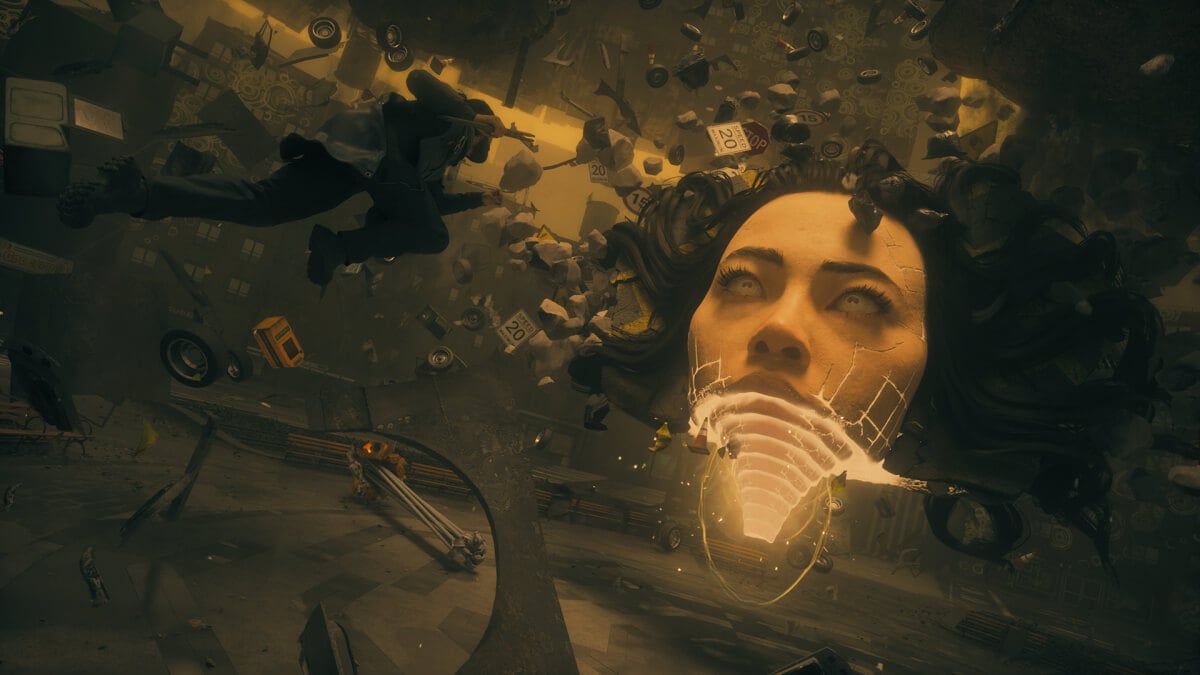
Can you build an interesting game out of boring parts? It’s the question hanging, like a skyline full of suspended human bodies, over Control Resonant, the latest game from endlessly frustrating Finnish game developer Remedy Entertainment. Like pretty much all of Remedy’s games—the TV-aping Quantum Break, the ludicrously ambitious Alan Wake titles, and most especially 2019’s Control, which it serves as a direct sequel to—Resonant is a collection of some of coolest ideas ever filtered into a video game, painfully stapled to some of the dullest execution. Interdimensional, non-corporeal monsters; the lurking threat of a secret world; visuals stolen straight from the storyboards for Christopher Nolan’s Inception—all of these things exist here. It’s just that they’ve been smashed together with basic game design ideas so hoary and ancient that it’s hard to believe they’re the products of the same minds. When you’re deep in the pocket of the things it cares about, sci-fi horror stories tinged with just a dollop of genuine human feeling, it’s one of the best games of 2026. The issue is that it’s only those things about 30 percent of the time.
It’s enough to make you wonder if there’s some arbitrary finite amount of creativity allotted to any single given video game, and Resonant has opted to spend all of its ration on worldbuilding, side stories, and big, flashy setpieces. It’s an approach that has paid off for Remedy before, creating standout moments like Alan Wake 2’s incredibly memorable playable music video sequence. It’s also a recipe for making sure that the things your players are interacting with for the majority of their time are the dregs—in this case, a collection of some of the most broken and boring trends of open-world video game design of the last two decades. To pick one that genuinely shocked me when I was forced to do it during the game’s opening hour of tutorializing: What kind of conversation goes into making people sync up with map towers to get their map for an area, a mechanic that was mildly novel when Assassin’s Creed did it in 2007, in 2026? Have we not all touched enough navigational pylons to last a lifetime at this point?
And that’s before we get into the game’s combat, which throws any number of complicated status effects, modifiers, conditions, and other considerations at the player to try to disguise how incredibly dull it is at its core. Much like Marvel’s Wolverine—another recent game that sought to obscure this kind of thing through multiple layers of flash—Resonant is ultimately a game about tapping on enemies multiple times while trying to dodge their briefly telegraphed attacks. There’s nothing fundamentally wrong with that formula in theory—a lot of very satisfying games have built thrilling combat systems out of parts so basic. But the combination of enemy health bars being long enough to turn every fight into a chore, and your own moveset feeling generally rote, turns the whole thing into a slog. (Not helped by the density of fights in the game’s open-world vision of a ruined New York; expect a battle every half-block.)
I have an unofficial rubric I use to measure this stuff: Every time I take a serious hit in an action game, not because the attack was difficult to deal with, but because I was too bored by the fight to keep my eyes on the screen, it loses a point; Control Resonant is running at about a negative 15 for me at this point. And don’t even get me started on the game’s damage-sponge bosses, which sometimes have as many as three moves to their name; I really thought Wolverine had a lock on “Most Tedious Boss Battles Of 2026,” but Remedy has issued a pretty definitive “Hold my beer.”
 Keep scrolling for more great stories.