B

Ruin the picnic in the tricky ant-based board game Gingham

Chain your ants together to build up stacks of sweets in this tricky strategy game.

Ruin the picnic in the tricky ant-based board game Gingham

You shouldn’t bring sweets to a picnic, because, as Malory Archer warned us, that’s how you get ants.

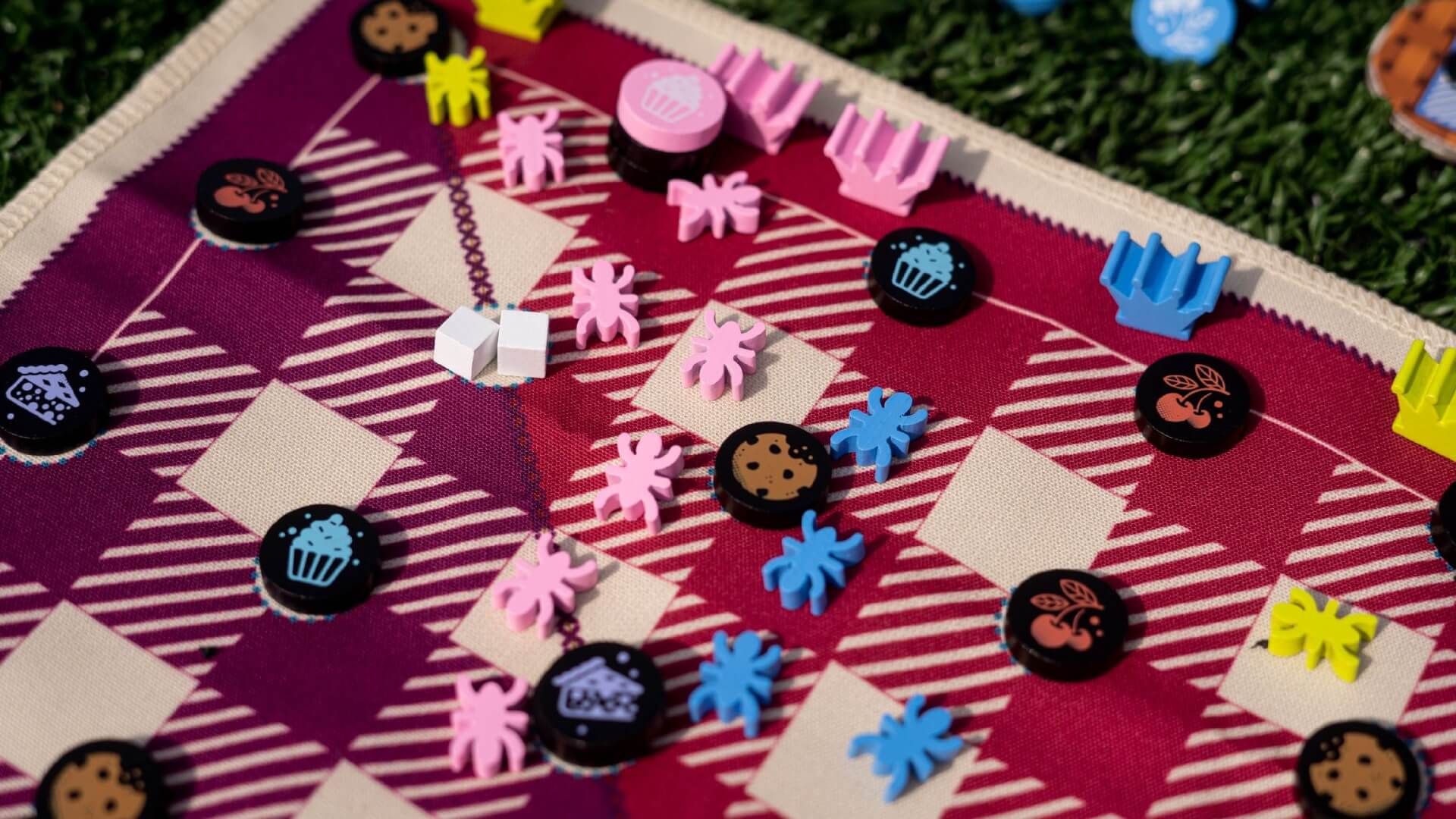
In Gingham, you are the ants, and their queens, trying to create chains on the picnic blanket to connect and claim tokens for various types of sweets located at the vertices of the chess-like board. It starts slowly, but space on the blanket becomes tighter as the game progresses, leading to longer chains and bigger stacks of sweets for higher point gains in the last few rounds.

Gingham plays two to four players, with one blanket for the two-player game, which uses five sweet types, and another for three or four players, where you use just four sweet types. Each player has a colony of ants and two queens that they’ll use to determine where their ants go. The starting player chooses one of the four sides of the board, which also has a stitch connecting two diagonally-opposed corners, and places their queen at the end of one of the rows on that side. They may then place one of their ants anywhere between the end space and the stitch, but not beyond it. In the first round, players go around the table and each take the same two actions—place a queen, then place an ant. You can place an ant on an empty space or bump someone else’s ant; if you do the latter, they get to move that ant to any empty space on the board, ignoring the stitch.

If any player creates a contiguous chain of their own ants between two sweets of the same type, they score one point per ant in the chain. The chains have to be orthogonal, and you score your shortest path, even if you have a longer one that connects the same two tokens. The player then takes one sweet token and stacks it on the other one, replacing the vacated vertex with one or two white sugar cubes. In addition, if the player surrounds any sweet token with their own ants—four ants in the middle of the board, two on the edge, just one in the corners—they can place their own matching token for that sweet type on top of the stack, scoring one point per token covered. You can even grow your stack by chaining it with ants to an unclaimed stack, or steal someone’s stack by surrounding it with your own ants and displacing theirs. You can chain two claimed stacks, but you can’t merge them.

Once all players have placed their two queens and placed two ants, the round ends. The player closest to the corner of the board with the stitch in it then becomes the first player in the next round, and turn order proceeds to the next closest player to that corner. The first player in a round gets to choose any of the other three sides of the board to use that round; they can’t reuse the same side. 

If a player places an ant next to a vertex with a sugarcube on it, they take that, and can use it on a later turn to take a special action costing one to three cubes. Those allow players to break or bend the rules, like placing a queen on a row that’s already occupied, placing an ant beyond the stitch, or moving one of your already-placed ants rather than placing a new one.

Play continues until a player reaches 40 points (or 32 in a four-player game, although I missed that when I first played this and we went to 40, welp), and then the game ends immediately. Players then re-score every sweets stack they have covered with one of their claim tokens, with an additional five point bonus to the player with the highest stack of each sweets type. Each leftover sugar cube is worth one point. 

The best part of Gingham is the last third or so of the game, where chains get longer and competition for spaces and stacks is much tighter, leading to much more direct competition between players. The scoring increases significantly faster at that point, and poor choices earlier in the game can really come back to bite you, as it’s hard to build longer chains late in the game without some of your ants already in position. The start of the game feels quite slow, though, and I think it takes a certain sort of brain to be able to envision scenarios many ants in the future and plan accordingly.

Gingham says it’s for ages 12 and up, although I see nothing in the rules that a smart 9-year-old couldn’t handle, while I think the 20-40 minute playing time is optimistic because at least some players are going to want to think a bit before each move later in the game. I am a very fast player for most games, and I found I was taking much longer than usual for my later turns, and had a hard time “seeing” the board as it might be a few moves down the line. The high degree of interaction from stealing stacks and breaking up chains is excellent, and the rules are pretty easy to pick up. It’s not exactly my kind of game, because of the way my brain works, but don’t let that deter you from having a nice picnic.

 
Join the discussion...
Keep scrolling for more great stories.