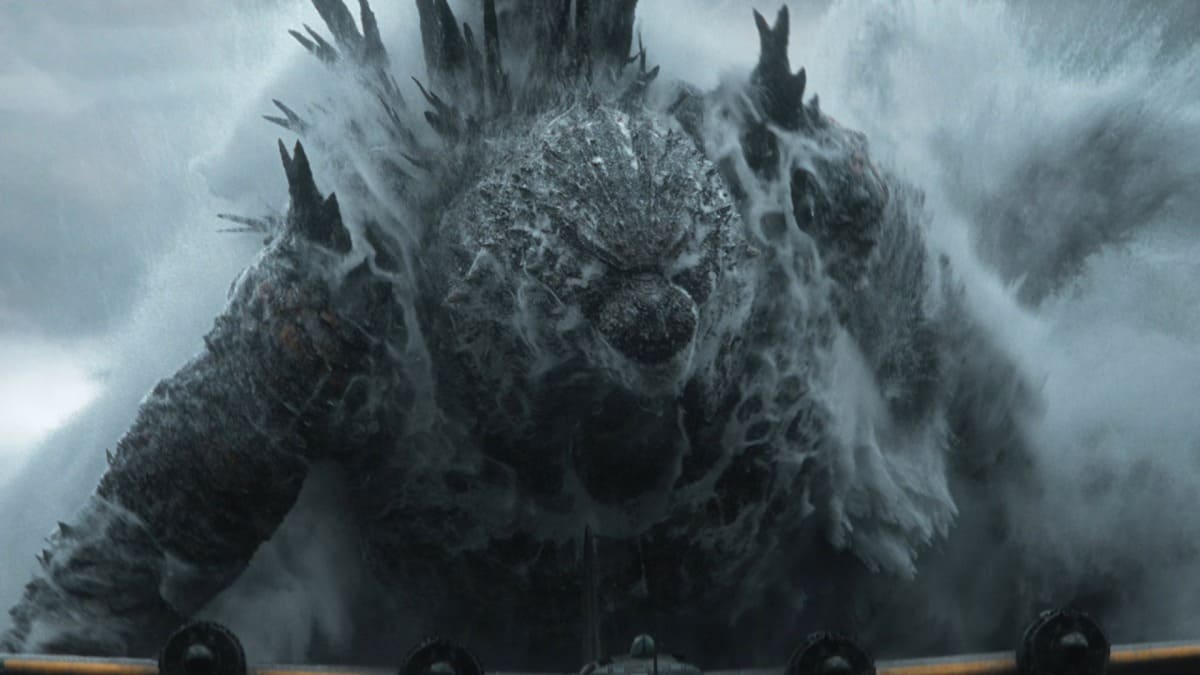
Godzilla Minus One did for the King Of The Monsters what Batman Begins did for the Caped Crusader. Foregrounding fantasy with human drama, Minus One’s mid-century melodrama grounded Godzilla tropes in a Spielbergian reverence for Golden Age adventure movies and a modern survivors’ guilt resonant with the COVID pandemic. It worked like gangbusters, becoming one of the highest-grossing Godzilla movies ever, and earning the 70-year-old lizard its first Academy Award. Building on the goodwill, the sequel Godzilla Minus Zero aspires to be the series’ Dark Knight, but comes closer to Dark Knight Rises. Exploring what surviving a Godzilla attack means for Japan’s people moving forward, the movie loses its human story and its star attraction in a thicket of plot tendrils and heads. Godzilla Minus Zero is subtraction by addition.
Written, directed, and special-effected by returning reptile wrangler Takashi Yamazaki, Godzilla Minus Zero opens two years after Minus One. As is often the case when one overgrown lizard touches Japanese soil, others aren’t far off. This time, the dragon Ghidorah takes Matsumoto City, pulverizing its buildings and levitating its population to death with anti-gravity breath. The chaotic, one-shot setup recalls this year’s South Korean invasion thriller Hope, while failing to compete with that film’s intense and labyrinthine staging. Minus Zero is missing some of its predecessor’s novel potency as it sets up Ghidorah and the plans to deal with it, striking a path of destruction toward a familiar franchise formula: Humans must work with Godzilla to defeat a shared enemy.
Ghidorah dominates the new movie, as it should. But Yamazaki didn’t abandon Kōichi Shikishima (Ryunosuke Kamiki), his wife Noriko (Minami Hamabe), or their adorable daughter Akiko (Sae Nagatani), the found family that gave Minus One its heart. Living a relatively quiet life in the physical and emotional wreckage of post-bomb, post-Gozilla Japan, neither Shikishima nor Noriko appear convinced things will ever go back to normal, particularly Noriko. After making a miraculous recovery between movies—thanks to Minus Zero‘s major MacGuffin, regenerative “Godzilla cells”—Noriko has begun to grow shoulder spikes, and her eyes take on a new shade of reptilian yellow. Meanwhile, her husband’s brave face withers when Professor Kenji Noda (Hidetaka Yoshioka) breaks the news that a second Godzilla has hit Japan.
Godzilla Minus Zero really soars, appropriately, once Kōichi takes flight. Minus One‘s reunited and still-outmatched squadron returns to coax the still-skittish ex-kamikaze pilot back into the cockpit. They descend on Ghidorah for a rollicking aerial display, where Yamazaki shows off his wing-walking skills as the jets sway like falling leaves to outfox Ghidorah’s atomic rays. Yamazaki hasn’t lost his taste for a good dogfight, and his work here is both exhilarating and terrifying, capturing the horror and wonder at the series’ core.
Yamazaki’s directorial flourishes also continue to draw out impressive performances, and his judicious use of Akira Ifukube’s original theme music remains tasteful and effective. Likewise, some of Godzilla Minus Zero‘s scariest moments come from composer Naoki Satō’s piercing, sustained violins. But the filmmaker labors over the story in ways typical of follow-ups. He reloads the kamikaze themes through Noriko, who must decide if she should become a human weapon of state violence to save her country when Professor Kanji Murakami (Min Tanaka), who survived Hiroshima only to meet Godzilla in Ginza, learns how to use her Godzilla cells to lure the beast out of hiding. Minus One reinjected the series with its atomic trauma metaphor and found potency in Kōichi’s survivor’s guilt. The Godzilla cells metaphor isn’t so tidy, requiring far more explanation to land on a rich but messy metaphor for the country’s post-Godzilla PTSD.
This compounds with a lack of Godzilla, which means the film comes dangerously close to being Godzilla Minus Godzilla. Sequels often push the heroes to the edges of the frame for a shiny new villain, and there’s clearly value in hiding your star until necessary. But the gaps between monster attacks feel more taxing this time around. It’s one of two major disappointments in the sequel, the other being that Godzilla’s trip to Manhattan (as seen in the trailers) is far too brief. The trip outshines previous layovers taken in Destroy All Monsters and Final Wars, but the single, effective sequence is frustratingly truncated. One day, Godzilla will make it to the Big Apple for an extended stay (sans Matthew Broderick).
Godzilla Minus Zero is hardly a disaster, but it does encounter the same issues that trapped the original Godzilla follow-ups. The visceral thrills of something new soon fall into a game of escalation, adding one new monster and challenge after another. Rather than finding a unique frame for the story, as in 2016’s Shin Godzilla, which launched the character’s current Reiwa Era, it retreats to formula, albeit with the style and intensity that made the last movie work so well. Yamazaki remains old-fashioned and people-focused, but he’s lost a step in the screenwriting, excising the “it takes a village” community-building for endless exposition dumps and go-nowhere plans. Godzilla Minus Zero is not a bad movie, and it’s an above-average Godzilla film. But it’s also a different type of throwback, one that recalls the days when you wouldn’t be roared at for checking your watch during the human scenes.
Director: Takashi Yamazaki
Writer: Takashi Yamazaki
Starring: Ryunosuke Kamiki, Minami Hamabe, Hidetaka Yoshioka, Yuki Yamada, Kuranosuke Sasaki, Sakura Ando, Miou Tanaka, Min Tanaka, Masami Nagasawa, Jun Kunimura
Release Date: November 3, 2026


 Keep scrolling for more great stories.