
Ambitious dance dramedy Ha-Chan, Shake Your Booty! makes moves, not all of them smooth
Rinko Kikuchi returns to Western film with a sensitive yet uneven dance about getting one's groove back.
Photo: Sony Pictures Classics
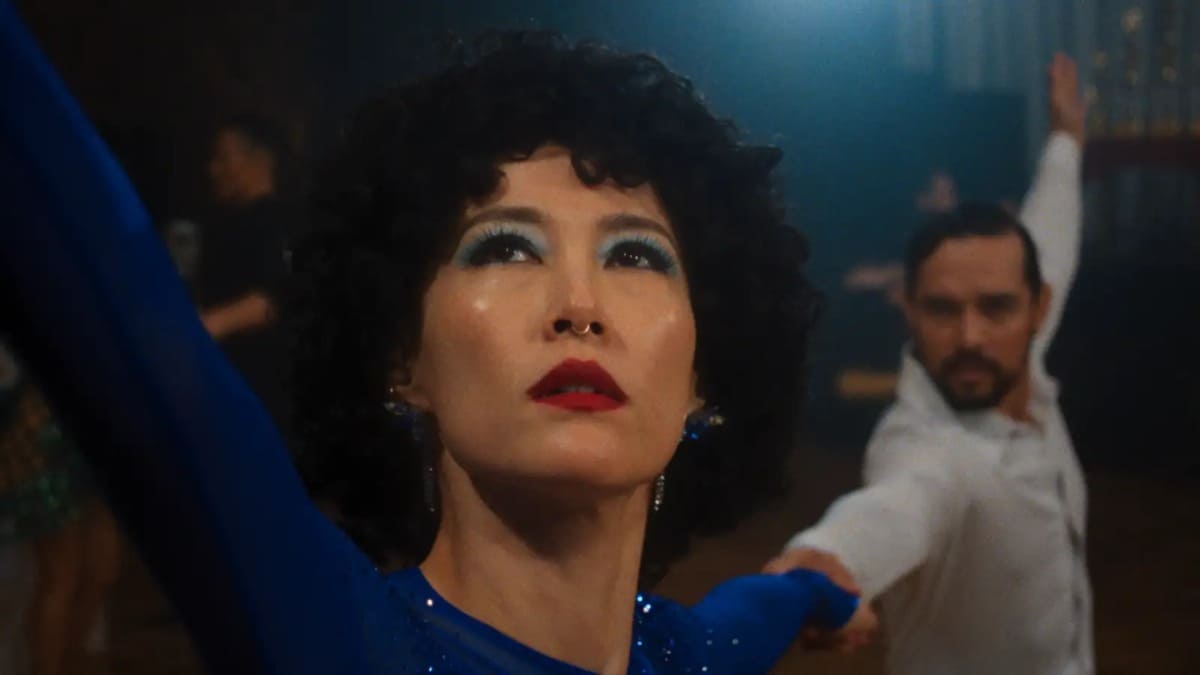
Josef Kubota Wladyka’s ballroom dramedy Ha-Chan, Shake Your Booty! is a charming, ambitious, and whimsical meditation of grief that takes wild swings, some of which are quite endearing, but not all land as smoothly as the dancers running through their rumba routines. Despite its jarring stylistic distractions, at the movie’s core, there’s a genuine feel-good story, a real love of ballroom dancing, and great performances from its ensemble cast.
Haru (Rinko Kikuchi) and her husband Luis (Alejandro Edda) are a match made on the dance floor. They watch performance videos over dinner, help each other get out the door on the day of a competition, and when Haru doubts herself, Luis is there to comfort her. Unfortunately, this will be their last dance together, as Luis suddenly dies in the middle of their routine. Waylaid by grief, Haru retreats from dance until her friends Yuki (Yoh Yoshida) and Hiromi (You) coax her to return to the studio with a new instructor, the dashing Fedir (Alberto Guerra). Haru reemerges from her grief through dance, but now must cope with her overwhelming crush on her new teacher.
A tribute to Wladyka’s own ballroom-dancing mother, Ha-Chan, Shake Your Booty! is filled with a love of the form, its community, and their quirkiness, which coalesces around so many Swarovski crystals and cans of hairspray. The film also bottles the sensations and experience of ballroom dancing, beautifully capturing the elation of moving so closely with someone that it feels like the world around you fades, leaving you and your partner dancing alone in your own bubble. It recreates the Fred-and-Ginger-like feeling of floating above the ground—when the dancing is so good, you won’t land until the music stops. It also relishes in the sheer energy of a busy dance floor, the intensity of practicing a paso doble or of a salsa floor full of twirling dancers. Wladyka even adds dream sequences so that there’s more dance scenes in the movie; even if their additions, like a street scuffle that turns into an elaborate bachata routine, are a bit silly, they speak to Haru’s love of dance. Overall, these moments are so joyous, that whenever something interrupts the film’s groove, it’s as rude as someone cutting in to steal your dance partner.
 Keep scrolling for more great stories.