In Hades II, this structure is used to tremendous effect with the Crossroads. There are two screens—one is a larger hub with several interconnected areas, such as a tavern, a hot spring, and a garden all centered around a burbling cauldron. The other is a smaller training area, where Melinoë can select her weapon, check her tarot spread, choose her companion, and brush up on her abilities before choosing one of the room’s two exits. There’s also a Pitch-Black Stone in this second area—a large obelisk which throws Melinoë into specific levels with special loadouts to earn limited rewards. Hecate refers to it as “the subtle influence of Chaos on this realm.”
“Our goals are intertwined,” Melinoë replies. “When I gaze upon the Stone, I begin to see different paths and possibilities in every facet. Some leading closer to our victory.”
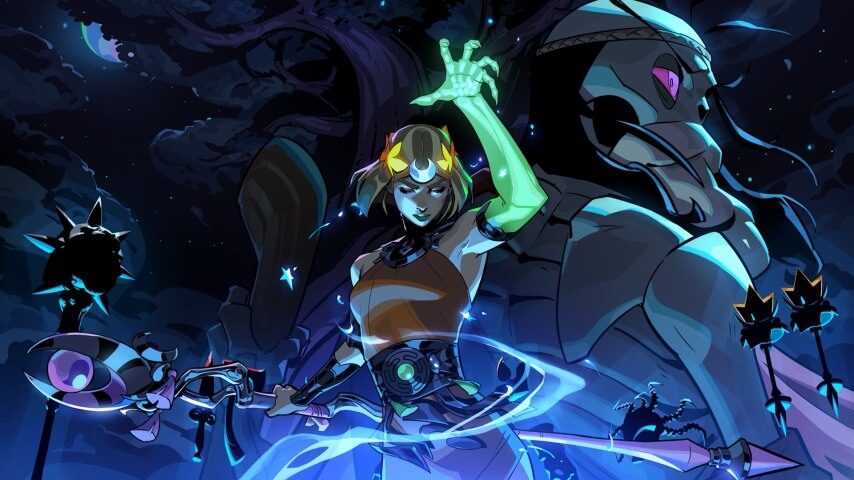
In these hub areas, Melinoë will learn vital context about her world and the figures in it. Her reverence of and devotion to the gods is tested, as she encounters as many of their victims as she does them. Figures like Artemis, Eris, and Nemesis complicate the player’s understanding of Olympian rule, as their current war with the Titans feels brought about by their own actions and arrogance.
Melinoë is torn between two worlds—she respects and loves her fellow gods, but begins to understand she cannot live her life in uncritical devotion to and adulation of them. This is especially true in some of her friendships with those aforementioned victims. One of her most frequent friends and flirtations is Arachnae, an ambitious weaver cursed with a spider’s body for trying to outdo the gods. Through Arachnae, Melinoë is exposed to a more critical perspective of the very people she was raised and taught by—and in some cases, worships. While she pledges allegiance and retains faith in them, she’s exposed to not only their shortcomings, but outright cruelty and pettiness. These discoveries aren’t abstract spiritual crises—they’re tangible evidence of the real-world harm gods are willing to do to put humans in their place.
Which, of course, puts Melinoë in an ideological and philosophical bind. She is as much of a witch as she is a goddess, which makes her something of a living contradiction. While she needs her power and the assistance of the gods to accomplish her task, Melinoë also feels a degree of pain and sympathy for those wronged by the different branches of her family. Is she more of a witch, a goddess, or something entirely beyond definition?
Melinoë’s struggle to determine the limits and meaning of her womanhood is perennial in literature centered around women. While some have likened Hades II to a coming of age or “rites of passage” story, Melinoë is not a child or even a teenager—she’s an adult woman surrounded by other adults. As such, novels centered on teenagers focused on the transition from adolescence to adulthood are a questionable point of literary comparison for what this game attempts to accomplish and belittling towards its female protagonist. She’s a woman torn between love, duty, and obligation versus personal gratification.
Anais Nin is an author renowned for chronicling similar figures—conflicted by their place, their purpose in a world that feels much larger and more hostile than them. Nin herself—an erotica writer by trade for much of her career, before finding success as an avant-garde novelist—was a woman of contradictions. A lover to many as well as prolific diarist, her writing scried the tempestuous pools of irises behind liner and shadow to probe the interior truths of womanhood.
Her 1954 novel, A Spy In The House of Love, encompasses much of this complexity. It follows Sabina, a 30-year-old married woman who indulges in affairs under the guise of trips for her acting career. She fetishizes and essentializes her conquests, only taking what she wants from them before breaking things off out of fear or dissatisfaction. Through each encounter, the reader understands that Sabina is a creature of passion—a woman in pursuit of heat and excitement, who grows cold inside and out at the first blush of trouble.
This does not describe Melinoë, yet a player can draw a solid line between both her and Sabina’s struggle for identity. Both throw themselves at the feet of their gods, lavishing them with gifts and affection. Eventually, however, the novelty wears off—in Hades II, dialogue will plateau and serve the main mission. Like Sabina, Melinoë’s relationships become purely transactional—and though she does find intimate closeness with six romanceable characters of the player’s choosing, this too is achieved through currying favor under the pretenses of a common goal.
Melinoë can freely date these characters, but also give ear to the plight of their victims; Hecate, for instance, brewed the poison which turned Arachnae into a spider. And Nemesis—the game’s most eligible lady, really—is responsible for cursing Narcissus to his eternity of self-obsession in retribution for spurning the petrified Echo.
“Should have seen what he did to this poor Nymph,” the detached character tells Melinoë. “Absolutely broke her heart. Didn’t even notice, or care.”
But regardless of what these characters are to each other—how much they’ve quarreled with or wronged one another—they are Melinoë’s to woo and profit from. Each one can give her something, and in some cases, grow tender with her. They’re hers and hers alone for one level, just one level, before she leaves them in the dust until she needs them again. Or, more accurately: until she needs what they give her.
Purely transactional is the destructive situationship Supergiant forces Melinoë into with Scylla—the Tartarus route’s second boss fight. This is not a traditional romance with an affection meter, but a relationship revealed through narrative progression over repeated attempts at the battle. The egocentric frontwoman of a three-piece band, the humanoid sea monster—cursed to the depths by Circe—eventually flirts with and pines for the protagonist after an early period of stated annoyance and hatred. After her initial tracks drag Melinoë’s hair and wardrobe through the mud, she later writes a ballad called “Bewitching Eyes” which—despite her protests—is very obviously penned by the smitten beast.
“You look at me with bewitching eyes,” Scylla belts. “A red and a green give me butterflies. I can’t disguise the way I feel about you anymore.”
She is doomed, however—as is Melinoë. A crush can never be more than that for these two, as their existences are diametrically opposed to one another. An understanding can never be reached. One must kill the other and strip them of their possessions in a perpetual temporal loop. It’s good writing, and a great modern interpretation of myth. The player is always doomed to be pulled in by the siren—charmed by her, even—but must overcome her. To stay for her entire song is to risk death, but to kill her is to deny her maladaptive and likely disingenuous affection. But hey—Melinoë needs that pearl for a potion.
This transactional nature of relationships, and the shattered sense of self that comes with it, is what reminds me of Nin’s novel. While Melinoë does not crash at a friend’s apartment and fade away into tears like Sabina at any point during Hades II—there’s no time for that while Chronos still lives—her true purpose carries a similar existential weight. As the Fates reveal to her in the post-game, Melinoë is a younger version of Hecate. Hecate attempted to slay Chronos thousands of years in the past, but failed, and instead sent herself to a time before the events of the first or second game. She bided her time in the shadows, disguised with Glamors and layers of cloth, as she honed her magic and earned a reputation as the powerful witch players meet her as. Along the way, she ingratiates herself to the gods, and eventually befriends Persephone to become a trusted confidant and—eventually—protector of her children. (Read: the protector of her adolescent self.)
This internal conflict is at the core of Hades II’s bleeding minotaur heart. Its protagonist is as divided as the routes she must traverse each night, and just as fraught to boot. The narrative hints at this existential heft throughout, too—before one encounter, Chronos tells Melinoë, “You don’t belong here. You don’t belong anywhere.” And during a chat over a bottle of Ambrosia, Melinoë asks Hecate if she “doesn’t mind” talking about her youth.
“I mind,” Hecate says. “Though perhaps as we delve deeper into this bottle, I shall not mind as much! Shall we find out? To discovering the truth!”
Veiled suggestions like these make the post-game reveal feel less like a cheap twist, and much more like something that has stared the player in the face for the whole of Hades II. With this information, the game’s mechanical and narrative themes of duality unified by chaos make more sense. The game itself forces the player to find an organic balance between diving into the House of Hades or fighting up to Olympus because this is the balance Hecate has struggled to maintain for centuries. To undermine rule or uphold it. Once again, the player’s organic actions reflect the narrative and vice versa—both on a surface level and on a more metatextual one.
To read Melinoë as a one-note character, then, ignores the very context of her existence itself. She was never meant to have the hero’s journey—in essence, Melinoë is a tool of her own flesh raised in secret to fix a problem. Her fate is set out for her, and the player only becomes interwoven with it mid-cycle. They, too, are a part of Hecate’s plan. The player is the one person who can topple Chronos seven times, then track down the missing Fates.
It’s fraught, then, to suggest Melinoë is a “sexist” or “shallow” character, as some have, because the game’s script itself wants the player to question what it takes for a woman to succeed under an oppressive power structure. That is, inherently, a feminist query. In essence, it suggests the penance a woman must pay to succeed in her goals is to mold a younger version of herself into a creature of habit with steely resolve. When taken out of the game’s context, this is a startling and astute observation—the idea that women must atone for ambition in a system designed to cheat them out of autonomy. That emotional resignation is so often the price of success in a system built around emotional callousness. The very narrative of Hades II itself reckons with what it takes to inhabit Melinoë’s role as both a princess and a warrior. She’s a sharp contrast to many of the other female characters, like Aphrodite or Circe.
Perhaps Melinoë’s greatest foil—by named design—is Nemesis. The hulking, chiseled warrior is deathly serious, with little time for niceties or politeness. She is the character some accuse Melinoë of being—stoic, serious, and driven only by her goal. Yet through this thick emotional hide lies a charming and fiercely loyal woman who only has the best in mind for the protagonist. Both characters bring out the opposite traits in the other through their romantic dialogue, which is a central point of their entire arc as a couple. I would contend, really, that Nemesis is meant to be an undressing and critique of stoic, goal-obsessed heroines with no emotional resonance or vulnerability. Melinoë, then, is the opposite—a trained fighter with focus, yes, but also a deep concern for the emotional wellbeing and care of her companions.
What’s frustrating about certain critiques of Melinoë is that women cannot seem to win, no matter how they’re portrayed. If they do unlikable things, their actresses get harassed with death threats. If they take a back seat and plan from the shadows, they’re lambasted as being too passive. And if they do the same things as male characters, they’re torn to shreds as “antiquated tropes” as Lara Croft so often is—Nathan Drake himself still beloved without criticism by most. It seems the only acceptable way for a female protagonist to do anything is to be a mirror for the player’s actions—an ego-avatar determined purely by their own input, or so sparsely characterized that they are immune to any meaningful criticism. Women cannot, in a sense, be anything other than whatever many players think a woman ought to be.
That makes it even harder, then, for a character as multi-faceted and torn as Melinoë. She is as strong as she is weak, charming as she is clumsy. As stoic and serious as the goddess may be, she has the capacity to make jokes, to get drunk and be a little too open. Melinoë can love, can hate, can bear resentment and let bygones be bygones. None of these are things the player can choose—they are, ultimately, things they must accept. Then finally, they must measure the weight of their choices, their experiences, their memories and conversations, then ask: is Melinoë a “good character”?
Let’s ask it in a different way: “is Melinoë greater than the sum of Hecate?” Because this is what the crux of Hades II’s narrative hinges upon. It is about Hecate’s sacrifice of a happy childhood and fulfilling life in order to ensure Melinoë can succeed where she has not and—eventually—come to thrive in the light among her rightful family, not just her chosen one in the shadows. Part of that thriving involves spending time with the game’s NPCs, in what is a compelling, branched script with well-realized characters and sumptuous dialogue.
Hades II introduces an affection and gift mechanic similar to the Social Link system in Katsuro Hashino’s Persona games. Through both romantic and platonic encounters, the player finds Melinoë is less dour and more open than Hecate. Transactional though her relationships may be, she ultimately does form meaningful and lasting bonds with gods, mortals, and everyone in-between. These spring from Melinoë’s ample curiosity, and are guided by both loyalty and passion—not their clinical “use” to the protagonist. This is where she differs from a character like Sabina, I’d argue, and becomes much more like Anais Nin herself—an observer of multiple worlds with duplicitous passions that inform her honest, steadfast commitment to the craft. For Nin, that craft was writing; for Melinoë, it is the craft—pre-pagan idolatry of gods she communes with face-to-face. To be a better witch, with a richer and more honest approach to her work, she must chase these passions and reap their rewards. It is the only way for her to be the truest, most well-rounded version of herself.
Melinoë’s struggle for purpose and how she finds it relates back around to the very existence of Hades II itself. It is—of course—the second Hades. But it’s also Hades with “two” paths which features “two” versions of its protagonist. As a team, Supergiant seems to understand that a sequel is not just an excuse to do more of the same; it’s a chance to reckon with existence itself, and what the “point” of doing another installment even is. That question is posited by the game’s subtext itself, which asks, “why continue to get up and let yourself be killed a little every day?” Its answer lies in the game’s characters; they can be read as stand-ins for the people we meet along the way, and the safe ground we share.
In life, we continue to suffer for the benefit of those we care about, so that they might suffer a little less. Our labor may not unseat the ivory towers of our self-styled “gods,” but the tenacity of our grace and strength of our conviction will show through the connections we foster and the community we build. This is a major point of Hades II. Not that the order of gods “needs” to go away, or that something “must” be done. Rather, the game uses its roguelike structure to evoke Melinoë’s textual sense of uneasy stasis. It asks questions instead of positing answers—a layman’s definition of the Socratic method. In that sense, the game offers not right-wing retribution nor left-wing reclamation, but something deeper and perhaps more honest and human than narratives that fall along any political binary.
It has been suggested that through this plot, in which Chronos is thwarted and time restored to its proper order, Melinoë “props up kings” while not affecting change for those wronged by their rule. But change is an arduous process which occurs over dozens of lost battles and even more lost comrades, not a “row row fight the power” yarn where One Great Woman saves her marginalized friends from oppression. Supergiant understands that a person’s character and worth is defined not by action alone, but by the sustainability of their actions towards others. How much time they give an outcast, how much of their own wealth they’re willing to share, how many deep, challenging bonds they form.
While these things may happen under the auspices of a broken system governed by malfeasant favoritism, they do not belong to that system. Moments we share with those closest to us, in which we shed our ego and give into vulnerability, are the ones we fight for. Whatever that fight is, however it’s being waged, protecting that is paramount. Without it, we are more easily picked as ‘tools’ for our ‘masters.’ To frame Melinoë as complicit in this and take her to task for culpability is short-sighted, and to a degree misses the point of the game, its mechanics, and who the player spends dozens of hours embodying.
As individuals governed by larger bodies, who act within systems dictated to us to survive, we operate under constant tension. Sometimes, it’s impossible to find meaning when your existence can be boiled down to a Social Security Number or the money in your checking account. We find ourselves stuck in our own “runs”—school, work, and the like. It’s tempting to want to burn it all down and build something new, but where does that impulse get us in the long run? And can it just as easily be capitalized on by bad faith actors to meet worse faith ends?
That is what Hades II strikes at. The pressure we feel to survive under conditions that starve, brutalize, and kill our friends, lovers, everyone in-between. How we, as a species, find the drive to continue when the masters we serve continue to move goalposts and shovel capital into an economic furnace that takes more than it provides. Like Melinoë, we often feel naked in the face of larger powers—as if our sole purpose is to provide labor until our bodies break, and waste away until our carcasses are returned to their earthen home. How many of us are “boring characters”? How many of us have blood on our hands, just by existing?
One of this medium’s historic failings is the ability to divorce player action from player choice. An overused but useful term for this is “ludonarrative dissonance”—the disconnect between what a game requires of the player versus how it wants them to feel about their actions. While sometimes misapplied, there’s a fair point to be made that as gaming narratives have gotten denser, the didactic way in which the player engages with the world through the mechanics can often feel limiting.
But Hades II sidesteps all of these issues by making “player action” and “player choice” the same thing. Every action the player must take is a choice, and every choice informs the writing in some way. That writing informs the player’s perspective, which in turn shapes their subjective motivation to continue. Most dialogue arises as a natural consequence of how the player challenges Chronos or scales Olympus, not because the player picks something from a dialogue tree. In a way, Supergiant eliminates dissonance by simply not allowing the player to choose their terms of engagement beyond who they talk to and what they give them. In doing so, the writing feels sharper, because it isn’t accounting for a made-up person who wants to play the game a certain way based on subjective morality; instead, it feels like a conscious synergy of mechanics and narratology communicated to the player through dialogue.
It’s also a timeless approach. In Altered Beast, the player has no say in whether or not Zeus resurrects their character. Every single time, they must rise from their grave and bleed until their eldritch corpse shell gives out. Push through each level, memorize each attack pattern until the game is won and Athena is saved. If Hades was a deconstruction of that gamified approach to Greek myth, then Hades II is an undressing of that game’s own ambitions. Where the first installment sought to invert the hero’s journey through a level-based interpretation of the pantheon in the context of a family dispute, the second breaks that idea to bits and rearranges the pieces into a much more complex mosaic. It complicates not only the family that the first game is focused on, but litigates the power of the gods themselves.
In doing so, Hades II muses on the limits of living under power by people as flawed as us—and the place we occupy under said power. By dividing their sequel’s mechanical structure, Supergiant reflects the complex plight of its protagonist and reveals the murky questions it poses to the player: are we defined by blood or by oath? Further, is humankind doomed to follow figureheads who promise a return to a greatness that may not have ever existed? And do any of our individual actions have any bearing on making the world a better place, or are we best served to—as Voltaire would put it—cultivate our own gardens?
As a whole, Hades II suggests this last question might be the real one—no matter how many of our gardens may be trampled upon. It posits that resistance cannot grow from grand proclamation, and instead, must come from the shadows, out of a commune of disparate souls, enjoined by circumstance and forced to learn about one another. This itself will become a bedrock which, when well-hidden, can weather the cruelest storms. It’s a story of maintenance as survival. Time itself cannot be conquered, nor can its corrupting influence on those in power. But it can be used—to build foundations and dig gardens which, when maintained, shelter and nourish until wickedness can be overcome and the bastards be brought to the light.
Several millennia later, the Greek gods still serve their purpose as reflections of the world man has built.


 Keep scrolling for more great stories.