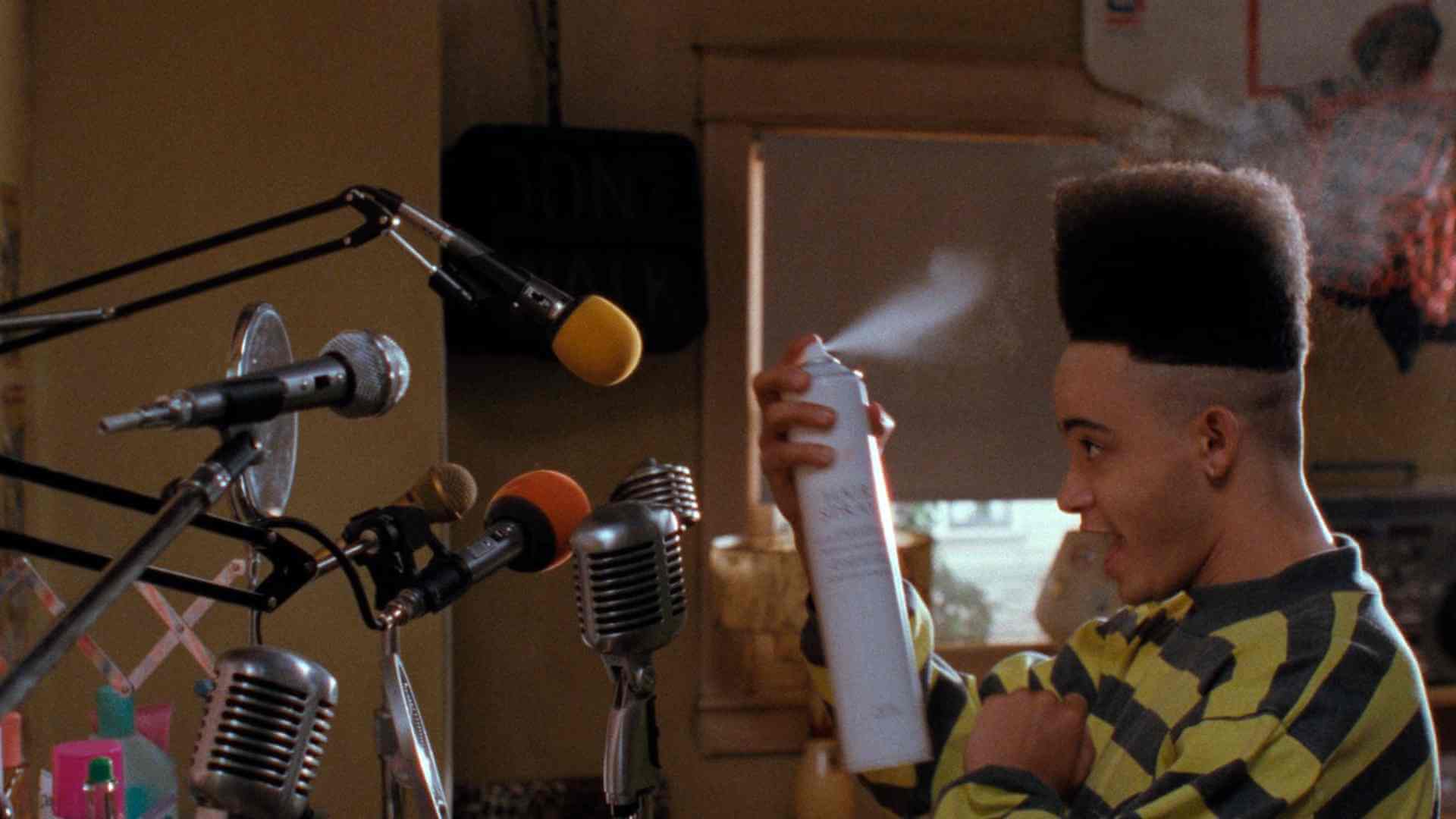
This January, The Criterion Collection, a company known for its dedicated work of restoring and releasing classic works from the likes of such auteurs as Ingmar Bergman, Federico Fellini, Robert Altman, and Martin Scorsese, released a different kind of classic—a hood classic, if you will. Released in 1990, House Party is a raunchy, screwball teen comedy and hip-hop musical that had African Americans on both sides of the camera. Writer-director Reginald Hudlin teamed up with his brother/producer Warrington to expand his seriocomic 1983 short, that he did as his senior thesis at Harvard, into a feature. The result traces one wild night experienced by a grounded teen (Christopher Reid), who sneaks out to a party being thrown by his best friend (Christopher Martin). The characters are known respectively as Kid and Play, which is also what Reid and Martin called themselves back when they were hip-hop duo Kid ‘n Play.
Comedies made by African Americans and starring rappers may seem commonplace these days, but it was a rarity back in 1990. Even though rap music was beginning to seep into the mainstream (this was the year of MC Hammer’s “U Can’t Touch This”), it was still seen as street music made by and for “urban” people. And unless they starred Richard Pryor and/or Eddie Murphy, Black comedies were few and far between on the big screen. Made for a paltry $2 million, House Party came out the gate defying expectations. It premiered at Sundance Film Festival, where it snagged a Best Cinematography award for Peter Deming (who shot Hollywood Shuffle, Evil Dead II, and Mulholland Drive) and a Filmmakers Trophy for Hudlin. When it hit theaters a few weeks later, it was the third highest-grossing movie that weekend, raking in double its budget. While it only played in 700 theaters, House ended up grossing $26.4 million, officially making it a sleeper hit. This is where New Jack Cinema began.
Like when Teddy Riley created that late ’80s fusion of hip-hop, R&B, and dance known as new jack swing (coined by Barry Michael Cooper, who would later write New Jack City, in a Village Voice profile of Riley), House Party and other New Jack Cinema films authentically brought hip-hop and Black youth culture to the big screen. As Hudlin said about House in an interview on the new Criterion release, “It was about the life of Black teenagers, and [hip-hop] music was part of being a Black teenager in that moment.”
There were hip-hop-heavy films in the ’80s, like Beat Street (produced by Harry Belafonte) and Krush Groove (based on the life of Def Jam impresario Russell Simmons). But they felt like awkward melodramas, conceived and directed by out-of-touch middle-aged guys that just happened to feature special appearances from East Coast rap icons. With House Party proving that a film that’s wall-to-wall Black—with an energetic hip-hop soundtrack and authentic characters dropping esoteric (albeit a bit dated) Black references—can actually make money at the multiplexes, the ’90s would be inundated with films geared towards contemporary Black audiences. While it felt a bit like Blaxploitation all over again, this time around, most of the movies were actually made by and starring young Black people who grew up on hip-hop.
If you ask Nelson George, a journalist and filmmaker in the thick of the movement, New Jack Cinema actually started back with Spike Lee’s 1986 rom-com debut She’s Gotta Have It, which made $7 million against a $175,000 budget (George was an early investor). In fact, he remembers it directly leading to House Party. “Reggie and his brother Warrington were friends of mine who, like Spike, were part of a Black indie film community that was active in NYC,” George tells The A.V. Club. “When the big bang of She’s hit, Spike started getting offers. He recommended Reggie for a gig. Eventually that turned into Reggie writing and directing House Party with Warrington as producer.”
But it was after House Party that movies headlined by rappers really became a thing. The year after House Party, West Coast rapper Ice-T starred in not one but two crime dramas: the aforementioned gangster saga New Jack City, directed by Mario Van Peebles (whose dad, Melvin Van Peebles, set off Blaxploitation with Sweet Sweetback’s Baadasssss Song), and the Denzel Washington action thriller Ricochet. Also in ’91, gangster-rap godfather Ice Cube would make his film debut in John Singleton’s coming-of-age drama Boyz N The Hood, which saw New Jack Cinema earn some establishment recognition with its two Oscar nominations.
While already-established Black filmmakers like Spike Lee (Jungle Fever), Robert Townsend (The Five Heartbeats), and Bill Duke (Deep Cover) continued to drop films in the ’90s, the decade mostly belonged to a new wave: the Hudlins and Van Peebles, Singleton, and the Hughes brothers (Menace II Society, Dead Presidents). Even Black music video directors known for working with those rapper-actors like F. Gary Gray (Friday, Set It Off) and Hype Williams (Belly) turned out beloved hood favorites during the boom. These movies also brought many actors and actresses of color into the spotlight; Samuel L. Jackson, Laurence Fishburne, and Angela Bassett are just a few of the Oscar nominees who gave career-launching turns in New Jack Cinema pictures.
Nelson George even got in on it, co-writing the scripts for the romantic comedy Strictly Business (which featured a young Halle Berry) and the Chris Rock rap comedy CB4. George, who wrote about his years covering and working in Black entertainment in the books Buppies, B-Boys, Baps, & Bohos and Blackface, remembers when these movies made both the film and music industries a lot of money. “Having a hip-hop soundtrack and/or an MC in your cast was important, since the profits from the soundtrack album would help the producers and studios make a profit,” he says. “The presence of Ice-T in New Jack, Ice Cube in Boyz N The Hood, and a few rappers in Menace II Society, and hip-hop on the soundtrack, helped them get greenlit and at the box office.”
Though less common, there were other Black films from the era that weren’t about this life. (Hood movies became so rampant during the early ’90s, the Wayans brothers eventually satirized them in 1996’s Don’t Be A Menace To South Central While Drinking Your Juice In The Hood.) The boho love story Love Jones and the Gothic psychodrama Eve’s Bayou showed that New Jack Cinema didn’t have to be monolithic. Those two films, along with Deep Cover and Menace II Society, have also been re-released by Criterion. (Boyz N The Hood will be part of a John Singleton box set, coming in April.) Ever since the New York Times called the organization out in 2020 for not releasing enough films by people of color, Criterion has rectified that situation by releasing more films from the African diaspora—foreign films, documentaries, even Blaxploitation—both on home video and The Criterion Channel.
Criterion curatorial director and author of The World Of Black Film Ashley Clark believes that New Jack Cinema shouldn’t be dismissed as ghetto fare. Many of them are original, groundbreaking movies that have rightfully earned their places in film history. “We feel that each film in the Criterion Collection is exemplary of its kind, and House Party—a beloved, influential, and beautifully-made snapshot of early 1990s hip-hop culture—fits that bill,” says Clark. “We’re delighted to have it sit alongside a host of Black 1990s films in a wide variety of genres that have stood the test of time.”
Even though it’s been proven time and time again that Black movies bring in audiences of every shade (some of them even go on to be nominated for a lot of Oscars), George doesn’t see another Black-cinema renaissance on the horizon anytime soon. “Streaming is the home for genres now,” he says. “The Power franchise is basically New Jack City. So, why would a studio finance a film like that for theatrical release? The last Best Man movie was made into a streaming series. Aside from Ryan Coogler, no Black directors have the clout to consistently make big Black movies.” Through House Party and its other New Jack Cinema releases, The Criterion Collection reminds audiences of the glorious, hip hop-scored era when they did.


 Keep scrolling for more great stories.