
Only YOU can save music videos
How to Be a Pop Star: Are music videos DEAD?!?! Columnist Lydia Wei makes the case for hosting music video parties with all your best friends.
Image courtesy of PinkPantheress/YouTube, shot by Jack Hamilton
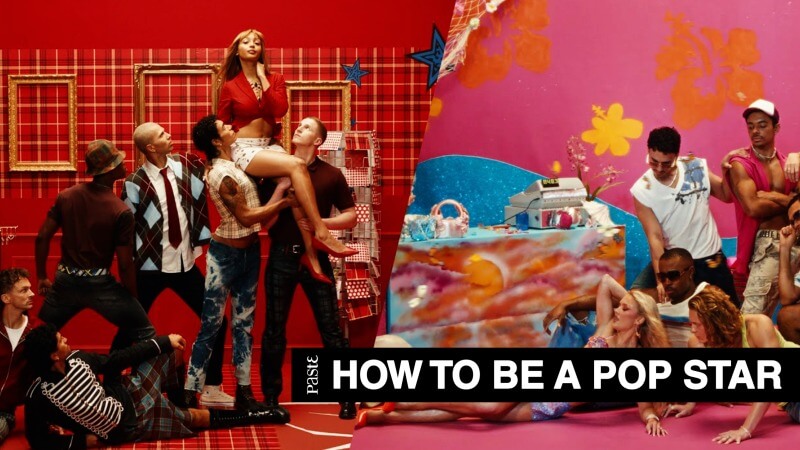
I’ve been thinking about music videos a lot lately. Right at the start of the new year, when most of us were watching the ball drop or popping bottles and sipping bubbly at the clurb or, let’s be real, rewatching When Harry Met Sally for the 30th time, MTV shut down all its music-only channels—including MTV Music, MTV ’80s, and MTV ’90s—in the UK and Australia. For music fans online, the news signaled the death of the music video.
But then again: Did it really? After all, how many people were still watching MTV by the end? I mean, who even has cable these days? (I suppose you could’ve watched MTV on Pluto too, but what the hell is Pluto, anyways?) My suspicion that this all amounted to a cultural nothingburger was partially confirmed by the fact that so many of the eulogies bemoaning MTV’s demise got so many of the basic facts wrong: MTV still exists, at least as a channel that mostly hosts an agonizing assortment of reality TV shows (which is its own topic of conversation, but I digress). Even the music-only channels still exist on cable in the US right now, although those are slated to go dark throughout this year as their distribution contracts expire. And so MTV isn’t really “dead”—at least, not in the way that news outlets and music fans online seemed to be implying—and the fact that very few of the people relentlessly mourning MTV clocked the fact that it was still alive in the US suggested, to me, that no one was turning on their TVs to actually watch MTV in the first place. In reality, MTV has been dying a long, slow death for a while now, its cultural relevance fading with each year. I suppose that’s just not as exciting a story as the ‘90s nostalgia thinkpieces that the MTV announcement spawned.
Perhaps more importantly, though, YouTube announced in December that it would no longer provide its video streaming data for Billboard’s various charts. The decision was based primarily on YouTube’s disagreement with Billboard’s method for counting music streams, where paid streams (ex: a Spotify Premium stream) are weighted more heavily than free or ad-supported streams (ex: a free YouTube stream.) YouTube wanted both paid and ad-supported streams to be weighted equally, and even though Billboard did agree to slightly bump up the weight on ad-supported streams, it wasn’t enough to reach an agreement with YouTube. Thus, as of January 16th, Billboard officially no longer uses YouTube streaming data for its charts. And if we were going to worry about music videos, that feels like the real tea leaves to read.
Perhaps I’m biased in my viewing of this YouTube announcement as a more crucial indicator for the culture; after all, I came of age in the 2010s, when YouTube VEVO channels had effectively already replaced MTV as cultural and musical kingpins. The biggest videos from that era of VEVO world domination still have absolutely mind-boggling view counts: 8.9 billion for “Despacito,” 6.9 billion for “See You Again,” 5.7 billion for “Uptown Funk.” YouTube is how I remember encountering so many music videos in my own childhood: Nicki Minaj’s candy-colored, hallucinatory “Starships,” Rihanna’s Requiem for a Dream knock-off “We Found Love,” even Avril Lavigne’s flop “Hello Kitty” (which, years later, is very fun in an unbearable sort of way). Part of the reason why some music videos from that period have such high view counts is simply because those songs were popular. Before the true rise of streaming services, watching music videos on loop was the closest you had to “streaming” itself. Music videos were a crucial means of consuming music, so everyone watched them; that’s probably how you found a lot of music at that time, regardless of the quality or memorability factor of the videos themselves. Even held at gunpoint, I couldn’t tell you what actually happened in Justin Bieber’s “Sorry” music video (4 billion views) without rewatching it, but God knows I watched it to hear the song then.
For all the hand-wringing that came with MTV being replaced by YouTube—gone were the halcyon days of Total Request Live!—this early Internet era was still far from the death of the music video. Perhaps we weren’t gathered around the TV, but people did anxiously huddle together around computers for YouTube premieres of now-canonical videos (like Lady Gaga’s erotic latex fantasy “Bad Romance,” or M.I.A.’s provocative and politically charged “Bad Girls”). There was the self-titled Beyoncé drop in 2013, which pioneered the idea of a “visual album” and granted new legitimacy to the art form of music videos. Then there were those videos that left us with indelible images and reshaped the visual lexicon: I think, for example, of Solange’s “Cranes in the Sky,” whose reverberations you can find in Kendrick Lamar’s “luther” video from last year; or Kanye West’s “Fade,” dripping with sweat and physicality, mirrored in Amaarae’s equally libidinous “S.M.O.” There were those artists, too, that had a preternatural talent for building aesthetic and visual worlds around their music, and for whom the relative independence of YouTube could be a serious boon. I’m talking now, of course, about the 2010s Tumblr pop girl canon: Lana Del Rey with her found-footage home videos and Americana nostalgia; Marina and the Diamonds with her tongue-in-cheek adoption of bottle blondes; FKA twigs with her deeply melancholic yet erotic imagination. While it’s true that no one ever again attained “Thriller” levels of either creative vision or complete cultural control during this era, there was still a lot of cool stuff happening.
Perhaps it may be premature to catastrophize about the end of music videos, considering people have been doing just that for years. You can even find a Vice headline from 2015 asking if music videos are dead—and I’m aware that, a decade later, I’m now part of the problem, doing the sort of culture critic rite-of-passage of penning an “Is XYZ DEAD?!?! and 10 other things you WON’T believe!!” article. Still, something about this YouTube announcement feels different. Maybe it’s because it comes at an odd inflection point in the culture: music videos were already struggling, and as our attention spans have become worse than toddlers’ (“Bath Song” by Cocomelon has 7.3 billion views on YouTube, and it’s a solid three minutes long), labels have pivoted towards producing more TikTok and short-form friendly content instead. In a 2024 article from The Guardian, music video director Olivia Rose notes the changing economics of the art form: while £30,000 would’ve been enough for one decent music video five years ago, now that same budget is supposed to cover three visualizers for three tracks, TikTok content, and the actual video itself. Creative industries are being squeezed, and the focus on creating short-form content that could potentially go viral on TikTok—the new king-maker of culture—takes resources away from full-length music videos. MTV wasn’t really the death knell after all. As always, it’s TikTok at the scene of the crime.
Now, with Billboard no longer counting YouTube stats towards its various charts, I worry that labels will lose any remaining incentive to make and produce music videos. The tides were already turning toward optimizing for TikTok, and labels might question the value of investing in music videos when you can pour those same resources into TikTok content that could, potentially overnight, juice your song up to the top of the charts. While big artists will always have the pull and star-power to make music videos, I worry more for smaller or mid-tier artists who might not have enough leverage for a label to front their music videos.
 Keep scrolling for more great stories.