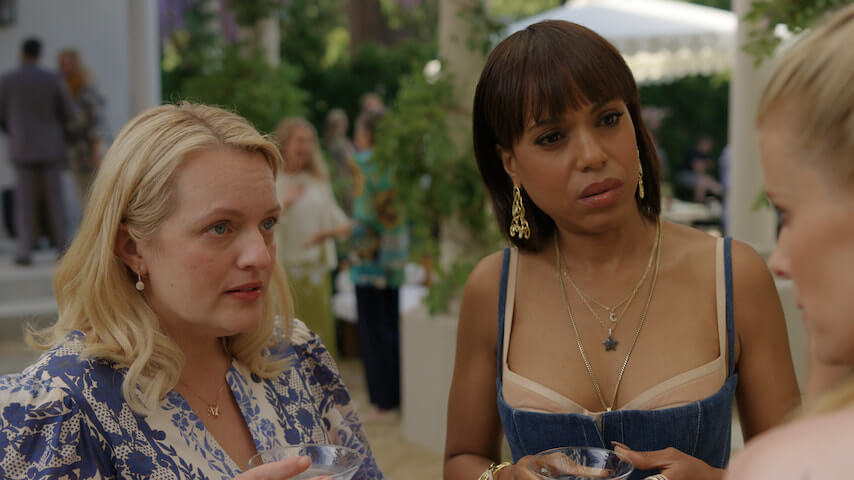
The old cliché studio note when it comes to female characters is that they have to be more “likable.” So it’s refreshingto see a series that seems largely unconcerned with making its female protagonists appealing to the masses. In Imperfect Women, Eleanor (Kerry Washington), Nancy (Kate Mara), and Mary (Elisabeth Moss) lie, scheme, and make questionable choices. But they are grounded characters that feel, for all of their messiness, recognizable. The show’s central three are not paragons of virtue, nor are they flattened into antiheroes for the sake of prestige-TV edge. Instead, this drama allows them to exist in a far more interesting middle ground: women whose flaws are deeply human.
Adapted from the novel of the same name by Araminta Hall, the show retains the book’s fascination with unreliable narration. Like the source material, the series is less concerned with delivering a straightforward mystery than it is with examining the complicated emotional terrain between three women who have spent decades orbiting one another’s lives.
Imperfect Women’s inciting incident is the murder of Nancy, a sweet, working-class dancer who married into extraordinary wealth. Her husband Robert (Joel Kinnaman) seems to love the bottle more than he loves her, and the marriage has long since calcified into something brittle and performative. Nancy has begun stepping outside the confines of that life in more ways than one. Most notably, she has reentered the workforce to produce a dance production, an effort that signals a quiet attempt to reclaim her independence. Her death sends shockwaves through her social circle and particularly hits her two best friends of 25 years.
For Eleanor, a privileged and ambitious career woman, the news is destabilizing in ways she struggles to articulate. Sent to identify Nancy’s body, she becomes increasingly untethered in the days that follow. Her already complicated family dynamics, which include a judgmental brother (played by Leslie Odom Jr.) and a mother so formidable she borders on terrifying (portrayed by Sheryl Lee Ralph), only exacerbate Eleanor’s spiral. Grief, guilt, and unresolved tensions with Nancy begin to bleed into every aspect of her life, leading her down a path of increasingly questionable decisions.
Meanwhile Mary, a devoted mother married to the mercurial Howard (Corey Stoll), processes the tragedy in the opposite way: by turning inward. Nancy’s death forces Mary to reassess the careful domestic life she has constructed for herself. The marriage she once believed stable begins to crumble under scrutiny, and memories of past compromises surface with uncomfortable clarity. Mary’s storyline is perhaps the quietest of the three, but it is also one of the show’s most emotionally resonant, examining how grief can reopen doors that someone has spent years trying to keep firmly shut.
Structurally, Imperfect Women plays with time and perspective in ways that keep the mystery engaging. The first stretch of episodes unfolds in the immediate aftermath of Nancy’s death from Eleanor’s perspective, steeped in the chaotic disorientation of early grief. The series then rewinds, shifting to Nancy’s viewpoint in the months leading up to her murder. Finally, the narrative settles into Mary’s POV, where the story’s various threads begin to converge and the truth behind Nancy’s death slowly comes into focus. It’s a structure that could easily feel gimmicky, but the show’s careful attention to character ensures that each shift in viewpoint deepens the story.
It almost goes without saying that both Washington and Moss deliver powerful, nuanced performances. Washington captures Eleanor’s unravelling with sharp precision, while Moss brings a quiet intensity to Mary’s slow emotional reckoning. But the series’ true revelation is Mara, who gives Nancy a magnetic presence that anchors the entire narrative. Through flashbacks and perspective shifts, Mara crafts a portrait of a woman whose contradictions make her impossible to reduce.
Nancy is at once vulnerable and calculating, loving and manipulative, hopeful and deeply disillusioned. Mara walks this tightrope with remarkable sensitivity, ensuring that Nancy never feels like a mere plot device. Instead, her absence becomes the gravitational center around which the series’ emotional and narrative stakes revolve. By the time the story reaches its final revelations, it’s impossible not to feel the full weight of the life that was lost.
What ultimately makes Imperfect Women stand out, though, is the balance between its three protagonists. Eleanor, Nancy, and Mary inhabit vastly different worlds (economically, emotionally, and morally), but the show gives each of them equal narrative gravity. Their perspectives overlap, contradict, and illuminate one another in ways that make the series feel less like a traditional whodunit and more like a study on the fragility of long friendships.
That ambition does occasionally come with drawbacks. The shifting timelines, while mostly effective, sometimes blunt the momentum of the main mystery, which can make skipping ahead a few eps a tempting prospect. There are also moments when the supporting cast feels slightly underdeveloped, existing more as a catalyst for the protagonists’ crises. Still, those minor stumbles are easy to overlook thanks to the strength of this central trio. Imperfect Women may not reinvent the murder-mystery format, but it does elevate it through sharply drawn characters and a willingness to let its them be complicated, contradictory, occasionally infuriating, and ultimately compelling.
Leila Latif is a contributor to The A.V. Club. Imperfect Women premieres March 18 on Apple TV.


 Keep scrolling for more great stories.