Early in the first episode of the new A24-produced British-Canadian sitcom It Gets Worse, a privileged young gay man named Ethan (Leo Reich) tells a therapist (Andrew Scott, in a cameo role) about his reluctance to grow up. “All I wanted was to live in a shit flat with my two best friends, and get drunk every night, and make memories that would make a lifetime, and just have, I don’t know, 10 years of my life where I wouldn’t have to worry about anything,” he vents. “I mean, is that too much to ask?” “Yes,” the therapist briskly replies, before standing up to spit in Ethan’s mouth and call him a “hole for daddy.” Turns out he was never Ethan’s therapist after all; Ethan just thought he’d get some free minutes in before during their scheduled hook-up.
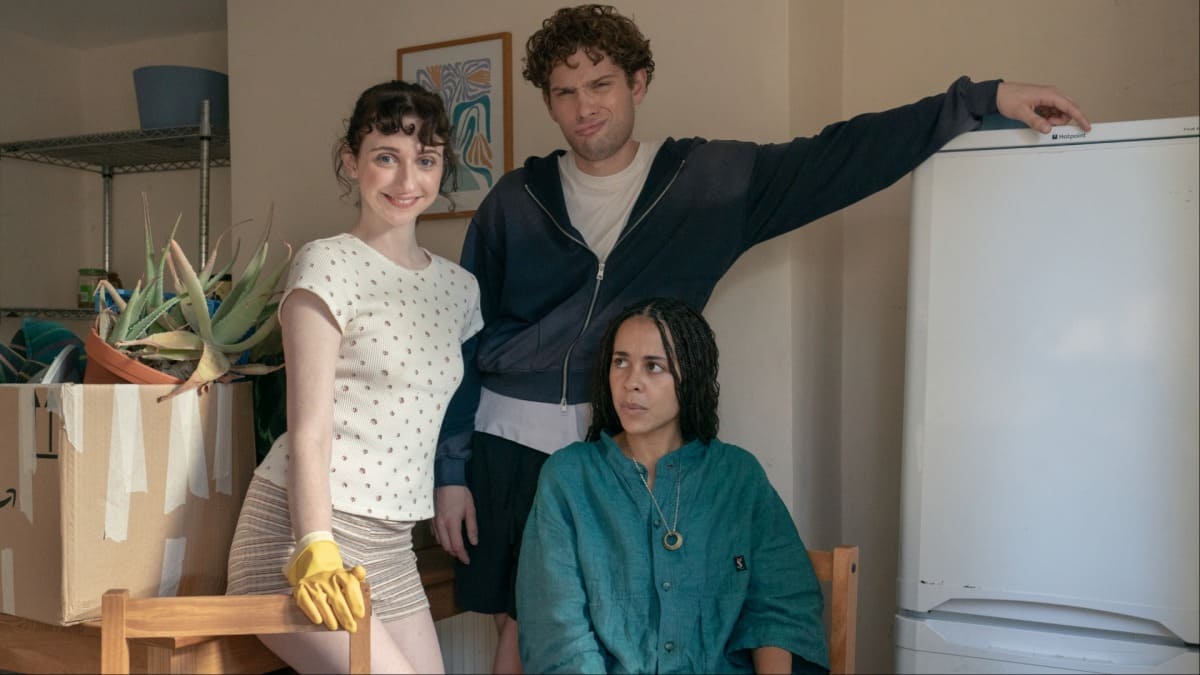
Among the three best friends at the center of It Gets Worse, Ethan is the closest to the show’s protagonist—at least for that first episode. When the series begins, he and the “two loves of his life” are in the process of moving out of their flat, with hopes to come back together after a month of couch-surfing. But it’s clear there are tensions from the beginning that may get in the way. Both buttoned-up corporate girly Abi (Emily Fairn) and free-spirited writer Sam (Olive Gray) love Ethan unconditionally, but they’re also fed up with his laziness and entitlement, qualities that come out when he procrastinates on patching up a hole in his bedroom wall and endangers their security deposit. Perhaps more importantly, Abi would rather pursue a stable arrangement by moving in with her boring, libido-less boyfriend Tom (Sean Delaney) than staying tethered to her pals from university.
The 28-year-old Reich, who created and wrote the series in addition to starring, has been a rising talent since his one-man show made it to HBO Max as a special in 2023, though some American viewers may also recognize him from his chaotic coworker role on the Lena Dunham series Too Much. (Dunham pops up here as Abi’s boss at the data-mining software start-up where she works.) Ethan is a slightly more grounded version of that character: self-obsessed, but also insecure and affectionate and frequently hilarious. He lives “one of the easiest lives in recorded human history,” according to the opening voiceover by author Zadie Smith, but that doesn’t mean he doesn’t struggle in his personal and professional life. If anything, a lifetime of privilege has sapped his energy to do much more than bop around the London gay scene, pursuing male validation from anyone mysterious or mean enough to be sexy.
Subsequent episodes rejigger the balance, giving spotlights to Abi and then Sam, and the second half of the season gives all three roughly equal attention. And while six 24-minute installments may not be quite long enough to fully grasp or fall in love with these characters, they’re certainly enough to establish a promising foundation. The show’s dips into social satire, along with its heavy emphases on sex and friendship, put it in conversation with Girls and Gen-Z descendants like I Love LA—but the dialogue is wittier than the latter show, equally raunchy but darker and more ironic.
Reich hasn’t necessarily worked out all the kinks, especially when it comes to plot. The storylines largely hit the expected beats, as when Ethan spends the whole season crushing on Sam’s roommate of ambiguous sexuality, or when Abi stubbornly refuses to address some obvious realities about her relationship with Tom. The same goes for Sam’s season-long quest to win back her ex-girlfriend Zara (India Mullen) by hooking up with Tess (Safia Oakley-Green), who… also used to fool around with Zara. The contrivances start to pile up in predictable ways before long, especially during a sex party at the warehouse co-op where Zara and her anarchist friends live—and certain subplots don’t get nearly enough time to develop, like Sam’s strange friendship with the incel teen she tutors.
The show’s balance of comedy and drama also isn’t quite seamless yet, which comes out most clearly in the overly serious tones of Smith’s voiceover, where the celebrated author of White Teeth narrates the characters’ lives and internal conflicts. (“Dying is cliché. It is the most derivative and predictable thing a person can do,” begins one episode set at the funeral for an old uni friend.) Still, a few emotional beats do land with some oomph, especially when Sam’s life starts to unravel while crashing with her ex—or when Abi’s yearslong love for Tom prevents her from seeing what she really requires to feel happy and fulfilled in a relationship. All three of these characters sacrifice their dignity repeatedly in searching for social or sexual approval or financial security, and watching them make the wrong choices feels wincingly relatable.
“We’re not responsible for other people’s feelings,” Sam remarks at one point, clearly trying to deflect blame for something. “Is that what other people have been telling you?” an older man shoots back. In a way, the moment is a wake-up call, but It Gets Worse is refreshingly resistant to pat endings and easy growth arcs—after all, look at the title. By the end, the show suggests that change may only be possible for those really, really willing to work for it—and maybe not even them.
For the series, at least, change feels within reach. The season ends in a promising place, with setup for a sequel that better capitalizes on the characters’ potential and tests their ingrained neuroses in more challenging, nuanced ways. The ingredients are already in place, from the strong performers and chemistry to the sharp jokes and lived-in world. Growth may not be so easy for Ethan; for Reich, it seems all but assured.


 Keep scrolling for more great stories.