In 1826, James Fenimore Cooper published The Last Of The Mohicans, the second installment in his Leatherstocking Tales, which follow the frontier adventures of Natty Bumppo, a white man raised by the Lenape people. The Last Of The Mohicans was the most commercially successful of the series, and to this day the most popular of Cooper’s novels, no doubt in part based on its filmic adaptations where stars like Randolph Scott and Daniel Day-Lewis portray Bumppo (in Mohicans known as “Hawk-eye”), who has become the archetypal “man who knows Indians” in American fiction. Almost 200 years detached from Cooper’s novel, it’s easy to see it as an artifact of a nascent America looking back nostalgically on its pre-Revolution wildness. But that belies that fact that Cooper and his Leatherstocking Tales laid a blueprint for the Western, which would go on to transpose his northeasterly frontier to imagery past the Mississippi, trading in old-growth forests and the rolling hills of the Allegheny Plateau for the dusty, barren plains and deserts much further from the coastal population centers.
While the imagery of that genre was solidified by post-Civil War dime novels, early motion pictures, and Wild West shows, the underpinnings were all there decades before in Cooper’s mega-popular novels. These works founded a lot of tropes, including poor portrayals of Native Americans—everything from the cruelty of Huron villain Magua to the stoicism and “fearless warrior” mythos of Bumppo’s Mohican brother Chingachgook—which were themselves founded in Cooper’s sincere interest in Native culture and demonstrating its complexities to white audiences. In his introduction to The Last Of The Mohicans, Cooper describes Bumppo as representing “a man of native goodness, removed from the temptations of civilised life.” While Cooper says that this is not meant as “invention” (i.e., ahistoric), he admits that his own moralistic romanticism of Bumppo betrays reality, but in a way that approaches “poetry.” James Cameron uses a very similar artistic license 200 years later in order to create his poetic science-fiction Western: the Avatar films. And none are more couched in that homegrown, ultra-American genre than the latest installment, Avatar: Fire And Ash—albeit, by denying the revisionism the Western underwent and instead sending it into the future in its most archaic, unnuanced form.
Picking up immediately where Avatar: The Way Of Water left off, Jake Sully (Sam Worthington) and his family are still on the run from Pandora’s human invaders (“sky people”), in particular his old nemesis Quaritch (Stephen Lang) who, like Sully, has been effectively reincarnated into a Na’vi body. Cameron’s films seek to explicate Na’vi culture using already existing conceptions; The Way Of Water appropriates Māori culture, while the first film implements the same relationship between human settlers and Na’vi as the English colonists and the Powhatan in Terrence Malick’s Pocahontas retelling The New World. But Cameron’s fictitious world at the same time flattens its influences by creating something of an amalgamative representation, built predominantly from white conceptions of Native American environmentalism that was especially popular in the counterculture of the 1960s.
The Western has always used its semi-historic, legendary playground as a place to speak to the present. When Cameron was coming of age, there was a reappraisal of the image of Native Americans in the genre, both in the well-intentioned, if thorny and reductive, idea of them as stewards of a land that subsequently has been looted by industrial, capitalistic greed, and as stand-ins for the continued genocidal atrocities committed by the United States, like how the massacres in Soldier Blue and Little Big Man call to mind images of My Lai.
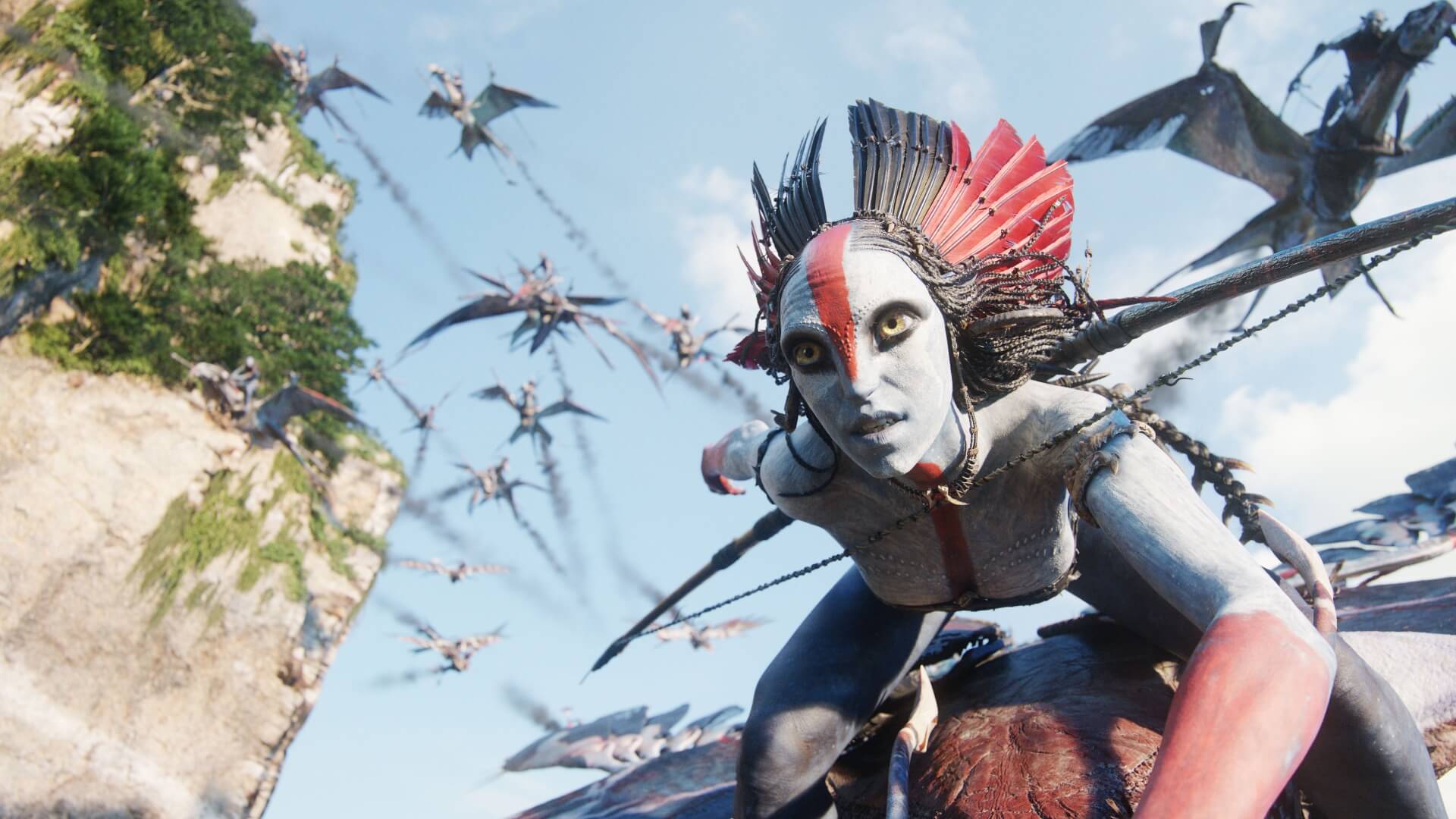
Cameron applies this approach decades later through Quaritch’s task force in The Way Of Water, where their search for Sully sees them round up whole Na’vi villages and torture people in ways reminiscent of American soldiers’ “search and destroy” missions. Fire And Ash leans more directly into its Western influence, though, with the introduction of the Mangkwan clan, who storm into the film like a stereotypical group of Apache raiders hiding just over the cliffs—in this case flying on Pandoran banshees rather than riding in on horseback.
The Mangkwan are so outdated that they lay bare Cameron’s pseudo-progressive bluff. The Western genre has always had a back-and-forth with its portrayal of “good Indians” (like Chingachgook) and “bad Indians” (Magua and the Huron). The Apache and Comanche tribes of what’s now the American Southwest are the typical examples in Western films, with both famous for their raids on settlers. Notably, both their names are exonyms meaning “enemy;” the tribes respectively refer to themselves as the Indé and nʉmʉnʉʉ, which both basically translate to “the people.” But these common barbaric portrayals have long faced pushback on screen, with films like Delmer Daves’ Broken Arrow flipping the script on Apache culture and John Ford’s masterpiece The Searchers arguing—via John Wayne’s Ethan Edwards—that brutal, racist violence is endemic to the white supremacist settlers of Texas. Persisting is the idea of an in-group/out-group mentality, which sees respective cultures desire to drive out others.
The Avatar series presses into this idea by having its Indigenous stand-ins not just be culturally divided from European settlers by historical circumstances and racial social constructions, but by literally being different species. This is not uncommon in science fiction or fantasy, but does present limits to the metaphor and forces Cameron to have bizarre genetic interjections into his storytelling to make up for how fluid concepts of tribal affiliation or whiteness are in practice—see Natty Bumppo being considered a member of the Mohicans, or how in The Searchers, characters are considered either white or not white based on their actions and circumstances. In Fire And Ash, conversations around this are between Jake and his wife Neytiri (Zoe Saldaña), who have effectively mixed-race children because Sully’s avatar is genetically engineered to be more humanoid. Stranger, though, is how Cameron walks himself into a corner with the character of Spider (Jack Champion), a white human child raised by the Sullys who, if he is to be accepted, has to become Na’vi not just through cultural or spiritual integration, but physically.
Moreover, there’s an aspect of sexual violence that Cameron co-opts from the Western—like the implied rapes in The Searchers, which Ethan believes makes the women no longer white, or how part of Magua’s goal in Last Of The Mohicans is to take an abducted Englishwoman as his wife (which Cooper describes as “repulsive” and eliciting a “powerful disgust”)—and makes into an essential part of Mangkwan leader Varang (Oona Chaplin), using her “queue” (the tendrils that Na’vi use to connect with plants, animals, and each other during sex) to dominate captured foes. There is a challenging conversation about these psychosexual fixations and the way they do or don’t relate to the story of colonialism and the struggle against it, but Cameron, in a digital space wholly of his own creation, isn’t willing to unpack his own proclivities. Instead, he creates a world that conforms to his simplest ideals.
In failing to address the complexities of his images, Cameron falls back on typical narrative concepts like “going native” (something levied against Sully in the first film, and then again towards Quaritch in Fire And Ash when Edie Falco’s character, General Ardmore, refers to him as “Colonel Cochise”); it’s all shorthand for his shallow, Boomer-brained twist on “cowboys and Indians.”
Even the portrayal of Quaritch falling for Varang is stale, like a toothless version of The Searchers’ Ethan being a mirrored reflection of the Comanche chief Scar (Henry Brandon) by way of the mutual alliance between the French colonists and Huron in The Last Of The Mohicans. Cameron can’t even go as far as to understand why the violence of the Comanche existed, or what their society might have looked like from the inside. The Mangkwan don’t live in tough but inhabitable Comancheria, but camp in an ashy hellscape that simply reflects that they are the “bad ones” whose only culture is death and collecting scalps—like how S. Craig Zahler tried to write himself out of accusations of anti-Native racism by having the bad guys in Bone Tomahawk not be typical Native Americans, but literal inhuman troglodytes.
The Mangkwan demonstrates how flat Cameron’s use of Indigenous cultures, translated through their cinematic stereotypes, really is. The Na’vi don’t exist, but they are referencing real sets of cultures in a mashed-up fashion—the Na’vi are Cameron’s idealized imaginings of Native societies based around the media of his time. It is an archaic representation not just because its adaptation of Indigenous culture is juvenile and old-fashioned (not to mention Sully’s paternalistic relationship to it), but because it freezes the portrayal of Natives in a bygone time, just like how Cameron’s transportation of Western tropes into the future ignores the history of their development, solidification, and revision. The tropes are now detached from their original conversation, one which has been evolving for two centuries. Cameron, now in a new genre, ignores nuances that have already been explored and instead presents his own dreams of resistance, which don’t look anything like the real world.
Cameron still thinks there is something radical about Avatar. As he told The Hollywood Reporter, “who’s to say we wouldn’t be going backwards even faster if it wasn’t for these films? There isn’t an alternative Earth without Avatar we can point to and say, ‘It made this measurable difference.’ What we can say is the Avatar films are on the right side of history.” It’s an idealistic, narcissistic sentiment—just as Star Wars did not stop American imperial wars, Avatar did not unite humanity to end genocidal violence. More tangibly, Avatar: Fire And Ash shows more clearly than ever before that this franchise exists as an aging white Boomer’s mystical fantasy of the Western’s Indigenous cultures—fighting against the imperial machine—now detached from history and immersed in a world of digital imagination.


 Keep scrolling for more great stories.