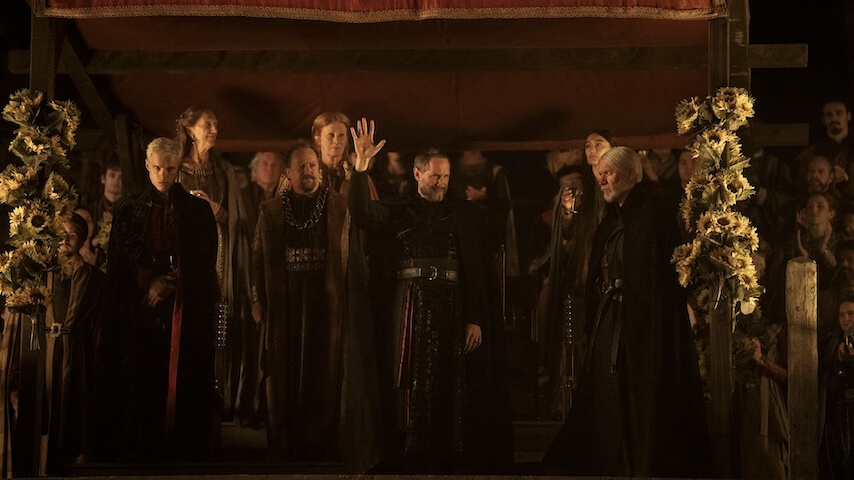
Prince Aerion "Brightflame" Targaryen, Prince Baelor "Breakspear" Targaryen, and Prince Maekar Targaryen in A Knight Of The Seven Kingdoms (Photo: Steffan Hill/HBO)
[Editor’s note: This piece contains spoilers for episode three of A Knight Of The Seven Kingdoms.]
For the first two episodes of A Knight Of The Seven Kingdoms, the “when” and “where” didn’t really matter. The smallfolk-focused show was more interested in poop jokes and puppet shows than the great houses and hereditary claims that take up so much of the rest of the Game Of Thrones universe. But that all changed in the show’s third episode, with the reveal that “hedge knight” Ser Duncan the Tall (Peter Claffey) didn’t just adopt any random little bald kid as his squire. No, humble Egg (Dexter Sol Ansell) is actually Aegon Targaryen—seemingly the umpteenth character to bear that name in the Thrones universe.
So where does this particular Aegon fit into George R.R. Martin’s ever expansive Westeros history? Since it can be hard to google anything about the Thrones universe without spoiling either the show you’re currently watching or—particularly in this case—the outcome of the ongoing House Of The Dragon prequel series, we’ve got you covered with an expansive but still spoiler-free explainer.
The basics: A midquel
The simplest explanation is that A Knight Of The Seven Kingdoms takes place almost directly between House Of The Dragon and Game Of Thrones, and Egg is one of many Targaryen princes running around at the moment. Given that House Of The Dragon follows a Targ-vs.-Targ civil war, it’s not really a spoiler to say that a Targaryen winds up on the throneat the end.And there are now several generations of new Targaryens lording over Westeros, with Egg as the youngest son of the current King’s youngest son, Prince Maekar (Sam Spruell).
Timeline-wise, the biggest update is that we’ve now officially transitioned out of the era when dragons are plentiful (as they are in House Of The Dragon) and into a time when they’re extinct (as they are at the start of Game Of Thrones). But dragons are just enough in living memory that the Targaryens are pretty testy about the loss—as evidenced by Egg’s older brother Aerion (Finn Bennett) crashing out over a puppet show.
The backdrop: A dynasty of Targaryens
Of course, there’s a whole lot more detail to it than that, as Martin has charted not just in his original A Song Of Ice And Fire novels and three Tales Of Dunk And Eggnovellas but also in full-on fictional history books. Martin’s obsessive love of lore has spilled over into a 700-plus-page encyclopedia called The World Of Ice & Fire as well as a 700-plus-page faux history tome called Fire & Blood, which offers an in-depth exploration of each ruler of House Targaryen. (Well, at least it does in the first half. In classic Martin fashion, he split the project into two volumes and is still promising to finish the second half someday.)
The level of detail is mind-blowing, with Martin dreaming up full backstories for all 18 Targaryen monarchs, including which of their siblings they fucked, what kind of political changes they put into place, and how they died. But the big-picture idea is pretty simple: Centuries ago, a guy called Aegon The Conqueror flew over to Westeros on a dragon, got most of the Seven Kingdoms to bow to him, and declared himself King of the realm. Then his descendants continued to rule for the next 283 years—all the way until just before the start of Game Of Thrones, when Jamie Lannister slays “the Mad King” and Robert Baratheon claims the Iron Throne for himself.
The inspiration: The history of the British Isles
Indeed, the history of Westeros is actually really easy to understand if you’ve ever taken a British history course. To create his fictional world, Martin basically took the real-life past of England, added some dragons and White Walkers, and set it on a landmass that’s sort of all of Europe shoved into a U.K.-shaped island. Where British history is often demarcated by William The Conqueror invading from Normandy and declaring himself king in 1066 A.D., Westeros has Aegon The Conqueror doing the same in the year 1 A.C., a.k.a. “After The Conquest.” (The idea that “Aegon” is the Westeros version of “William” makes it a little more understandable that there are so many of them running around.)
From there, Martin just transmuted various British events into a high-fantasy setting. The power struggle of Game Of Thrones is Martin’s riff on the War Of The Roses, with the Lannisters and Starks standing in for the Lancasters and Yorks who battled it out in the 15th century. Meanwhile, House Of The Dragon is inspired by a lesser known 12th-century civil war called the Anarchy, in which William The Conqueror’s direct line nearly ended because there was only a woman left to inherit the throne. Instead of Empress Matilda fighting for her right to rule, we’ve got Queen Rhaenyra doing the same.
Now A Knight Of The Seven Kingdoms is here to fill in the gap between those two events—roughly Robin Hood times, if you want to think of it in British history terms.
Egg/Aegon Targaryen in A Knight Of The Seven Kingdoms (Photo: Steffan Hill/HBO)
The specifics: The era of Daeron The Good
Specifically, A Knight Of The Seven Kingdoms takes place in 209 A.C.—80 years after Rhaenyra and her half-brother Aegon II start duking it out on HOTD and 89 years before Robert Baratheon kicks the bucket on GOT. It’s a time of relative peace. Though the Targaryens took a little while to find their feet again after the destructive “Dance Of The Dragons”—including an intense detour into religious fanaticism with King Baelor The Blessed—they’re now once again a stable dynasty.
In fact, the current king is literally known as “Daeron The Good.” He inherited the throne from his irresponsible father (yet another Aegon), but has spent the past 25 years of his reign putting things right. King Daeron’s biggest accomplishment is doing something no other Targaryen ruler was ever able to do before him: bringing the southern kingdom of Dorne into the fold as an official part of the Seven Kingdoms. For the first time ever, Westeros is fully unified.
Which isn’t to say there hasn’t been some trouble during Daeron’s rule too. Thanks to his father’s famed sexual appetite, Daeron’s got a whole lot of bastard siblings with potential claims to the throne, including one namedDaemon Blackfyre, who waged something known as the Blackfyre Rebellion 13 years ago. (Egg recounts some of that bloody history while singing in a tree.) And there’s always something of an anti-Targaryen bent among the old great houses of Westeros. As Raymun Fossoway puts it, “They’re incestuous aliens, Duncan. Blood-magickers and tyrants who’ve burned our lands, enslaved our people, dragged us into their wars without a mote of respect for our history or our customs.”
But, for the most part, it’s a time of stability for the Targaryens. That’s partially because Daeron has so many sons,which gives the realm a sense of confidence that there won’t be any more stressful questions of succession anytime soon. While Daeron is so far an unseen character on A Knight Of The Seven Kingdoms, we have met two of his four adult sons. Crown prince Baelor “Breakspear” (Bertie Carvel) seems like the ideal noble to inherit the Iron Throne next. He’s the one who remembers Dunk’s old master Ser Arlan of Pennytree and pushes for Dunk to be able to join the tourney.
Meanwhile, King Daeron’s youngest son Prince Maekar (Sam Spruell) is a little more petulant but still relatively chill by Targaryen standards. And since Baelor and Maekar both have a handful of their own sons (more on them in a second), there’s a real sense that the Targaryens will just keep flourishing forever.
The personalities: A Targaryen coin flip
Indeed, one of the themes Martin is most interested in throughout all his Targaryen histories is questions of nature vs. nurture. Are Targaryen leaders destined to bend toward cruelty or madness? Or can they be raised to be magnanimous, selfless leaders? And what happens when other great houses get involved in the gene pool?
Since incestuous marriages are one of the main ways Targaryens consolidate power, it’s notable that King Daeron married outside of his own bloodline to shore up his union with Dorne. Prince Baelor’s salt-and-pepper hair comes from his Dornish mom, Queen Myriah Martell. And he’s now passed it down to his own son, Prince Valarr (Oscar Morgan)—the brunette we briefly see compete in a joust in episode two.
Prince Maekar, however, inherited his dad’s looks. And he’s now passed the silver hair onto his own children—including his still-missing eldest son Prince Daeron; the classic blond Targaryen asshole Prince Aerion; and our dear sweet Egg, who shaved his head so he wouldn’t look like his cruel older brother.
Meet Egg: A Targaryen alone in the world
Part of the reason it’s not a full-on state crisis when Egg goes missing is that he’s not a hugely important Targaryen. He may be King Daeron’s grandson, but he’s also the fourth son of a fourth son, which puts him well out of the line of succession.
He’d need three uncles, several cousins, his dad, and three older brothers to die before he’d even be in consideration for the Iron Throne. And that allows him a little more freedom than the Targaryens who have to be the public face of the family. Where House Of The Dragon is interested in the pressure of being raised to rule, Egg is more of a free agent—an Arya Stark rather than a Robb. And that means Martin and showrunner Ira Parker can explore questions of Targaryen nature vs. nurture through a new lens.
Rewatching the first three episodes with the twist in mind, you can see some of Egg’s Targaryen imperiousness coming through. He tells Dunk he can ride a horse as well as he can, he doesn’t care about getting a coin for tip, he knows all the famous knights by name, and he warns Dunk his knightly sales pitch is “undignified.” But there’s also a real sweetness to him in a way we haven’t really seen from a Targaryen before. He’s a hardworking squire who seems genuinely dedicated to Dunk. Whether or not their friendship can last now that Egg’s true identity is out in the open—and what that might mean for how Egg will grow up—will be questions driving the rest of the series.
Spoiler alert: Connecting all of this to Game of Thrones
Since the Dunk And Egg novellas are rooted in Egg’s childhood, the question of what happens in his adulthood seems like a little less of a direct spoiler. And there are some intriguing broad strokes about how this current story connects to the original Game Of Thrones show. But stop reading here if you don’t want to know anything about Egg’s future beyond that ominous prophecy he heard on the tourney ground.
As that fortune teller suggests, the reason Martin wanted to explore Egg’s childhood is because he does wind up becoming King Aegon V “The Unlikely” after a plague and a series of accidental deaths improbably elevate him in the line of succession. In fact, the only other person really put up for consideration is his older brother Aemon. But because Aemon had already dedicated himself to a life as a maester, he turns down the offer and eventually heads off to the Night’s Watch instead—and that’s how we get blind Maester Aemon (Peter Vaughan) befriending Jon Snow and Samwell Tarly up at the Wall on Game Of Thrones.
In fact, Aemon’s dying words are about his brother Egg, which is a reminder that the era of A Knight Of The Seven Kingdoms isn’t really all that removed from the events of Thrones. Egg’s son Jaehaerys and daughter Shaera wind up marrying each other against his wishes, and it’s their son Aerys II who ultimately becomes “the Mad King” who inspires Robert’s rebellion. And since it’s Aerys’ son Rhaegar who eventually fathers Jon Snow (technically another Aegon, lest we forget), there’s a pretty direct line from the little boy we see on A Knight Of The Seven Kingdoms and the harrowing future of the realm.
One of the things Martin is interested in with the Dunk And Eggseries is questions of fate and chance, the way random turns of events can steer so much of history. And knowing Egg’s future royal destiny gives the show a whole different level of meaning for those willing to go deep on Westeros lore.



 Keep scrolling for more great stories.