There are few bigger names in horror filmmaking than John Carpenter, and for good reason: from Illinois suburbs to Antarctic research bases, his films can make just about any place or premise instill dread, tension, and often disgust (ie, that part in The Thing where Copper gets his arms bitten off as he very unsuccessfully delivers CPR). Beyond his career in filmmaking, Carpenter has also expressed an interest in video games, and while this has mostly been limited to admiration from afar, he’s contributed to soundtracks and consulted on games like F.E.A.R. 3 (which he also narrated) in the past.
This context makes the prospect of the upcoming co-op zombie shooter John Carpenter’s Toxic Commando a bit more exciting, because at least on the outside, this doesn’t seem to be a Tom Clancy situation where the name on the tin doesn’t mean much. Carpenter is credited as both the game’s writer and composer. So this begs the question: just how much John Carpenter is in here?
The short answer is that outside of its synth-laden soundtrack and pulpy action-horror premise, not much. At least through the first few hours of Toxic Commando (which we went hands-on with via a preview), the game works as a great reminder for how auteur theory mostly doesn’t apply to bigger-budget video games. The complex, interdisciplinary process of making one (alongside other factors like large budgets that discourage creative risks) ultimately makes it unlikely that one person can single-handedly guide the creative process from the director’s chair. And while this FPS has a few distinguishing elements in its own right that slightly separate it from the many other four-person co-op games about blasting zombies, Carpenter’s singular direction isn’t one of them—honestly, how could it be in this kind of online-focused affair where the expectation is that you’ll be bantering with buddies instead of paying attention to dialogue and cutscenes?
If nothing else though, the setup for the plot is certainly in his wheelhouse. Four mercenaries sign up for a job that takes them to a quarantine zone that was the site of a mysterious disaster. Before long, they find out why this area was sealed off when they’re suddenly accosted by waves of shrieking former humans infected by a black goo. Hey, it’s a bunch of zombies. They hold them off for a bit, but ultimately come down with this plague and are given a week to live, tops. To stop this illness from spreading and escape alive, they’ll need to team up with the man responsible for accidentally letting this thing loose in the first place, a vain rich dude who was trying to drill to the center of the Earth in search of renewable energy, as vain rich dudes tend to do.
All of that sounds perfectly Carpenter, whether it’s commandos being deployed into a walled-off nightmare zone to complete a job (Escape from New York), human-consuming organisms (The Thing), or critiques of callous corporate elites (They Live), but the reality is that this serviceable spin on a Left 4 Dead-style co-op shooter doesn’t quite bring enough new to the table to entirely stand out.
As for its format, you and up to three allies proceed through semi-open-ended levels to complete objectives, all while blasting very large numbers of zombies in the dome and collecting graded resources that can be used to upgrade your arsenal (this part is strikingly similar to Helldivers 2). Shoot various types of monsters and battle tar-covered tendrils while completing objectives like defending power generators and finding decryption keys.
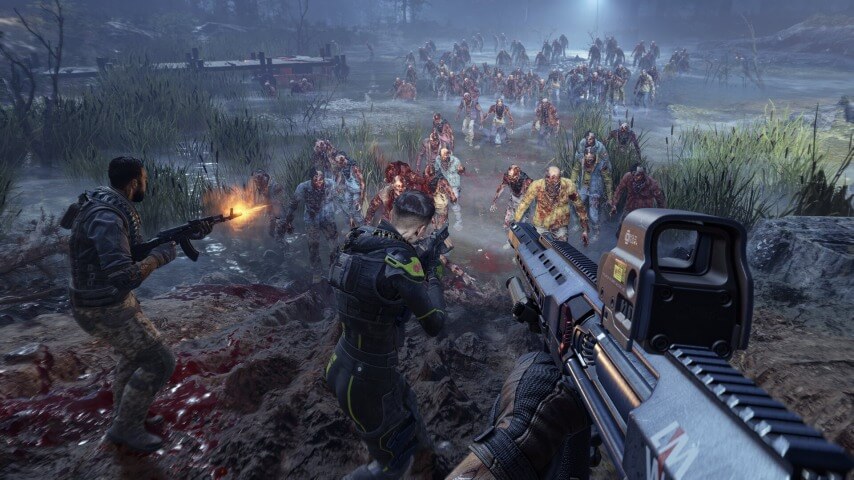
It’s pretty standard stuff, but thankfully, there are a few differences from Valve’s influential duology and its imitators. For one, your crew has superpowers. As a side effect of the infection, the members of your team gain unnatural skills: the ability to shoot fireballs out of their hands, a defensive shield, a healing sphere, and a killer drone. These function a bit like the powers in a hero shooter, and while the cooldowns are a bit too long to fundamentally alter the experience, it’s hard to say no to the satisfaction of launching an explosive ball of plasma into a horde of foes.
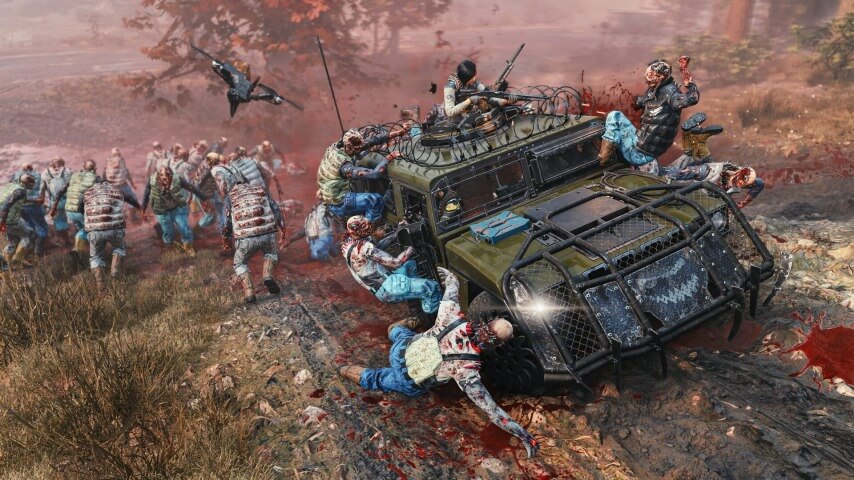
Another major distinction from most other zombie shooters is that this one truly, genuinely loves trucks. Like, a lot. In the tutorial mission, you become acquainted with a beefy four-wheel drive outfitted with a heavy machine gun, a harpoon used to rip down doors and gates, and a healthy dose of Mad Max regalia like plate armor and spikes. Then you’re encouraged to pilot this bad boy through crowds of bodies, some of which will dive onto the windshield or grab hold of a door until you’re able to give them a good shake (or a double tap). The levels are designed around these vehicles, whether it’s navigating the elements, like thick mud that puts engines to the test, or how you need to chart pit stops for resources like gasoline and bullets to keep your ride running. These vehicles have a solid weight to them, and the way they interact with environmental obstacles like thick muck, uphill slopes, and, most of all, freaky undead monsters adds a physical, tactile quality to being behind the wheel.
Making good use of these vehicles is particularly important because if you don’t, it’s easy to become overwhelmed: another area where Toxic Commandos goes a bit past the co-op shooters of yesteryear is that new tech lets it throw even more zombies at you at once. In the opening setpiece, you drive through a sea of undead, as untold thousands of bodies churn in the background before trickling into an abyss like a putrid waterfall. While this segment slightly oversells how many attackers you’ll be dealing with during dedicated gameplay sections, even outside of this showy intro, there are times when there will be an uncomfortable number of creepy guys running at you full tilt. Related to this, the highlight of the entire preview was a defense mission that involved holding out against a seemingly endless assault, as the sheer volume of these foes inevitably results in some slipping through the cracks and piling up on the bolted doors you’re supposed to be protecting—the scale can be quite impressive, and it’s helped by mechanics, like the ability to set up barbed wire and electric traps ahead of time, that make this feel like a last stand.
But while a few aspects here are at least slightly different than its predecessors, the game still can’t quite escape a fundamental sense of déjà vu. The weapons you choose from are a variety of barely distinguishable assault rifles that would feel at home in any given military shooter (granted, these aren’t real ones licensed from gun manufacturers that intentionally or not advertise AR-15s to teenagers, so that’s an improvement). At least so far in the preview, there weren’t any wacky contraptions that would feel fittingly pulpy for a game with both “John Carpenter” and “Toxic Commando” in the title. Where are the flamethrowers, nonsensical sci-fi weapons, and most important of all, the inexplicable shuriken?
Even more boilerplate are the progression systems which have all the trademarks of an RPG-ified gaming landscape. There are skill points that deliver thrilling boons, such as a marginal walk speed increases, weapon levels that very slowly increase to grant more attachments, and rifles that glow with rarity indicators like Borderlands. And while the script was apparently written by Carpenter, it feels barely distinguishable from any number of multiplayer-focused action games with forgettable characters and only the thinnest possible pretense to get out and start blasting, something not helped by unremarkable cutscene direction.
Perhaps the most fundamental issue, though, is that pulling the trigger doesn’t feel as satisfying as it could. To be specific, it takes a strangely long time for your character to aim down the sights—Call of Duty may be jingoistic propaganda, but damn, the original Modern Warfare really changed this genre forever with its absurdly snappy aiming. Being outdone by an 18-year-old game is not great, especially considering that shooting is the central thing you’ll be doing here. The feedback on weapons feels decent (as in, it’s satisfying when zombie heads blow up like watermelons), and there’s a real tension as your bullets fail to break the next incoming wave, but hopefully, this area improves before the game launches next year.
Regardless, it’s easy to imagine at least a few Carpenter-heads will be disappointed that this game isn’t something a bit more in his wheelhouse: a survival horror title, an Until Dawn-style choose-your-own-adventure, or really any form of exclusively single-player experience that could build some real ambiance (you can play this one solo, but it’s abundantly clear it’s meant for co-op). I’m sure just as many have grown cynical about X person’s name being on a thing, but considering Carpenter’s name is in the credits, it’s not unreasonable to have expected a bit more of his style. Judged (perhaps more fairly) by its own merits, the game is a competent enough cooperative zombie shooter with a few unique hooks, like your magic sludge powers and (more literally) your big dumb truck’s hook-harpoon gun. It’s the type of thing which could quite plausibly keep a friend group busy for a few weekends. Unfortunately, like its B-movie premise, Toxic Commando seems like the kind of game that may have been best saved for a Blockbuster rental.


 Keep scrolling for more great stories.