Characters in his movies meet stomach-churning ends for storytelling purposes, certainly, but deaths tend to be character-driven and thematically relevant, too. Anwar doesn’t go for mere shock value, like Christian Tafdrup’s Speak No Evil or Srdjan Spasojevic’s A Serbian Film. He’d rather entertain than abrade. When Ghost In The Cell and his other horror projects—Impetigore; Satan’s Slaves and its sequel, Satan’s Slaves: Communion; Grave Torture—commit to gruesome imagery, it’s for good reason.
“I’m not a fan of violence for violence’s sake, or gore for gore’s sake,” Anwar tells The A.V. Club. “I’m not a fan of mean-spirited horror. I don’t like to provoke people.” His reasons for this aversion to empty stimuli, lately exemplified by fare like Eli Roth’s Ice Cream Man, are partly practical and partly creative. It’s important to Anwar that audiences consider their time and money well-spent on his movies; it is likewise important to “show meaning with every element of the film.” This is a truth that should be self-evident: As an art form, the magic of making people extremely dead in horror films is well-documented and has improved incrementally over decades’ worth of effects artists’ contributions since the age of Herschell Gordon Lewis. In short, anybody can crush a prosthetic head or disembowel a dummy loaded with fabricated entrails.
Horror effects very much are an art unto themselves—a grim art, but an art all the same. An appreciation for the nuts and bolts of breaking down bodies into their component parts is practically required for watching horror movies in the first place. One discovers their tolerance for violence by gazing in contemplation at human viscera, and learns how much agonized screaming they can listen to before a horror film proves too much for their sensibilities. This is one of the key pieces of Anwar’s cinema: He understands his own boundaries while knowing how to push those of his audiences, and finds substance in his characters’ deaths (apart from their blood and guts).
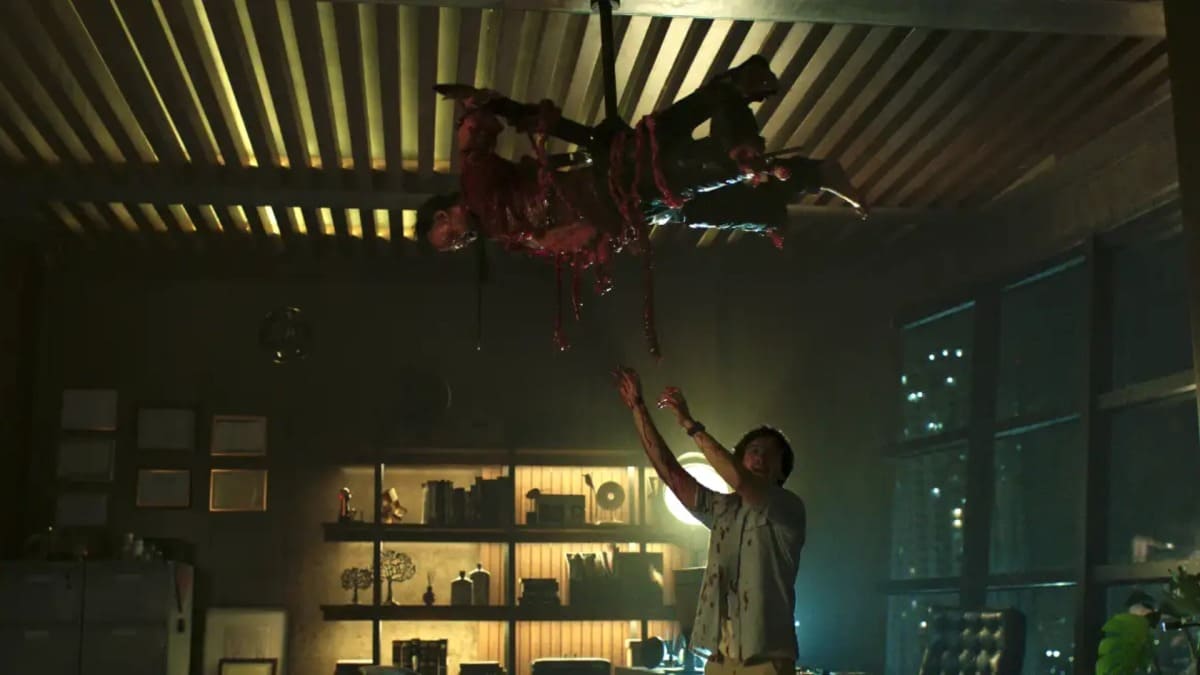
Ghost In The Cell brims over with examples of this thoughtful dynamic in action, though Anwar has one in particular in mind: Novilham (Magistus Miftah), a dance instructor at the prison, whom the film’s protagonists—Anggoro (Abimana Aryasatya), Six (Yoga Pratama), Irfan (Danang Suryonegoro), Wildan (Mike Lucock), and Pendi (Lukman Sardi)—turn to as a way of releasing their animus. The wraith haunting their confines only targets people in states of emotional pique, and art, as Wildan helpfully explains, is a great outlet for lifting up one’s spirits. “Everybody can dance,” he replies to Anggoro’s protests. Unfortunately, not everybody can dance well. This puts Novilham in a sour mood, which in turn stirs the ghost. A few moments later, Novilham’s mutilated corpse is found posed in a ghastly mockery of pointe; his impeccable form, now frozen, stands as an example of what he struggled to get out of his class of inmates but couldn’t, to his frustration and, ultimately, peril.
“The deaths [in the film] mirror something,” Anwar explains. “They reflect something. When [Novilham] dies, we love him. He’s innocent. He doesn’t do anything wrong, but he dies anyway. In our society, in the real world, innocence will not get you off the hook. You can be a good person, but you still can be a victim of the system.” Ghost In The Cell is full of victims of the system, like Dimas (Endy Arifan), a journalist wrongly convicted for slaughtering his asshole boss in Ghost In The Cell‘s opening sequence. Dimas brought the ghost back with him while on assignment in Borneo, the site of an illegal nickel mining operation as well as the source of the plot’s inciting incident. And while Anggoro and his gang are each technically guilty of their own misdeeds, none are strictly bad men, in contrast to Tokek and the other unsavory types locked up in the prison.
This can be applied to characters in Anwar’s other films, too. Ki Saptadi (Ario Bayu), one of two antagonists in Impetigore, commits atrocities out of what he considers his duty to his village, but also out of a place of hurt and perceived betrayal; in Satan’s Slaves, Bahri (Bront Palarae) and Mawarni (Ayu Laksmi) turn to a Satanic fertility cult for help starting a family, knowing full well that their bargain means surrendering their last child, Ian (Muhammad Adhiyat), to the cultists on his seventh birthday. These are awful acts in a filmography littered with them. But Anwar sees humanity even in his worst characters, not to mention a need to show his viewers a good time. Where a director like Mike Flanagan can lean toward the saccharine with this kind of empathy, Anwar embraces a messier, more grounded take on compassion. He keeps his characters on the hook, but he also cares enough to show how they stuck themselves there in the first place.
“The way [Novilham] dies, and the way his body is displayed, was not because I want to show people that we can do a really cool display of a corpse,” Anwar says, returning to Ghost In The Cell‘s macabre, delightfully gonzo material. “We tried to send something. We want to show meaning.” No matter how outré, gnarly, and downright gross Anwar’s films get, from Ghost In The Cell‘s forced self-mutilations to Impetigore‘s casual flayings, each reaches for a profound catharsis, or at least attempts to make deeper statements about the factors that influence these characters’ choices and circumstances. Call them nauseating. Call them disgusting. Just don’t accuse them of being pointless.


 Keep scrolling for more great stories.