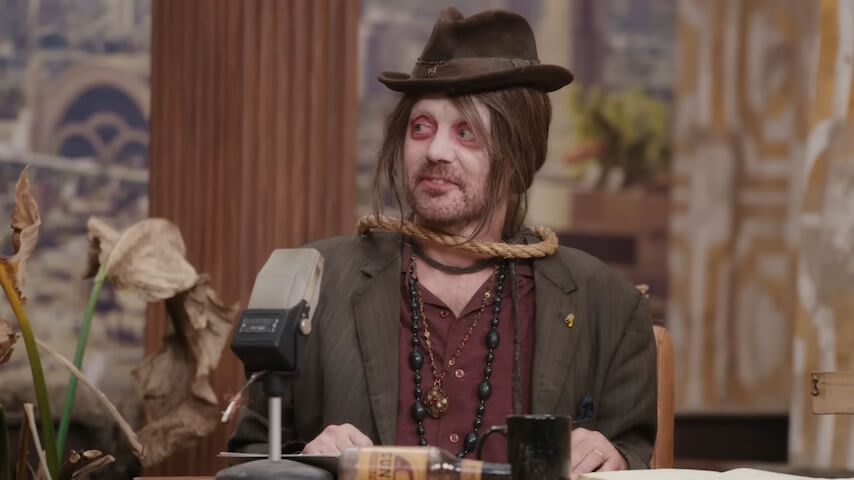
We’re longtime fans of comedian Jon Daly here at The A.V. Club, whether enjoying his antics on Kroll Show, grooving to a little “Abracadabralifornia,” or being simultaneously creeped out and amused by his recurring turn as a comically malevolent snake-oil salesman on Prime Video’s Fallout. The latter character has been popular enough that Daly was featured heavily in the marketing for the post-apocalyptic show’s second season, popping up at the end of its trailer and even getting his own miniature spin-off, a satirical chat program labeled Fallout Fake Talkshow (in which an in-character Daly grilled the show’s cast members about their salaries on the series and their extant number of teeth).
Ahead of Fallout’s second-season finale on Tuesday, The A.V. Club sat down with Daly to discuss his tendency to wind up as a “human cockroach,” nerding out with Kyle MacLachlan about Dune, and the surprising sweetness he found in one man’s quest to endure any hardship to get back to his beloved sex robot.
The A.V. Club: Looking through your filmography, I counted four pretty recent post-apocalyptic roles, in Future Man, Miracle Workers, Twisted Metal, and Fallout.
Jon Daly: Also American Dad! It’s not post-apocalyptic, but somebody pointed out on Reddit that I play an irradiated person on that. “Jon Daly’s played two characters that are irradiated,” and I’m very proud of that. I think it speaks to the tenor of the national feeling, the national discourse, that a lot of stuff’s coming out that’s post-apocalyptic.
AVC:Do you think there’s something about you that makes people say, “We’re doing the end of the world; let’s get Jon Daly”?
JD: I don’t know, but hopefully it means that I’m gonna be a part of the future. Maybe I’m a humancockroach, you never know. Maybe I’m immune to radiation and don’t know it, but people pick up on these subtle signals and cast me in things, knowing that I will survive. So hopefully it’s because I’m bulletproof to radiation and I will, you know, live far into the dawning of a new civilization.
AVC: When you were first cast in Fallout, how was your character described to you?
JD: The character was described as a Wastelander who is dealing with some amount—they didn’t say radiation poisoning, but that was kind of dealing with some amount of radiation poisoning, both due to his own experimentation on himself and due to living in the Wasteland. A Wormtongue kind of carnival barker, old-school snake oil salesman. And I love the show Deadwood, so I kind of was like, “This guy could exist in Deadwood” and extrapolated from my love of the characters within that show. I’ve played Fallout, so I knew it was going to be a wasteland show, with little towns everywhere.
So it’s kind of a guy that would exist in Deadwood, come into town and, you know, probably get killed by Dan. And somebody would feed him to the pigs eventually. But what I love about him is that he’s a survivor. In order to survive in horrible circumstances, it helps to keep your high status.Which is also good for comedy. It’s my favorite kind of character to play.
AVC: How was the tone of the show described to you?
JD: Kind of a gigantic Game Of Thrones-size comedic drama, comedic action-drama. Large in scope with elements of comedy and action and epic storytelling.
AVC: Your character feels really integral to that tone. Your first scene in the show is essentially a comedy sketch.
JD: It’s so comedy that when I come back, and they resolve it, it’s a nice surprise.
AVC: In that light, I’m interested in how the Snake Oil Salesman ties into the show’s whole vibe. Because he feels really central to the idea that just because something’s funny doesn’t mean it’s not dangerous.
JD: He’s survived in the Wasteland. People who are hardcore into the games are like, “This is a perfect cutscene character.” Except we’re following him. So you get to see this survivor and learn how he survives. Getting to know how an ordinary guy—maybe his ancestors were kind of ordinary business people—kind of devolved socially is so interesting. Here’s how people survive now. It’s kind of this mix of modern life and hucksters and liars and carpetbaggers and everything else that happened in the American West. It’s kind of happening again.
The show is so epic, and you’re seeing these gigantic stories about epic war and warriors and Mr. House, mysterious leaders and all these kinds of giant things. And here’s an example of how the ordinary man survives the apocalypse. And you have to pull out all the stops and be an aggressive salesman and make yourself useful to people. Even if, you know, you’re selling snake oil. It’s an example of how an ordinary person survives in the Wasteland with very few options.
AVC: With his beloved sex robot.
JD: With his beloved sex robot! And it’s nice to see him with that sex robot, I think. I know that it’s an Easter egg from the game, and it’s funny to see because everybody knows that it’s a sex robot. But I think it’s adorable that he has risked his life, walked from Los Angeles to Las Vegas, pulled out the stops in his life to get a valuable fusion core. And what he’s using it for is intimacy, his version of an intimate moment with the thing that he can get intimate with. Which is F.I.S.T.O. This guy’s not going to be pulling down any ladies or gentlemen or whatever. He’s a guy who can pull a sex robot right now and risks his life to get there. He’s picking flowers and risking his life numerous times. He fights a radroach, he traverses the desert, he’s in the middle of the Wasteland, but what’s important to him is this romantic moment that he’s self-generating. If you’re in the Wasteland, you’ve got to take what you can get. And so he’s making his own medicines and selling them, and all he needs from them is to work immediately. And then he can get the hell out of there.
I think it’s kind of beautiful that he sets up a little romantic relationship with this robot. He could take that fusion core and go find some power armor and steal it, kill some people, make himself the leader of a gang. But no, he takes it and has this human moment with a robot.
AVC: Does the character have a name beyond “Snake Oil Salesman”?
JD: I do have a name, but I don’t want to reveal it because they’ve told me not to. I’ve named myself. And then the fans have really named me “Chicken Lover,” um, or “Chicken F-er.” And that really is my name online.
AVC: How long do you have to spend in the makeup chair?
JD: Nowhere near as long as Walton Goggins, who works with the genius Jake Garber to put on that Ghoul makeup. That’s a real haul, like three hours. I’m about an hour and a half, especially when I’m in Hank’s office after getting the controller on my neck. That makes it take about two hours, ’cause that’s real-deal special effects makeup. And my character is the first person that it works on whose head doesn’t explode, so there’s an effort to make it look kind of improvised, so there’s a lot of visible flesh and blood around it, which is great. They do a lot of detail with that. That took a little extra time, but it looks so amazing.
AVC: You’ve gotten to have a lot of scenes with Kyle MacLachlan.
JD: He’s one of my heroes.
AVC: That first scene between the Salesman and Hank is so intense, with you basically locked into eye contact with him.
JD: I was kind of hesitant to bring this up with him, but there’s kind of a reverse Muad’Dib/Kwisatz Haderach thing there, where my hand is in a box. And so on set, I kind of brought up, “Hey man, this is kind of like a reverse Muad’Dib, where I’m Muad’Dib, and you have the gom jabbar at my neck.” And he was like, “Yeah!” You know what? We kind of discovered that together. What a thing to discover. It was just great. Just a nice little thing.
AVC: How did you put together your “chipped” version of the character?
JD: I knew what the chip did, so I just altered my performance in terms of that. You have to be in the moment, but you also are doing an assignment that’s programmed. So I was doing different versions of that control and keeping the snake oilness of it was essential. Delivering the message [to Lucy and The Ghoul], I knew it was an opportunity to be threatening to The Ghoul. That was really fun to play with. I’m effectively dangerous. They want to kill me, definitely, and wouldn’t think twice about it. But they know they can’t. And so that was really the tension.
AVC: Where do you, as Jon, fall on the moral questions the show raises about the chip? It’s presented as not just straight mind control but wiping out memories and trauma and trying to make something “better” in their place.
JD: It’s wiping out the trauma of your life and smoothing you out basically, making you into a functional and happy worker. I’m against it, and I think it’s evil.
I do think that the idea of having your brain, or somebody like the Chicken F-er’s memory, wiped is kind of a nice prospect for him, though. He doesn’t know where it’s going when he agrees to it, but wouldn’t that be nice? Especially if you’re just living in the desert on your own, it might be nice to just have your memory wiped. “Yeah, let’s start over. Maybe this’ll work out. Hey, this guy seems organized. Maybe I’ll just go and do this.”
AVC: The “Please, yes” when Hank asks if he wants to forget everything is such a perfect delivery for that moment.
JD: Oh, thank you! His life is really tough. I’m like an animal in the wilderness. “How’d you like to forget all the horrible things you’ve done?” Like, “Oh god, please. That’d be great.” The implications. He doesn’t really know that he’s going to be made to be this messenger of doom.
AVC: Let’s talk about Fallout Fake Talkshow a bit. Where did that idea come from?
JD: That was Jonah Nolan. He wanted to do a Fallout weird version of Watch What Happens Live. And then Holly Phillips at Kilter Films sent out a call to me that they were building what they called “the post-apocalyptic Jimmy Kimmel set,” and they wanted me to be in character and interview the cast. And so I literally just showed up, they put me into makeup, and I just sat in a chair and the cast came in and I just improvised with them. There were two writers there, Carson Mell and Graham Wagner, and they were kind of throwing out things like, “This is coming out concurrently with Stranger Things; say some stuff about Stranger Things.” So I riffed on that and used my knowledge of the history of these celebrities I was interviewing, a mixture of treating them as if they’re in the reality of Fallout and then, you know, telling Macaulay Culkin that I liked him in Home Alone.
AVC: What was shooting like? How much did you film?
JD: It was about 10 to 15 minutes [per actor]. The actors were going from one press junket to another press junket, and this was just part of their press day. They were in a room getting interviewed on a couch, and then I was in a little studio, and they’d built that beautiful set. They prepped them for it, and then they were just kind of like, “All right, you’re going to get interviewed.” It was way more experimental than it seems. They were like, “We’re trying this.” And, thank god, it worked out, getting millions of hits, which is amazing.
AVC: Do you have a favorite interview that you did?
JD: I love Johnny Pemberton; we’re buddies. So it was really fun to do it with him and just mess with him because he was messing with me. The best. And then after that, the Walton one. Walton is just amazing. And working with him this season in the show, he’s the kind of guy that makes you better. And he’s so committed. And this was also true in the talk show. He finds a way to get there; he’s just in the present. When you’re acting with Walton and he’s in full ghoul makeup, sweating his ass off, he is giving 100 percent. Some people don’t do that, man. Especially when they have heavy makeup. So him having that energy in him, and then getting to be in a more improvisational environment, was really magical. So I really love that one too.
AVC: When you’re doing this kind of anti-talk-show thing, how much are you asking yourself, “How far can I push this? If I’m yelling ‘Succession sucks!’ at Macaulay Culkin, am I in danger of pushing things too far?”
JD: That’s all I’m thinking of. This was a thing where I was called and they said, “Come here, sit in this chair, and make it funny.” I wasn’t like, “We’re doing an anti-talk show,” I was more along the lines of, “I’m going to make this talk show funny.” You know what I mean? And I was very conscious of that, and I’m always like, “God, I just don’t want to offend this person.” I’ve met Mac before; we’d been in an LCD Soundsystem video. I did not want to offend him, but at the same time, you gotta be funny. And so you’ve just got to kind of say things that are funny. And so I was like, “I’m going to do a thing. And I really hope it doesn’t go in a bad direction.” And when it did, I felt as though I was good at—because, you know, these are my colleagues. I don’t want to offend them and make them uncomfortable. I did stop quite a few times and was just like, “Let’s cut. I don’t want this; let’s go in a different direction.” I wanted to be very careful, because I want them to like this. I watched it, and I’m kind of like, “This is really funny.” I don’t know if you want to put that in an interview, but I’m like, “Hey, this turned out really good!”
William Hughes is a staff writer at The A.V. Club.


 Keep scrolling for more great stories.