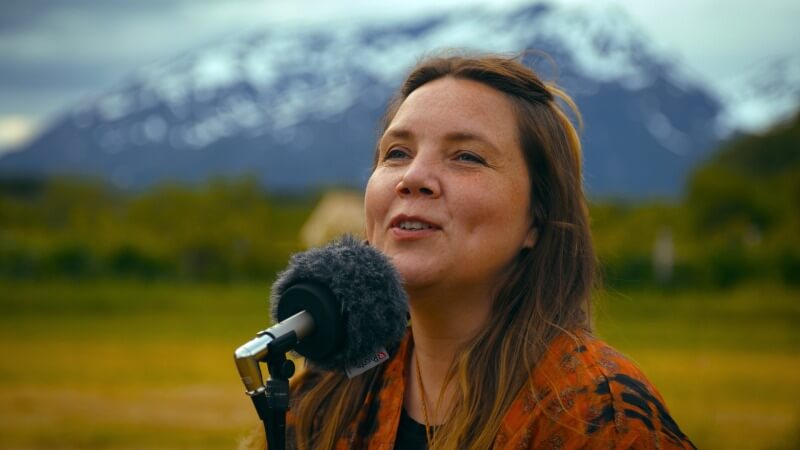
Held each summer in Sápmi, the ancestral homeland of the Sámi people, the Riddu Riđđu Festival in Northern Norway exists as a unique meeting point for indigenous artists from around the world. Framed by the majestic Arctic landscape and a sun that doesn’t set, the festival situates performances within the land itself. It was in this setting that the Paste team settled in for a session with Kajsa Balto, a singer raised in Oslo, dedicated to incorporating her Sámi heritage into her music as a way of honoring it and preserving it. Joined by her cellist Ragnhild Tronsmo, she delivered an unforgettable and intimate set.
Backed by immense snowcapped mountains and a seemingly untouched landscape, Balto began with “Rájás,” meaning “on the border,” a song written about the strength she inherited from her ancestors. Tronsmo opened the piece with a steady, driving cello, establishing a simple yet vital foundation for Kajsa to sing over. Throughout the song, the melody rose in both pitch and intensity, and the character of Balto’s voice gave off the strong impression of strength, pride, and triumph. As her songs are largely dedicated to the Sami people and the land in which they reside, it felt as if the Norwegian landscape itself was the fuel for the performance. Balto’s movements became more animated as the song progressed, her body responding instinctively to each dynamic swell.
She followed with a joik, the traditional Sámi form of song and vocal chant. As she explained to us between songs, this joik came to her father before she was born, while he sat by the Karasjohka River. He had thought that if he were ever to have a daughter, this would be her joik. Now she proudly carries it, identifying with the chant as strongly as she identifies with her own name. Tronsmo accompanied her, and it was truly a privilege to hear joiking for the first time in the native land which had originally inspired its composition. You could close your eyes and imagine the Sámi voices that had occupied the region for generations.
For someone new to Sámi culture, the experience of seeing Kasja Balto was quite an honor, as she clearly cares deeply about the preservation of her culture. Balto’s performance, entirely acoustic, was one we were lucky to record.
A large thanks from the Paste team to Kajsa Balto and her crew, as well as everyone from the Riddu Riđđu Festival who helped make such a great session possible. Keep your eyes peeled for more from Paste Studios’ “On the Road” series.


 Keep scrolling for more great stories.