Images: Kermit statue at Jim Henson Studio courtesy of Disney; Center For Puppetry Arts photo courtesy of the Center For Puppetry Arts; Kermit statue in storage photo by Garrett Martin
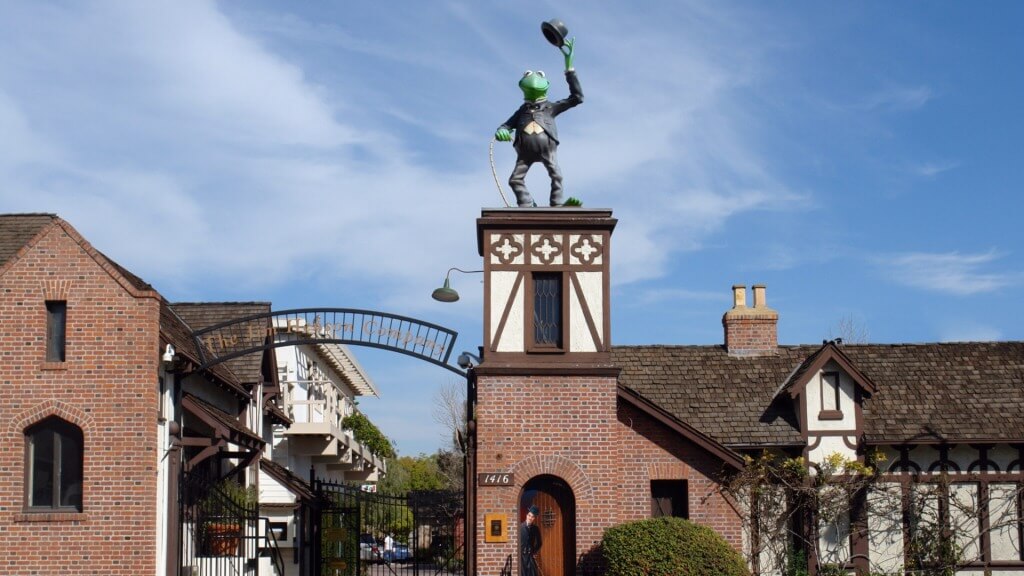
For 25 years an old friend was always ready to greet you near the corner of La Brea and Sunset. Kermit The Frog, 12 feet tall and dressed conspicuously like Charlie Chaplin’s Tramp, loomed over Hollywood from the entrance to The Jim Henson Company lot. Built by Chaplin to house his studio in 1917, the Henson company bought the site in 2000, installing Kermit atop its gate that June. There he stood, cane permanently bent, doffing his bowler to all who passed, until this past December, after a new ownership group led by John Mayer and McG bought the studio. Kermit came down from his perch and tramped east, leaving Hollywood for a city that’s a little smaller, a little slower, a little cheaper, and yet whose traffic is almost as unconscionable. Like much of the entertainment industry over the last decade and change, Kermit moved to Atlanta.
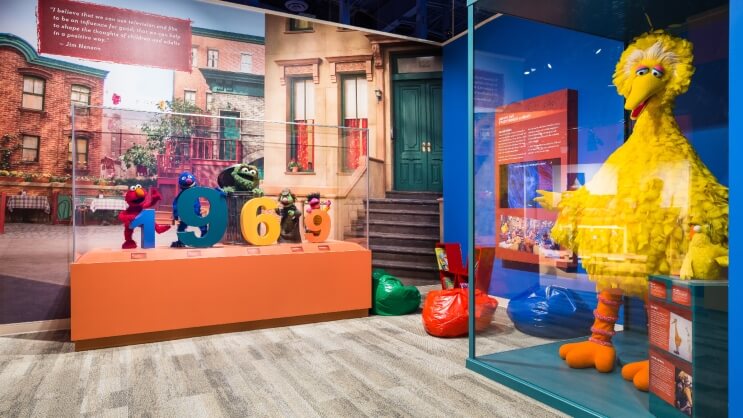
Atlanta might seem like an odd home for the former Hollywood landmark, but not to anybody who closely follows either the art of puppetry or the City Too Busy To Hate. For almost 50 years, the Georgia capital has been home to the Center For Puppetry Arts, the largest arts organization devoted to puppets in the country. Since Atlanta-based puppeteer Vincent Anthony opened the non-profit inside the old Spring Street Elementary School in 1978, it’s hosted a constant schedule of performances, workshops, and training classes, alongside a museum that houses the largest Jim Henson collection in the world. One of its two permanent exhibits is devoted to Henson’s career, with a revolving display of puppets and other artifacts from his earliest days in TV up through his final works. It was Henson, along with Kermit, who cut the ribbon when the Center opened in 1978; for its 10th anniversary, Henson and his Muppeteers returned for an event called The Muppets Take Atlanta. (A young Jeff Dunham opened.) In a sense, the Kermit statue has left one longtime home for another, joining the menagerie of Muppets, Fraggles, Sesame Street denizens, and other Henson creations inside the museum he helped open.
“After Jim passed, his family decided that they did not want to open a Jim Henson museum that they were going to run,” museum director Jill Nash Malool explains to The A.V. Club. “They wanted to share their legacy with people who knew about puppetry and museums, and we were already equipped to carry that on. We take very seriously that it’s our job to make sure that we share this amazing body of work with people of all ages. We own the largest collection of Jim Henson puppets, props, and costumes.” Now, with the addition of the statue, they own what Malool calls “the largest piece of ephemera” in the Henson collection.
The Henson exhibit pays tribute to the life and work of America’s most beloved puppeteer and his family and partners, but it also serves as an entry point into the wider world of puppetry—a role Henson himself proudly served throughout his career. When you enter the Center’s gallery you can either turn left for the Henson exhibit or right for the museum’s Global Collection; whichever one you choose, it ends right where the other begins, encouraging you to move straight from one to the other. If you come to see Big Bird, Miss Piggy, and Sir Didymus, you’ll most likely wind up in the museum’s other exhibit as well, getting a crash course in the history of puppetry and the many different forms it’s taken in cultures from around the world. The Global Collection features puppets from dozens of countries across every inhabited continent, including non-Henson superstars like Lambchop and Wayland Flowers’ Madame. It currently features a full-sized Slimer puppet used on one of the Ghostbusters films, his arms outstretched as if he’s about to give you a giant, slobbery hug. This collection explores the deep history and diversity of humanity’s attempts to recreate tiny little versions of itself, and is as visually striking and inspirational as any art exhibit.
The exhibits are only part of the Center’s mission. They host several puppet show performances a day, from an in-house company and traveling troupes alike. World premieres are common, as are beloved classics and adaptations of cultural touchstones; a live version of Rankin-Bass’s Rudolph The Red-Nosed Reindeer Christmas special has become an annual staple. And if seeing puppets in person sparks your creativity, you can learn how to make and perform puppets at the Center’s regular workshops.
On a recent weekday morning, several school buses of elementary school children arrived for a musical puppet show based on the Pete The Cat books. Chaperones tried to get them to sit criss-cross-apple-sauce for a pre-show head count, their visible excitement set to burst like a shaken-up can of Coke. A video promoting the show promised a light, jazz-inflected comedy ideal for kids. Next to the theater, in a small gallery devoted to temporary exhibits, the fifth installment of a series devoted to contemporary puppetry focused on Korean-born, Hawaiian-raised Tom Lee, with wooden puppets from Shank’s Mare alongside a life-sized horse puppet from War Horse. Parchment with personal notes and memories from Lee’s life ran along the walls of the gallery, and in one the puppeteer credited pioneering microtonal composer Harry Partch as an inspiration. From cute cats to difficult modern composers, the Center For Puppetry Arts proves that puppetry is truly for everybody and all ages, and not simply children. And soon it’ll have a new icon beckoning guests towards it, in the shape of the most famous puppet in the world.
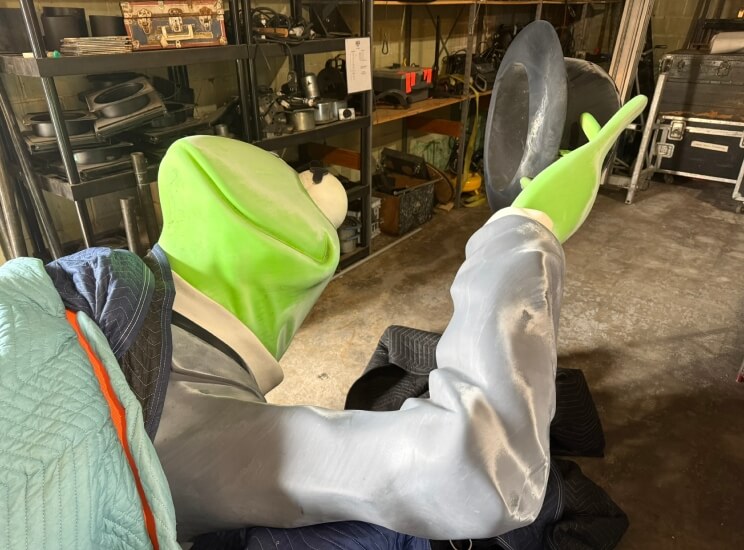
Today, the Kermit statue rests inside an undisclosed location near the Center’s main building, its 900-pound frame tucked under moving blankets atop a handcart. Two large, faded green feet and the hook of a curved cane are the only hint that a statue once seen by thousands of people a day temporarily resides in this Atlanta storage space. 25 years of exposure to the California sun have left Kermit blanched and chipped; it’ll undergo a full restoration before the Center puts it on display later this year. Malool can’t say when the statue will be ready for the public, or where exactly it will be placed, but its new spot won’t be as prominent as its last; although Spring Street is a major road in midtown Atlanta, it can’t exactly compare to the intersection of La Brea Avenue and Sunset Boulevard. Malool notes that the building’s roof probably isn’t structurally sound enough to support the statue, so they can’t really replicate the dramatic placement it enjoyed at the old Henson lot, but they think “it’d be really fun” if the statue was still visible from the street. But there’s no rush to pick out a final spot; Kermit’s not going anywhere. The Center For Puppetry Arts might not quite be the old digs, but for puppets of every stripe, it’s home.


 Keep scrolling for more great stories.