It feels like Nintendo will let Masahiro Sakurai get away with anything. Creator of Kirby, reviver of Kid Icarus, and host of a YouTube channel teaching game design between projects, Sakurai enjoys more creative freedom and visibility than most at Nintendo, thanks in part to being a freelancer with the company. When it was announced that his next game was a sequel to GameCube cult classic Kirby Air Ride, you’d be forgiven for thinking that he demanded making it after close to a decade working on the Smash Bros. series after 2012’s Kid Icarus: Uprising.
According to the man himself, Nintendo approached him with the concept. In the first of two roughly hour-long Directs he hosted for the game, Sakurai said that Shinya Takahashi of Nintendo and Satoshi Mitsuhara of HAL Labs “strongly requested” it while he was in the middle of DLC for Super Smash Bros. Ultimate. With Bandai Namco Studio 2 (the Smash Bros. development team), he began work on the game alongside the YouTube channel in 2022. At the time, it releasing so close to Mario Kart World wasn’t intended but with its proximity the main question around this game is: why get it when World came with the Switch 2?
In the launch year of a console, it’s important to put your best foot forward. To come onto shelves with your strongest swings and best arguments for upgrading. Beyond its stronger specs, the Switch 2, with GameChat, GameShare, and several multiplayer-centric exclusives, is aiming for co-op and competitive play to set it apart from the Switch. And racing games are the most obvious genre to make that case with: Mario Kart World and Fast Fusion at launch, Sonic Racing: Crossworlds, and now Kirby Air Riders have graced the system in the last six months alone.
It’s been 22 years since Kirby Air Ride came out on the GameCube, so let’s refresh ourselves on that first. The only Kirby game for that system, and the last time Sakurai worked on Kirby until now, in Air Ride you run races with four palette-swapped versions of Kirby. It’s best remembered for its City Trial mode, a concept Sakurai returned to with Smash Run in Super Smash Bros. For Nintendo 3DS; it drops players for five minutes into a city hub that’s dotted with power-ups to increase their stats for a final challenge. Meteors rain down and random challenges pop up to reward winners and participants with extra power-ups, but the focus is on upgrading your stats and choosing the right machine (the game’s equivalent to karts) for you. Maybe you spend the whole time optimizing for speed and the challenge turned out to be a Destruction Derby.
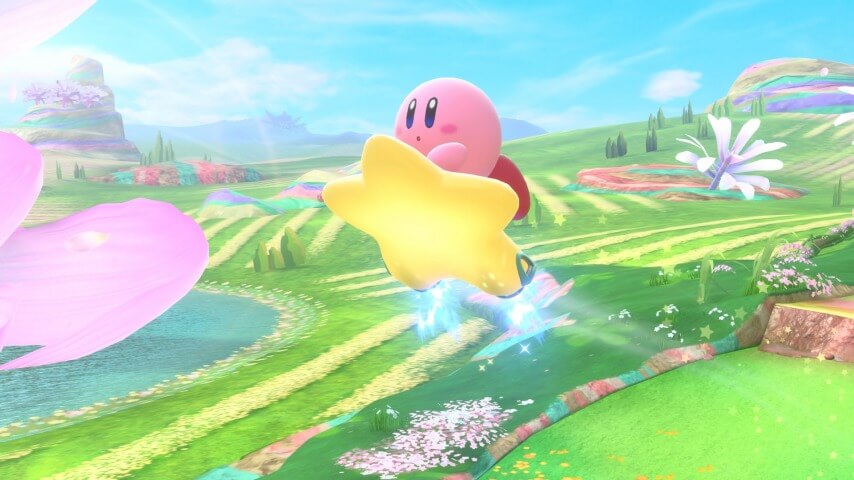
City Trial returns in Air Riders, along with every Air Ride course (standard racing fare). The game is a massive expansion on everything the original did, with a character roster spanning the series, vehicle customization, and so much more. The menus are as flashy and fun to navigate as you’d expect from a game directed by Sakurai, the haptic feedback is immaculate, and the whole game is a kaleidoscopic journey across Planet Popstar.
It’s long seemed like Sakurai can get away with more at Nintendo than a lot of designers and that’s most obvious when you check out this game’s customizable options. Mario Kart World doesn’t even have volume sliders, let alone the ability to choose the announcers from every supported language, remap the buttons within the game, change the brightness or text size or color filters, or steady the camera. That the game only uses two buttons outside of the menus (one to activate your Special Move and one for everything else) certainly helps with approachability. Sakurai and co have made the most accessible Nintendo-published game so far and that is commendable.
Also rare for Nintendo games is the Checklist. An achievement system returning from the original, each of the game’s five modes has a unique checklist to fill in and unlock various riders, machines, and cosmetics. Unlocking one reveals a mosaic tile on the grid and tells you how to unlock the adjacent tiles, even letting you jump into a specific track-rider-machine combination from the Checklist menu to try them. Although the online checklist doesn’t appear until you first connect to the internet, and only unlocks decals and other cosmetics, it is worth noting that a fifth of the game’s achievements aren’t doable without a Nintendo Switch Online subscription.
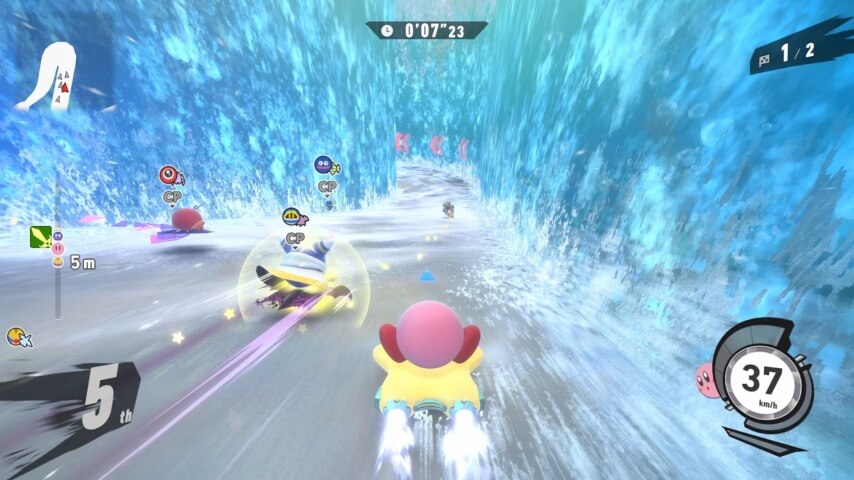
I’ve already talked about City Trial, so let’s break down the other modes. Air Ride is the game’s equivalent to a standard Mario Kart race, with laps of a course full of Copy Abilities to use against your rivals. Try to keep in your opponent’s streams when lagging behind and move the control stick left and right (or shake your Joy-Con 2 if you enable that in the options) to attack them. You will automatically advance and defeat enemies in your path but hitting the button at the right time lets you inhale and spit them out or take their ability, just like in the main series. Build up enough energy and you can unleash your Special ability, which ranges from an all-out attack, getting out of your machine and running or flying ahead of the pack, or littering the course with spicy curries. All nine tracks from the original have been remade in HD alongside nine new courses, unlocking as you tick off the checklist missions.
Top Ride is a lesser mode, at least in isolated play. Played from a zoomed-out, top-down perspective, you race around a track inspired by one of the Air Ride courses and compete for victory. Copy abilities are still in this mode, but special moves are not, so make sure to pick riders just based on the stats you want. The whole track can be seen at once, with the option to move the camera a bit, so this mode is best enjoyed by those into Scaletric slot racing kits as a child. None of the original Top Ride tracks were brought over, so this is also the slimmest mode in Air Riders with just nine tracks. Despite my disappointment in the limited potential of Top Ride, the game’s new mode manages to redeem it.
Road Trip is Kirby Air Riders’ story mode. Did you ever wonder why Kirby and co are racing around? Why, it’s because an ancient vehicle fell to the earth and was granted a wish by a sentient space station, of course! A single-layer only mode, Road Trip has players choosing from up to three options while racing through various biomes. These can offer items or different ways ahead, but are mostly challenges that take aspects from everywhere else in the game and recontextualise them as a novel challenge. Do a lap of an Air Ride track while trying to defeat a rival, eat as much food as possible in a Gourmet Race in Top Ride or take down one of the giant enemies that can pop up in City Trial all by yourself. The story itself is a thin excuse to race but the way Road Trip takes every part of the game and mixes it together is something I wish more campaigns would do.
I asked earlier why anyone would buy this for Switch 2 when Mario Kart World is right there, and there’s one simple answer: Kirby Air Riders is much better. Races are always chaotic, City Trial matches are always a frenetic rush and the game is always a joy to play. It can be overstimulating at times, with most of my play sessions not going over an hour, but with nothing in the game taking longer than five minutes at most, it’s easy to jump in for a couple of races or a trial before switching to something else. Mario Kart 8 was rarely far from my Wii U, and Kirby Air Riders is set to be a perennial title for solo or multiplayer play for me. If you’re on the fence about getting a Switch 2 or are looking for a new title to pick up, this is the best the system has to offer so far.
Kirby Air Riders was developed by Sora and Bandai Namco and published by Nintendo. It is available for Switch 2.


 Keep scrolling for more great stories.