Calico is a modern classic, with a cute theme of quilts and cats that belies the very difficult spatial and pattern-matching puzzle beneath. I have played it many times, and I like the game—but I also find that it’s really easy to sew yourself into a corner and end up unable to complete patterns later on because of choices you made eight turns earlier.
There’s now a sequel game to Calico, Knitting Circle, which is less punitive and easier to learn, although its tie to the first game is mostly limited to the theme and art (by Beth Sobel in both games). Knitting Circle also revolves around pattern-matching, but it’s more open in almost every aspect of the mechanics, and even if you can’t complete the particular pattern you wanted, you still have a chance to salvage that garment and score some points anyway—even if you have to take the penalty for knitting an ugly garment.
Players in Knitting Circle will take tokens in six different colors from the rondel on the table, collecting four each turn, and use them to sew garments of six different types, working on one or two at a time. They gain points from completing garments—which means filling most of the yarn spaces on the garment cards, but doesn’t require that you fill them all—and from meeting the criteria on your buttons, which relate to the colors you use, the patterns you create, and the garment type. You start the game with six buttons, two in each category, and can get new ones each round once you’ve placed previous ones on your garments. Play continues over six rounds, after which players discard any incomplete garments and score their garments, buttons, garment bonuses, and public objective cards (if used).

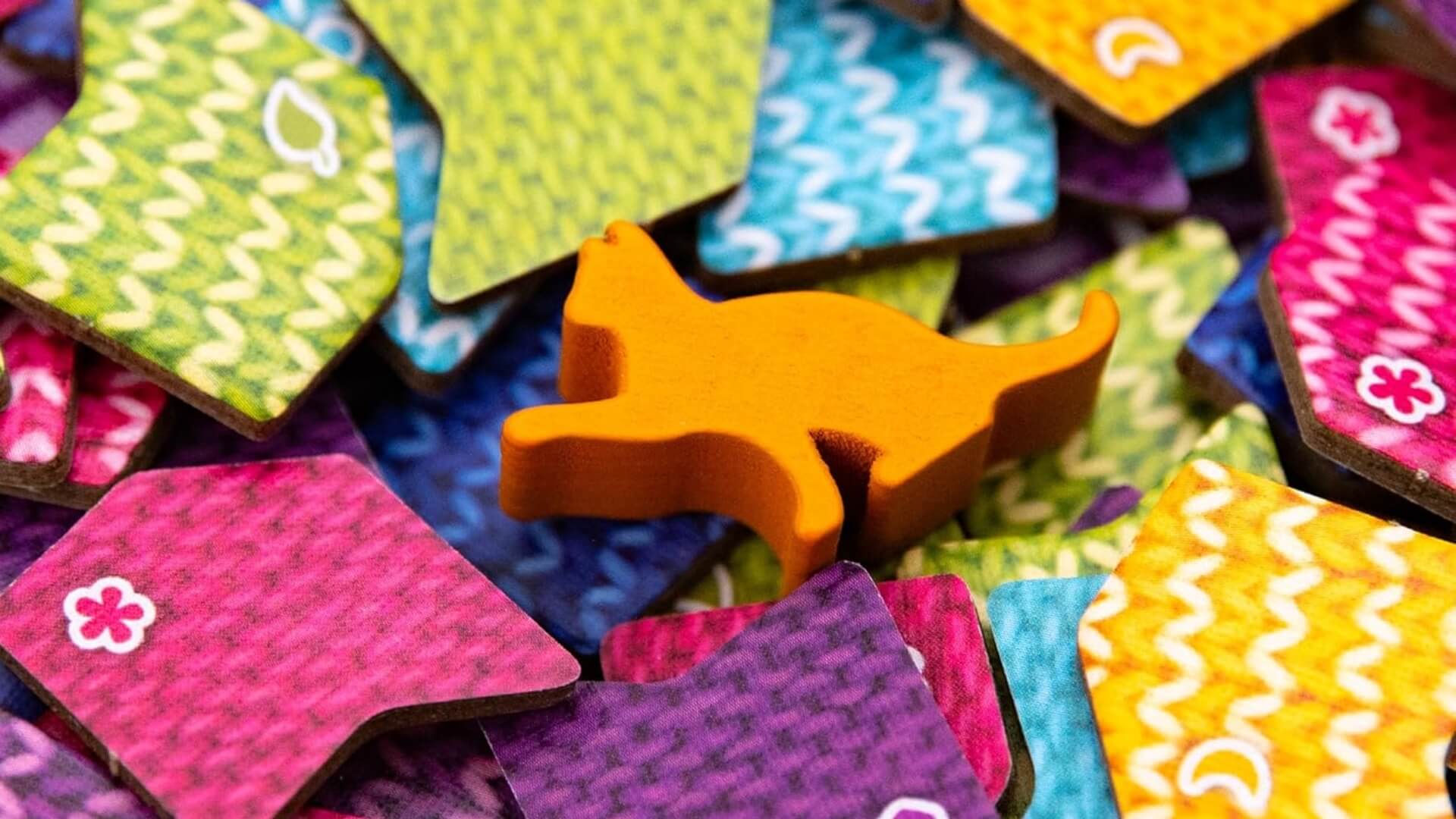
Each round begins with a drafting phase, where each player, in turn, moves their cat token one or two spaces around the rondel and takes one of the yarn tokens next to their landing space. Yarn tokens around the rondel show either their knit or purl sides and can’t be flipped unless you later discard another yarn token to take the flip action (flipping up to four tiles in your area). Once all players have four tiles, you move to the crafting phase, which happens simultaneously; players move all yarn tokens they wish over to their garments, placing knit tokens on knit spaces and purl tokens on purl spaces, and may discard a yarn token to take a new garment pattern, as long as they don’t already have two in progress. A player may also use a special “grabby pay” token at any time to reach into the yarn bag and select a token of any color, placing that token in their basket with either side up. Completing certain spaces on patterns unlocks a free yarn draw from the bag or a bonus grabby paw token.
The core concept in Knitting Circle is easy to understand: You collect yarn tokens and make patterns like solid, striped, symmetrical, or color blocked (at least two of each color) on the garment cards, which hold four to seven tokens. The buttons are similarly straightforward; some color buttons require just one color, while others require two or three, and are worth an extra point or two. The objective cards are not necessary in my view, and they’re by far the most complicated part of the game, while the garment bonuses are a little involved but are much more rewarding in the points sense and the psychological sense, as they give you more reason to try to craft specific garments or patterns for more points across your whole collection.
The drafting phase gets a little nihilistic with the fourth draws, as the odds are pretty low that there will still be a token you want and that your cat will be close to that space, so that last time around the table gets rather desultory; I don’t know if refilling the rondel would help or make the game too easy, but it would at least avoid that part of the game, which was notable enough for me to mention it here. I find the core parts of Knitting Circle the most compelling: It’s set collection where the order matters, with some flexibility to help you get a critical yarn tile at the right time. For four players, it’s 45 minutes to an hour, and the age range of 10+ on the box is spot on. It’s not a Calico replacement by any measure, but a companion game that takes the tension down a notch—in a good way. It’s cozy without becoming boring.


 Keep scrolling for more great stories.