Director Lance Oppenheim has always had an eye for theatricality. In his first feature film, Some Kind Of Heaven, his camera didn’t just capture a day in the life of seniors living out their golden years in Central Florida. He found artful compositions in the mundanity of regularly scheduled activities. He focused on everyday characters with painfully relatable problems, who leapt off the screen once they confessed that their picture-perfect paradise left much to be desired. In his subsequent projects, Spermworld, a look at the wild world of online sperm donors and the families who request their services, and Ren Faire, a Succession-like docudrama set at a Texas Renaissance Fair, Oppenheim and his creative team have taken the nonfiction form further and further from limited talking-head setups, and plunged their stories into color-soaked fantasias, where subjects enact their dreams on the stage that is Oppenheim’s frame.
Everyone wants to control the narrative, whether that’s in the last years of their lives, the process of family planning, or in determining whose head gets to wear the crown next. The same could be said about Oppenheim’s first fiction feature, Primetime. It was an accident that led Oppenheim to this film’s focus, another man who would be king. His wife, Abbey Rowe, gifted him a Cameo of To Catch A Predator host Chris Hansen after Spermworld came out in 2024. “I saw the Chris Hansen of my childhood, this sort of crusader, but I also saw someone new,” Oppenheim tells The A.V. Club. “I saw someone who had fully absorbed the cultural mythology that had grown out from around him and had embraced it. It was almost like watching a man becoming a meme.”
Long before Hansen became a meme, Oppenheim was fascinated by his show and its commanding host. “I was always obsessed with the theatricality of Chris Hansen’s performance and the way he would mix truth and fiction and artifice and reality with getting these actors to pretend to be children and these props and these sets,” he says. After seeing the Cameo, Oppenheim thought more about this early-aughts staple of appointment television and the contradiction of the showman and the crusader. “I was really curious about how he handled it, how he spiritually dealt with it, how doing this work for almost 20 years, probably spending more time doing this work than spending it with his own family and friends, how that would affect you,” he muses. “I just kept wanting to learn more.”
Oppenheim followed his curiosity, doing more internet sleuthing. He watched other Cameos where Hansen called someone a “certified flex offender.” He listened to the host’s podcast, Predators I’ve Caught, and subscribed to True Blue, Hansen’s true-crime streaming network. “Something overtook me, something really captivated me, almost just as a fan and a morbid curiosity,” he says. Even though his fascination was building, Oppenheim almost abandoned Primetime after running into fellow documentarian Lana Wilson at True/False, a documentary film festival. She told Oppenheim her husband David Osit was making a film about Chris Hansen called Predators. “David is such a great filmmaker,” Oppenheim says. “I saw Predators, and I loved it. There was a moment in time where I thought, ‘You know what? I’m sad that I’ll never get to make a movie about this fascination I have into this person, man, and meme.'”
Fate had other plans. Oppenheim met Robert Pattinson for another project and happened to show him that Cameo. Two weeks later, he ran into Pattinson’s producing partner, who sent him a script for the very topic the two had talked about. “Ajon Singh, the screenwriter, he tapped into something that was so up my alley, that felt closer to a fever dream than it did like a conventional biopic,” he says. “I really need to make this. I need to drop everything. This is destiny.”
As Oppenheim set about recreating the early-aughts television landscape where Hansen hit his prime, Oppenheim also created a version of TV history for himself, much to the confusion of online commenters pointing out discrepancies in the schedule. After all, Primetime is a story “inspired by” true events, not faithfully recreating them.
“I grew up watching shows like What Would You Do?, and Smallville, Lost, and Studio 60, which in the movie, we’ve sort of created a counterfactual version of history where Jeff Zucker cancels Studio 60,” he explains. “Merritt Wever’s in that show, which was fun. I moved the board around to just keep my favorite shows alive. I loved Friends. I know people always hate when I say this, but I grew up with Friends over Seinfeld. I watched Joey, of course, and I was devastated when it was canceled when I was in middle school. So, I kept Joey alive in the movie.”
Stepping back to the recent past of 2006 also meant revisiting the aesthetics of the era, diving back into an aesthetic rarely seen today. “We’re in this time period now where network news and even movies, there’s this muted kind of color palette,” Oppenheim says. “When you go back to 2006, things are so colorful, it almost can give you a stomachache. It’s like looking at cotton candy and eating it all the time. I liked that there was this kind of queasiness, this nuclear bomb of colors that was coming my way.”
Culturally revisiting the past also meant uncovering the psyche of a nation that regularly tuned in to watch Hansen catch the bad guy of the week. That anger bubbles up in uncomfortable ways in Primetime, like when a fan of the show tells Pattinson’s Hansen that he should just kill the men he catches, a chilling comment the host in turn tries to laugh off. “At least my cultural memory of it as a kid, we were in a war that everyone was confused by,” Oppenheim says. “As the war kept going on, we were unsure of what we were doing there to begin with, and there was a lot of rage and anger. I felt like the show, To Catch A Predator, was almost this perfect receptacle for all of these feelings of the time.”
It’s not a surprise to Oppenheim that people are still interested in Hansen and the show that launched him into the pop-culture stratosphere. Oppenheim points out we’re in yet another war, and there’s more rage and anger. “It feels like the laws of reality are governed by reality television more than anything now,” he says. “Chris Hansen’s still doing the show. He’s still doing the same thing. Not only him—there are other people who are doing it.”
There’s another reason why 2006 weighs heavily on the film, making it feel like a time capsule. “2006 was the last year we had before the iPhone was introduced into society,” Oppenheim says. “Network news was like a monoculture. The internet was different. Everything felt a little bit more centralized. I liked that there was something almost futile about the concept of netting this primetime slot. In this time period, that’s all that mattered for these characters.”
For both Primetime and Oppenheim’s next film, You Can See Everything, he rallied together many of his previous collaborators, including cinematographer David Bolen, composer Ari Balouzian, and producers Christian Vazquez and Rowe, to maintain his nimble yet creative approach to documentary. “I didn’t do any rehearsals with the actors,” he says. “I barely shot-listed, which I think made people freak out a lot of the time. I just wanted to get in the rhythm of what the performers were doing and give them a long leash so that I could move around and respond. I didn’t want to know what Rob’s next move was, and I don’t think he wanted me to know either. Merritt would never want to talk about what she would do before she’d get into a scene. Skyler, there’d be some back and forth, but a lot of the time, he would just add things. He’d ad-lib lines and improvise, and that kept things really fresh and alive.”
As a documentarian, the theatricality of To Catch A Predator fascinated Oppenheim. He describes the way Hansen mixed artifice and reality made the show feel otherworldly. “There was this sense of doom that kind of hovers over it,” he says. “It’s like a surrealist, carnivalesque sensation when you watch the show. I wanted to make something that was almost stranger than fiction that would push everything into a different, even more heightened space that borrows from the tenants of the previous movies I’ve made. I love the idea of cinematically expressing that, seeing the dream turn into a nightmare.”
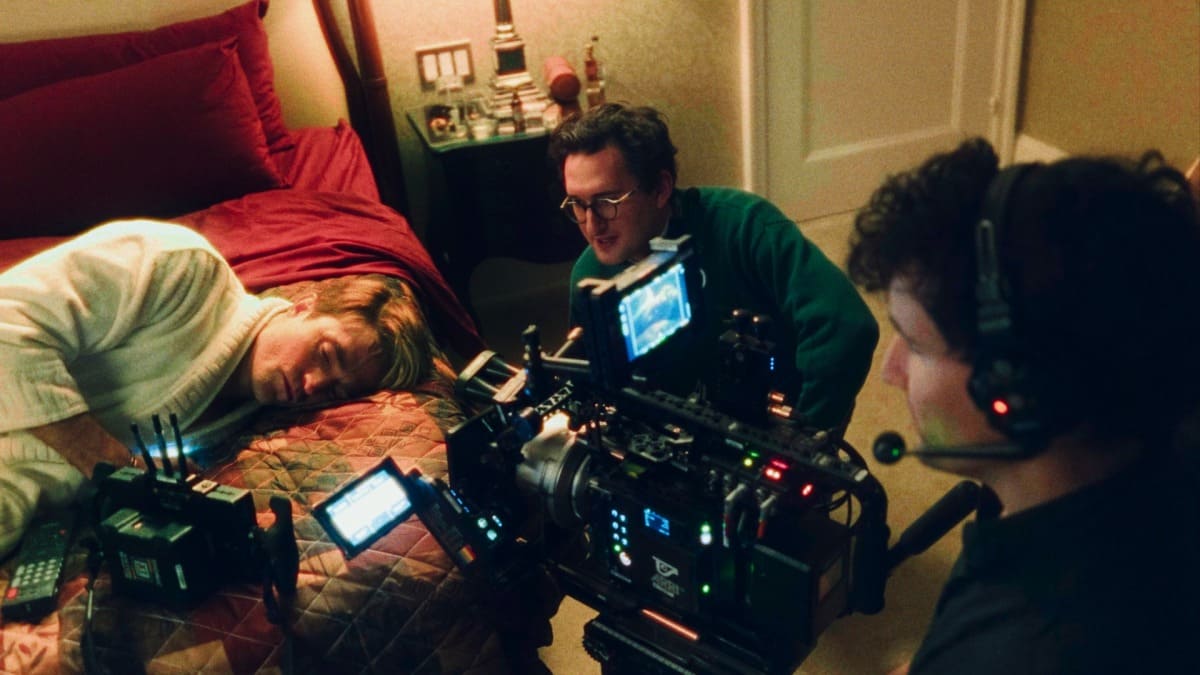
Part of Primetime‘s theatricality also lies in the choices Oppenheim and Bolen made to recreate the broadcast television quality of the production. Oppenheim said he filmed in 30 different camera formats, sometimes mirroring the chaos of Hansen’s own shoots, and filmed when the cast and crew weren’t expecting it. “Each movie has to have its own aesthetic value system,” Oppenheim says. “I’d say this movie belongs in a family with my other films, which I consider a form of docuphantasia. You Can See Everything is a totally new thing that was really exciting and inspiring. It could only have come about through the collaboration I had with Nathan [Fielder]. We had to come up with [that] just by virtue of what we were doing and what we were trying to capture. We had to come up with an entirely new aesthetic that was dictated by the limitations and the experiences of being in that room with those subjects.”


 Keep scrolling for more great stories.