It makes sense that Lanterns could only give us what we wanted once one of the main characters was dead. “The Jordan Boys” plays with those expectations—and meets them—while maintaining the series’ tone of regret and loss and time irrevocably gone.
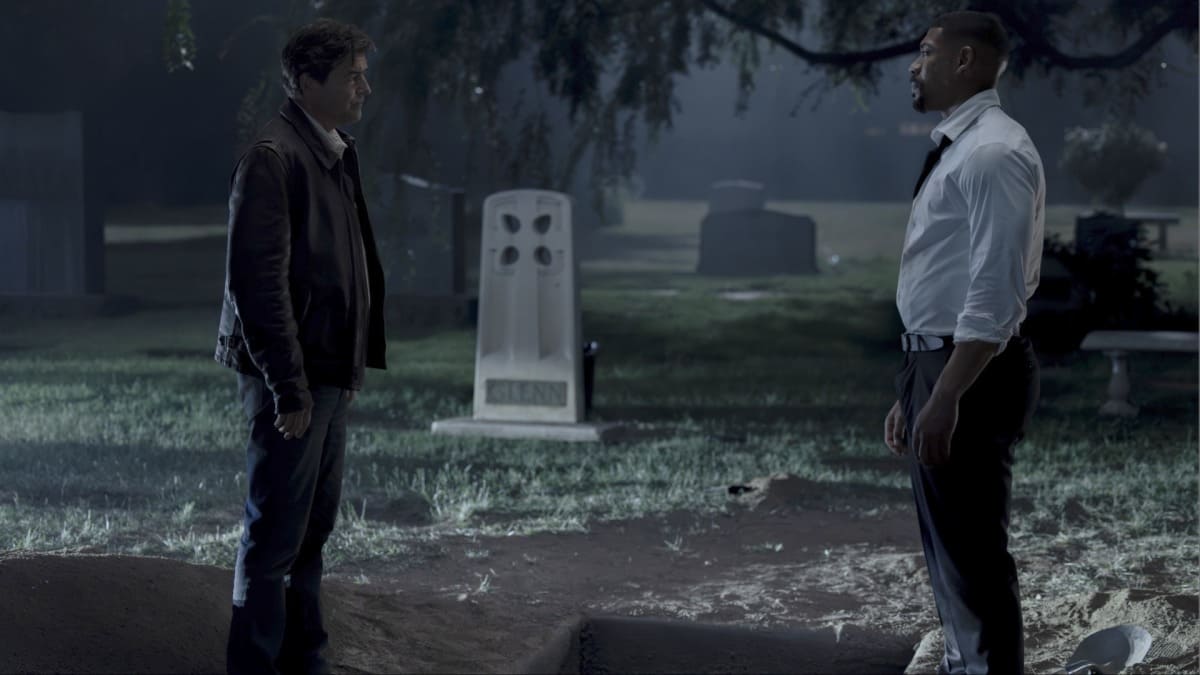
Hal Jordan is back in the form of the Halogram, this version allowing Kyle Chandler to shed a decade’s worth of pain to present a Hal more in line with the adventurer comics fans are used to. He’s reckless, refusing to help John break into The Fortress Of Storage until he gets to see Kerry, but it’s a more fun kind of reckless. Freed from his 10-year dormancy only to peer down into his own grave, this Hal is confused and pissed off, certainly. But he’s also not yet crushed and defensive and, well, afraid.
The dynamic between the Halogram and John bristles with the sort of crotchety banter the trailers deceptively frontloaded. John is blessedly relieved that he can finally shut his mentor up just by wishing it, realizing that he can banish the stubbornly insistent Hal by belting out some Outkast. Hal is the cheeky wiseass veteran Lantern—completing the whole buddy cop dynamic promos for the show teased us with—but his position as someone not quite alive (and fully shocked by John’s revelations about his fate) leaves Chandler acres to stretch out his characterization.
And then there’s Kerry, trying to keep a lid on the town’s volatile reaction to having another Green Lantern situation in its midst, all while preparing to host 100 people at her house for a party celebrating Noah’s hyped up college football decision. Kelly Macdonald’s been outstanding, even if Kerry’s status as the non-super of the central trio shunted her aside more than her male colleagues. But watch her eyes in the scene where John, blackmailed into introducing Hal’s “ghost,” tries to prepare her. If there’s a way to play a scene where someone channels the mix of emotion you feel when your dead lover (for whom you have deeply complicated feelings) appears in front of you while clearly not being the exact person you knew, then Kelly Macdonald finds it here. (The little flinch after she reaches out to touch Hal’s face is eloquently heartbreaking.)
The Halogram asks John on the way to meet Kerry, “I was in jail? I was in love?,” and the second question registers as more inconceivable than the first. Chandler, too, is remarkable in “The Jordan Boys,” tiptoeing the Halogram through a tangle of thoughts and emotions only a sci-fi scenario can truly create. The Halogram (I’m just calling him “Hal” from now on), is stubborn, ornery and filled with pain the likes of which the episode finally reveals. But he’s also a hoot, with 10 years of encroaching obsolescence and exhaustion shed in a green blip of fleeting new existence. (The episode makes clear the ticking clock on Hal’s five percent battery life, with no lantern around to recharge.)
Aaron Pierre is freed up as well, clearly relishing his new control over the guy who, as he notes in “The Jordan Boys,” ruined his military career, crushed him in two separate car accidents, and generally shirked any responsibility to prepare him for the destiny John had been preparing for his whole life. John’s rigidity has softened before. The Guardian was genuinely taken aback when John offered sincere sympathy for the death of one of her fellows, and here John—in the middle of a fraught and dangerous mission on another planet entirely—does the same when Hal confesses that his fighter pilot father killed himself. If Hal enjoys his second chance, then John warily exposes how much he truly wanted a mentor more like this one.
“The Jordan Boys” begins with the young Hal (Henry Samiri) battered and bruised for not giving up the baseball when his coach tried to take him off the mound during a game. Hal’s father (Jake B. Miller) first apologizes for his son’s obstinance and then, upon discovering Hal was pitching a shutout, gets into a fistfight with the much bigger coach. Miller’s swaggering Matthew McConaughey vibe is exactly what you’d expect a 1970s hotshot pilot to be, and exactly the man a young Hal Jordan would emulate. But icing down their respective bruises with rocket pops outside the airplane hangar where Martin Jordan performs his death-defying feats, the father tells his son that his own father killed himself.
All this father-to-son generational tragedy is manipulative in theory. In practice, it works. (Despite Lanterns once more getting too on-the-nose with needle drops—Queen’s “Father To Son,” really?) Deconstructing further our expectations of heroism, super or otherwise, it turns out Martin’s pilot father left him a note in a locked safe explaining how his own feelings of inadequacy (as a man, husband, father, hero) grew until, as Hal finally tells John as they row a boat across an alien lake, “He couldn’t bear to let us see him.” Martin left Hal a note, too, this last father-son moment occurring right before the accident young Hal knows wasn’t an accident at all, even as no one else does. As Martin tells his son, not meeting the boy’s eye as he gives Hal a key, he has a safe as well, one only Hal can know about. “Its not something she can carry,” Martin says of Hal’s mother, “But you can Hal. It’s in your blood—Jordan boys’ legacy.”
If the trauma is too pat, the actor redeems it. Chandler’s face as Hal looks away to the ruined nothing of an alien world is that of a little boy, brows bowed, eyes darting. He’d asked Kerry earlier if he’d told her about his father, and the knowing glance there indicated that their closeness was the only place he felt safe enough to tell the truth. As Hal finally tells John, not meeting his trainee’s gaze, “I’m not fearless, I’m broken.” Again, only in the speculative reality of comics could such an outlandish circumstance exist for an actor like Kyle Chandler to explore so powerfully.
If there’s a weakness to “The Jordan Boys,” it’s on the periphery. The Maggie blackmail subplot is the sort of effortful complication that could be avoided with a conversation between John and Kerry. And the final confrontation on that alien planet (there’d been one of those portals in the guise of a ball of goo in the storage locker) should land with more impact, considering the big reveal that the escaped Sinestro is camped out there.
I’m thrilled that Ulrich Thomsen is going to match wits once more with this younger, less experienced Hal, and the way that John and Hal’s grudging buddy relationship allows them to get the drop on the ring-less supervillain is satisfying stuff. (Outkast to the rescue!) “The Jordan Boys” introduces the possibility that Lanterns is about to take off, literally and narratively, into the sort of universe-spanning adventure fans were anticipating.
But look around—the first world we see is Antaan’s. It’s dead and desolately howling with remnants of the fear gas the Manhunters used to exterminate an entire world full of people. The spectacle comes in John’s shocked reaction to the sight of abandoned, ruined cities in the clouds as he pulls a shattered alien skull out of the lifeless sands. Stubborn as Hal Jordan (any version), Lanterns‘ vision of the superhero story strips away the colorful constructed narrative like a costume left to mothball. And it takes skin with it.
Stray observations
- • Aaron Pierre’s delivery of “Separate incidents, motherfucker!” is the sort of catharsis I imagine John has been waiting to vent upon his mentor.
- • Young Hal, listing off the teammates who’d pummeled him to unsuccessfully pry the ball from his grasp, notes, “And both Raffert twins—I think.”
- • Martin explains how his father had a genuine safe to lock away the record of his perceived failure. “Literal guy, your grandpa.”
- • Hal asks if “the squirrel” came to his funeral, and catches John lying when he sets a Mogo trap. “Mogo’s a damn planet!“
- • The saga of John’s next-level Lantern abilities continues, as Hal marvels that John can still manifest him without the ring. Not sure how thrilled I am with this idea, but Chandler makes Hal’s real pride at John’s feat deeply affecting. (As John says, bashful at his vulnerability, “Hal never complimented me before.”)
- • One more time, Kelly Macdonald is just terrific playing about six levels at once in the scene with Hal. Her simple goodbye, “It’s nice to see you again,” fills pages.
- • “You got a fucked up brain, man.” “Yeah, and there’s a bullet in it.”
- • Hal’s guilty fear that older Hal left John a key to a safe sees Chandler once more killing it with unspoken depths.
- • Poor Guy gets another oblique put-down, as Hal blurts, “A gym teacher with a gold tooth? You gotta be shitting me.”
- • Oh, and Noah ostentatiously postpones the “hat ceremony” announcing his future that literally the whole town has assembled to hear so that he and the team can concentrate on their shared goal of winning the big game. This kid is, as Kerry hints, angling for a career in (presumably Republican) politics.
- • Asked about older Hal’s true thoughts on John, Kerry explains, “You talked about John like a football team who’s always giving you hope and then letting you down. He’s the TV you yell at every Sunday but you never miss a game because, you know, big fan.” Ow.
- • Hal tries to excuse busting in on Kerry by calling his gesture romantic.
“Romantics don’t brag about being romantic, Tex.”
- • Okay, I have to say it: As subtly excellent as Aaron Pierre is on Lanterns, the way the Shakespearean actor is tasked with pronouncing “ask” as “axe” keeps snagging like a thorn.
- • John’s fear gas nightmare could have been freakier, but it got the job done, as countless apples bob up all around his tiny boat and his father and younger self accuse him of being afraid.
- • Like John’s reaction to Hal’s praise, Hal reacts to John’s heartfelt sympathy about his father’s death with an unspoken gratitude pointing to these two finally getting on the same page.
- • The symbolism with young Hal’s baseball is a bit on-the-nose as well. Coming straight from his father’s funeral to pick up the weight his father called too “fucking exhausting” to carry all his life (complete with a Queen reprise) shouldn’t work as well as it does. But it does.
- • Next week’s the finale, gang. On the subject of who killed Hal, I haven’t gotten the screener yet (promise), but it seems like there’s only one real possibility—an unsurprisingly painful one.


 Keep scrolling for more great stories.