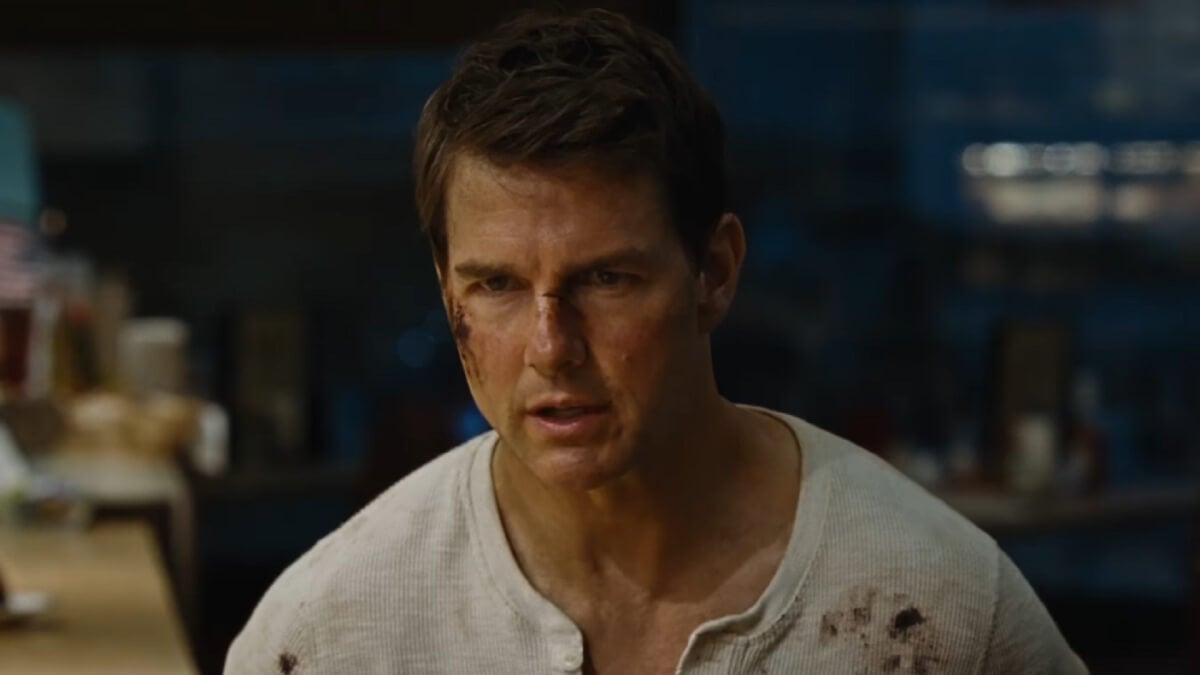
Beyond the strictly literal sense of who’d stop a sunbeam from hitting who, it’s a little wild that Alan Ritchson’s Jack Reacher ever managed to eclipse Tom Cruise’s. Ritchson was, after all—and with all due respect to Blue Mountain State fans—a relative nobody when he signed on to the TV version of the franchise in 2022, whereas Cruise was, well, Tom Cruise when he made his first of two movies based on Lee Child’s novels in 2012. Child himself acknowledged (in a recent Collider interview timed to the latest Reacher book, Chain Reaction) that Cruise’s movies made him a ton of money, rocketing the tale of his itinerant former Army officer into the public consciousness, and his back catalogue onto the bestseller lists. But it was also Child who killed Cruise’s franchise dreams, and he says he did it due to clear and clamoring fan demand.
This is not the first time, admittedly, that Child has talked about the ways Cruise and his relatively teensy proportions were not necessarily a fit for fans’ mental versions of Reacher, a man described in Child’s own prose as “one of the largest men… ever seen outside the NFL.” He admitted as much way back in 2018, while casting was still running for the Reacher TV show. Now, though, the author’s admitting that he was also the one who pulled the plug on the Cruise films in the first place, exercising a contractual veto he’d been given before a third movie in the franchise could be made, and that fan reactions heavily informed the decision. Although he was very comfortable letting the movies exist outside his books, which he considered the core Reacher experience, Child says fans disagreed: “The readers did not think the same way. They felt very betrayed that the movies had not mirrored the books more exactly.”
Child is quick to note that it wasn’t just Cruise—who he’s said he personally enjoyed working with—that led him to axe the movie franchise. Jack Reacher: Never Go Back came out in 2016, at a time when the rise of streaming had already begun, and the author says his books made a lot more sense stretched out into a TV show than they ever did on the big screen. (“You can tell the whole story,” Child notes, “All the light and shade, all the quiet parts, all the fun parts. It doesn’t have to be rammed together for 90 minutes of content.”) There was also the economic angle: Cruise, in full action star mode, eats up a lot of a film’s budget, to what can often feel like diminishing returns. Or, in Child’s phrasing: “What actor is worth a $200 million investment? Whereas with television, the platform pays it, and you can have anybody. You can have total unknowns. The star on television doesn’t really attract either the audience or the money, and so we had a completely free hand for casting.” Which has, of course, paid off pretty handily for all involved: Reacher has been a big enough hit that Prime Video is about to be five seasons and a spin-off deep in it, Child’s books are selling incredibly well, and Ritchson is now a certified Big, Famous Man. A pretty good deal for all involved (except for Cruise, who isn’t exactly hurting for work in any case).


 Keep scrolling for more great stories.