Joseph Goebbels, Nazi Reich Minister Of Propaganda, knew that entertainment was more effective than propaganda. “At the moment that propaganda is recognized as such, it becomes ineffective,” Goebbels said in a 1937 speech. “However, the moment that propaganda, message, bent, or attitude as such stay in the background and appear to people only as storyline, action, or side-effect, then they will become effective in every respect.” But messaging through entertainment is seductive. It’s diverting, less obvious and more palatable, hidden in the everyday. Good entertainment is the spoonful of sugar that helps the fascism go down. Luckily, Melania isn’t any good.
However, should you find the fortitude to watch Melania once the documentary inevitably hits Prime Video, there’s much to learn about how American fascism is currently using cinema. As the premier manufacturer of caffeine-free Michael Bay imitations, Brett Ratner (disgraced director and friend of the Trump family) attempts to use the most basic storytelling grammar to write his run-on political sentence. Melania Trump is contextualized within a hero’s journey and surrounded by movement as she struts through set pieces from American history. Politics dissolve into the background, like eugenics into Ratner’s X-Men: The Last Stand. The definition of an American becomes akin to the French taxi driver from Ratner’s Rush Hour 3, who swears allegiance to Starbucks and bloodlust. To be American isn’t a state of citizenship; it’s a state of mind. Yet Ratner neglects to include other crucial elements of red-blooded four-quadrant fare, such as a plot built on cause and effect, centered on a likable protagonist. Observing Melania‘s uniquely legible failure reveals a clear attempt by the current administration to use the elements of American action filmmaking as a corrective framework for how it would like to be viewed by the public.
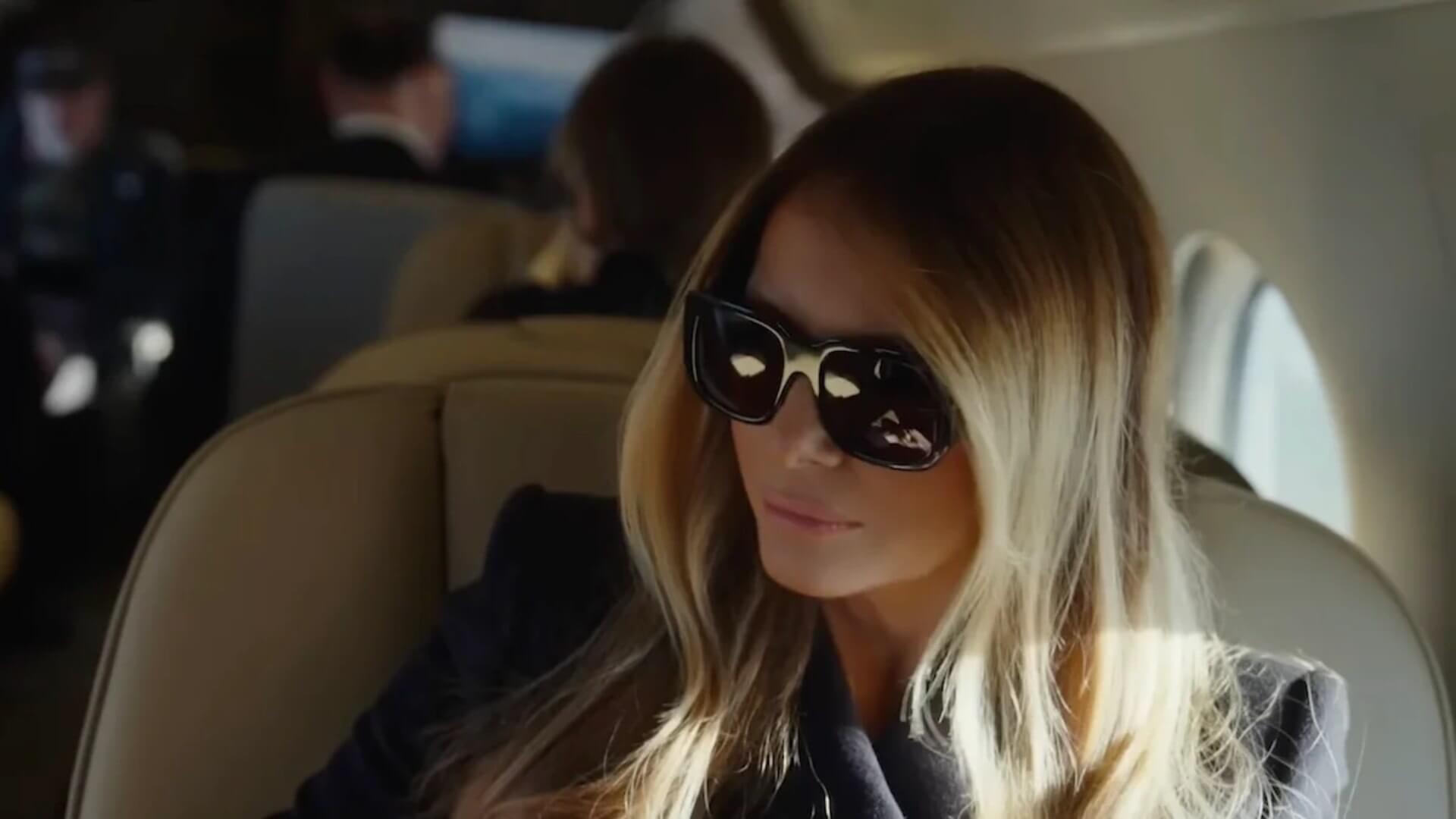
Melania opens not unlike Ratner’s 2014 Hercules, with a whooshing push of the camera and a voiceover narration telling us that what we’re about to see is the truth behind the talk. In watching the 20 days leading up to Donald Trump’s second inauguration, the audience is (ostensibly) going to see The Real Melania. Her hero’s journey is an odyssey of hors d’oeuvres and encounters with sour-faced liberals as she makes her grand return home. To build the sense that we’re witnessing a high-heeled empress kick open the doors of power, Ratner keeps his camera moving at all times. Like any true American imperialist, he loves drones; drones that sweep over large expanses or in, above, and around motorcades. It’s a reminder that the aesthetics of contemporary action films grew from a wave of commercial directors trying to sell products. Ratner attempts the same thing here, selling America’s Eva Bronzer.
This sponcon slickness contributes to the modern “aestheticization of politics”—an idea coined during the Nazi regime, where an injection of spectacle makes a fascist leader or idea seem righteous or divinely untouchable. And Melania is a high-gloss show-and-tell special. Ratner delights in speed and movement, attempting to make even the most mundane trip to the airport feel urgent. Melania may just be going to the elevator, but the camera tracks her as if she is heading to a top-secret lab. By seeming to always be in motion, Melania creates the illusion of importance while obscuring ineffectuality, similarly to how loud public speeches attempt to drown out a stagnant economy and gridlocked government.
But if Ratner and Mrs. Trump wanted to produce a thrilling biography, Melania is missing some key elements. The best action films, perhaps the best films in general, proceed with a domino-like logic. But Melania is simply around, following a highly manicured social calendar clattering undynamically toward a foregone inauguration. Melania‘s draw is not what any insider access might reveal, but rather that the access exists at all. And no one is more excited about the privilege than Ratner, who eagerly and giddily inserts himself into his own documentary. He is a more visible presence than the American public, and a more revealing figure than his subject.
Apart from some voiceover, there’s little substance to any feel-good Cinderella story about a little immigrant girl from Yugoslavia. When Melania isn’t talking to one of her sinister coterie of white gays about fashion, she’s waxing in vague poetics about traditional family values—all while working around the clock, never in the same room as her family for long. She rambles about her role as a supportive mother, though her son Barron does not appear in the documentary. Such character neglect is Ratner’s biggest misstep. Sneaking your fascism into a mainstream template demands a likable, charismatic figure whose sacrifice and vulnerability make them worthy of leadership. But in trying to avoid making Melania unlikable, the filmmaker has forgotten to make her likable, or even recognizably human. He films his titular subject like a beautiful stranger in a music video.
This is likely because Ratner has never considered the perspective of a human woman before; in his films, they’ve always been mere playthings. He can only contort Melania into the mold of one of his busy businessmen, like Nicolas Cage in The Family Man or Ben Stiller in Tower Heist. If there is one moment of revealing, personal, mask-off reality in Melania—the kind that documentaries make their bread and butter on—it’s when Melania suggests putting the word “unifier” in the president’s inaugural speech. After trying it on and finding it fitting, Trump turns to the camera and tells Ratner to edit out her contribution. It’s an unremarked-upon moment in which the film captures the Trumps engaging in what passes for their husband-and-wife dynamic, and it’s also a rebuttal to anyone who tries to claim that Melania doesn’t participate politically at the White House. It’s the one moment, in fact, where Mrs. Trump appears worthy of a documentary at all.
Much of the rest of the film is notable not for who is in focus, but who isn’t. The immigrant workers who make Mrs. Trump’s lifestyle possible are trotted out for their boss’ vanity project, forced to smile for the camera in their face. Ratner reduces their stories to cliché soundbites about the American Dream in the service of making Mrs. Trump look like a benefactor for “the good” immigrants who come to this country “the right way.” On the opposite extreme of dehumanization, is the abstraction of Black people to the acoustic level—you won’t see Black people in this film, but you’ll hear them on the soundtrack. It’s a brazen moment of cognitive dissonance, one highlighting the inherent contradiction when white supremacists try to listen to good music.
By removing all the people with differing points of view, Melania lacks a clear villain for its hero to fight and for its audience to rail against. Sure, she encounters what most people would consider a rogues’ gallery of ghouls like Hervé Pierre, Elon Musk, and Jeff Bezos, but those are her friends! That doesn’t mean dissent is wholly absent, however. We can feel its threat when the Trumps debate whether to get out of their car during the inaugural parade. Hunched intently over a table like she’s being briefed for an impossible mission, Melania is terrified of stepping outside. The fear is clear on her face as she imagines all the places an active shooter could be. She never addresses who might be shooting at them or why, or even why she might fear this possibility in this specific moment—which might invite acknowledging some kind of national disharmony—but only she tells the camera that she’s relieved she gets to stay in the car, away from the preying sights of an imagined sniper.
The best way to watch Melania is to follow her lead and look paranoidly at the regular people in the background. Though unintentionally included, one can spy resistance in the nauseated faces of the folks in the frame’s periphery. They may appear only briefly and barely register on camera, but their dyspepsia—dismissed yet still recorded by the camera—indicates cracks in the film’s utopian narrative of American fascism.
In Brett Ratner’s complete inability to make Melania an entertaining work of fascist filmmaking, we can see how the sausage is made. This isn’t to say that it would be better if Ratner were Leni Riefenstahl, or to argue that we deserve better Nazis. Rather, the film lays bare how easily the most popular Hollywood tropes can be put to this use. Action cinema loves a celebrity star, especially one who appeals across class lines. Its populist heroes’ journeys idolize a bootstrapping leader. Drone cameras coat the everyday in the aesthetic of war. Minorities are cynically included, only for marketing purposes. By putting all these unsavory elements into the transparent form of a pro-regime commercial, whatever subconscious power they might have held vanishes as propaganda overwhelms entertainment.


 Keep scrolling for more great stories.