Samus Aran’s voice is very rarely heard. The intergalactic bounty hunter from the long-running Metroid series has barely spoken in any of the games in which she appears. She doesn’t speak in any of the original Metroid Prime trilogy of games, even though there are moments when other characters do speak, at times directly to her. In keeping with that trend, Samus doesn’t speak in Metroid Prime 4: Beyond, either. The problem with this is that in Prime 4, so many other characters speak—and, indeed, speak directly to Samus and ask her questions. Samus’s silence in the face of direct questions often scans as comedic, but at other times, it just seems rude. Surely that can’t have been the intent.
How did we get here? Why would game developers be hesitant to let Samus say anything? I suspect that the series’ most widely disliked game, Metroid: Other M, has a lot to do with it.
Over the many decades of Metroid games, Samus’s silence has usually made sense in context, especially given that in many games, she’s alone and therefore has no one to talk to; unlike some video game protagonists of the modern day, she doesn’t talk to herself. Her foes in most games are aliens that do not speak a human language, so it wouldn’t make much sense for Samus to exchange one-liners with them in a fight. Samus’s greatest foe, the space pirate Ridley, is a big purple dragon who has never spoken in the games. (Fans might be surprised to learn that Ridley can talk; he does so frequently, including directly to Samus, in the semi-canonical Metroid manga, parts of which inspired the plot of Other M. But we’ll get to that.)
In the first two Metroid games ever released, there’s no in-game dialogue text, not even succinct mission logs. The player therefore has no idea what Samus is thinking at any given moment, or what her personality or voice might be like. Back in those days, Metroid players were free to project their own feelings onto Samus, imagining her hesitations or fears, or her confidence or even arrogance. There was nothing to contradict any of these disparate interpretations that fans had formed about this mysterious woman, and that was the beginning of what would become a series-long problem for a character who was about to start talking.
Super Metroid starts off with a brief, businesslike mission log from Samus, so short that it’s easily forgotten. Metroid Fusion is the first game with significantly long mission logs. Fusion is the moment when Samus begins to express actual emotions and personality by way of these written logs (albeit still without voice acting). She describes “a nameless fear in [her] heart” upon being called to her in-game mission, for example, and she has frequent conversations in the game with a computerized AI that instructs her where to go, and she often expresses frustration with the AI and questions its orders. Fusion was the beginning of Samus Aran having a lot to say, and a personality to go along with all of that dialogue. She could be headstrong and stubborn, as well as sentimental and even fearful at times. She seemed human; fans and critics loved it.
The first Metroid Prime game, in which Samus doesn’t speak at all, came out the same year as Fusion and was developed by a different team. Prime 2 and Prime 3 were both released before Other M, and in all three Prime games, Samus didn’t speak. This wasn’t so strange, though; even though Samus had done quite a bit of talking in Fusion, none of it was “out loud” (voice acted). No one had ever even heard what Samus’s voice could sound like, outside of the combat barks performed by Jennifer Hale in the Prime trilogy, which are of course not dialogue. In Prime 3, there are several other characters who meet and talk to Samus, but she doesn’t respond; these scenes go by quickly enough, however, that it just seems like Samus is kind of an awkward person. And again, this was still a time period in which Samus spoke very little, if ever. Heck, even if you had played Fusion, you could easily thumb through the brief moments of dialogue, or ignore it entirely; it’s not like there were unskippable cutscenes.
Metroid: Other M changed all of that in 2010. The game was directed and written by Yoshio Sakamoto—the same man who had directed Super Metroid and Fusion, as well as Zero Mission, a remake of the very first Metroid game that similarly adds in a couple of mission logs for Samus. Sakamoto didn’t work on the original Metroid or Metroid 2, in which Samus doesn’t speak at all, and it’s clear from the games that he has directed that he’s very much interested in having Samus speak more. Sakamoto also did editorial consulting on the Metroid manga that includes characters like Ridley speaking aloud, not to mention tons more talking from Samus.
In Metroid: Other M, Samus expresses far more hesitation and fear than she has in any previous series entry, but this time, she also had a voice actor to accompany those feelings, which made them feel even more intense. Also, these were 3D cutscenes, so therefore much more memorable to experience. Samus spends the game deferring to the whims of her commander Adam Malkovich, a relationship previously alluded to in Fusion. Except in Fusion, Samus would often argue with a computer whose bossy nature she likened to Adam, whereas in Other M, she doesn’t seem too keen to argue with the real Adam. This was, apparently, how Yoshio Sakamoto saw the character all along. It wasn’t how most fans had ever seen her, though, and the argument wasn’t winnable on either side. Sakamoto had been the one writing Samus ever since she had first spoken in a game, so didn’t he know her best? Or did we, the players who had projected our own feelings onto a mostly-silent protagonist, know her better than he did?
This unwinnable argument about who Samus truly is, and what she might say if she were to speak more often, has fascinated me ever since Other M came out. When I played Metroid Dread, a game that Yoshio Sakamoto also worked on, I spent the whole time wondering if Samus was going to talk, and what her personality would be like if she did. Because I knew Sakamoto had worked on the game, I figured the words “Other M” had probably been uttered in various stressed-out development conversations. In Dread, Samus only speaks one time, in the language of the Chozo. The decision to make Samus so laconic made sense, especially in a post-Other M world where any wrong step could reignite fans’ ire over the heroine’s portrayal. If you barely have Samus talk at all, then you can’t be criticized for it, right? At this point, it’s the least offensive option.
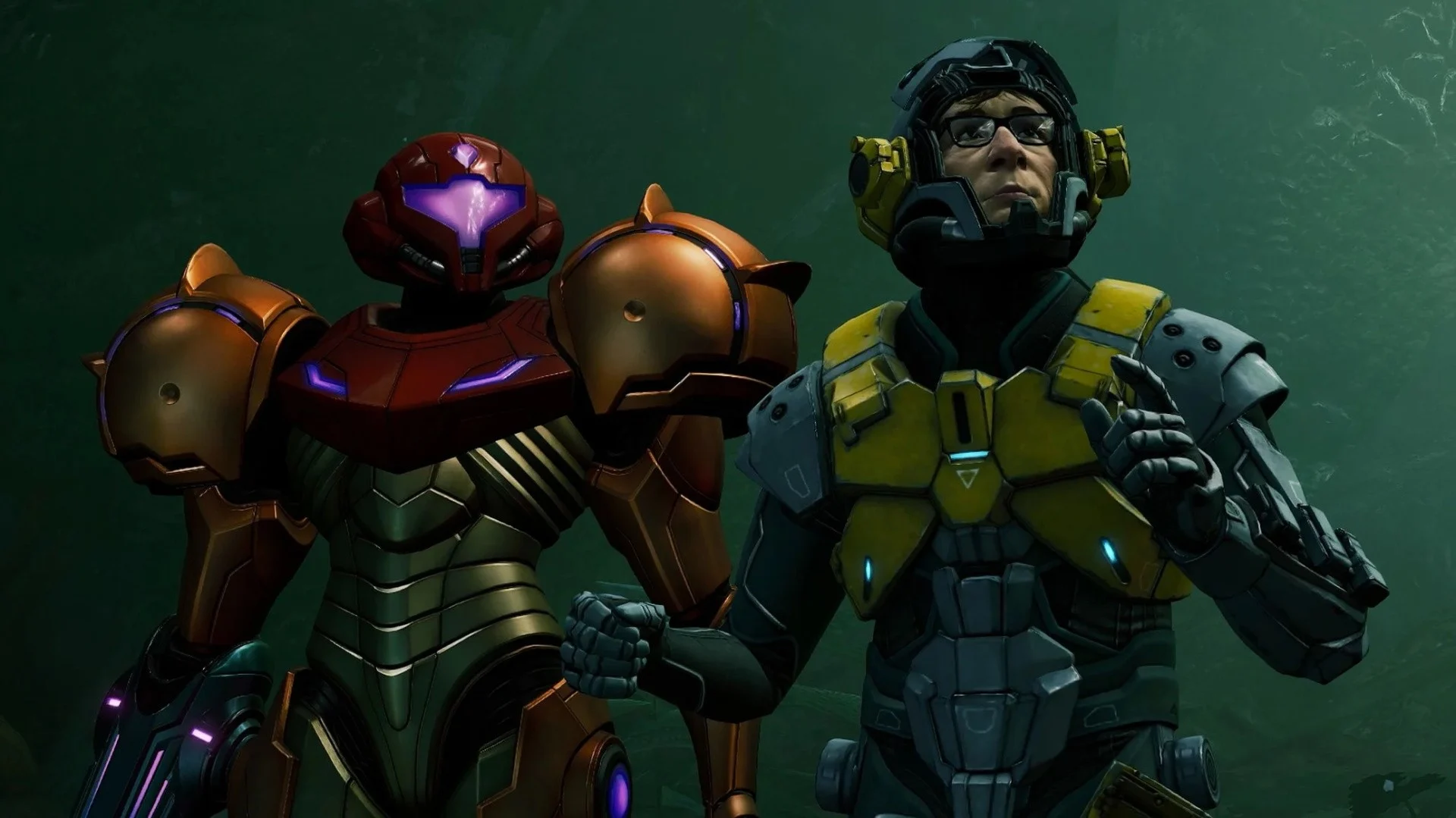
Metroid Prime 4 is the darkly hilarious pinnacle of the state of Samus Aran and her voice (or lack thereof). I can’t imagine why the game’s developers decided to challenge themselves in this particular way, but for some reason, Prime 4 is full of characters who talk to Samus. Fans have been debating since the game came out about one character in particular who they think is “annoying,” but personally, I’m taken aback by how annoying Samus herself seems in this game. In some moments, it is legitimately funny that Samus just doesn’t respond when other characters talk to her. It seems like she’s giving them a death glare or icing them out. But in Prime 4, I don’t get the sense that the writers made this choice because of its comedic potential, because more often than not, it’s not funny so much as outright bizarre.
At various points in the game, Samus is fighting off hostile aliens, and another character will contact her on comms to ask how she’s doing, or if she’s still even alive. Alternatively, a character might ask her a direct question about the mission that has an obvious or simple answer. In these moments, it’s extraordinarily strange that Samus doesn’t say a word, to the point where it’s not even clear why the other characters’ dialogue is present in the first place. Are we the player meant to assume that Samus is being rude? Why have other characters ask questions of her if she cannot respond? More importantly, why can’t she respond? It’s not like she’s wounded her larynx at the outset of the game. The only answer I have is that she doesn’t speak in Prime 4 because she didn’t speak in any other Prime game, so she can’t start now. But if that’s the case, then the writing of the characters around her should show more restraint, so as to make it less awkward that Samus isn’t speaking.
It’s easiest for Samus to not speak if she’s in an isolated environment, with no one else speaking to her at all. But I don’t necessarily want or need Samus Aran to be alone and isolated in every single Metroid game. For some fans, that’s what Metroid is all about—the stoic, silent Samus exploring and gaining upgrades, barely saying a word outside of a quick mission log or two. As frustrating as Other M is to play, in part because Samus obeys commands from Adam to not use her abilities at various points when she definitely needs them, I see it as an even more tragic problem that Samus (or, more accurately, Yoshio Sakamoto) seems to have squandered her one big opportunity to speak for herself.
The fact that one of the most famous female characters in games just so happens to be one who literally does not have a voice most of the time is not lost on me. And yet, I too am susceptible to the allure of the stoic and silent Samus. The games in which Samus doesn’t talk, or barely talks, have great narrative power because of the environmental storytelling they display. Super Metroid is one of my all-time favorite games, and when I replay it, I don’t need to hear Samus’s reaction to the baby Metroid’s sacrifice. I can simply imagine she’s shedding a surprised tear, like I did the first time I experienced that moment.
But what if I didn’t have to imagine that? Would Super Metroid’s narrative climax still land, if in that moment, it was clear that Samus actually had feelings? How would that even work, without taking away from the power of that game’s silence? I’m not sure, but the alternative—in which Samus does not express any feelings at all, lest she come across as “weak” or, let’s be honest here, feminine—doesn’t sit right with me, either. I can only hope that the future holds something more for Samus than her simply standing there, staring blankly, as though her entire mind is a dark void. There’s got to be a better option than that.


 Keep scrolling for more great stories.