Almost as soon as there were films shot digitally, there were filmmakers trying to get the new technology to ape the old. In 1999, George Lucas snuck a few shots captured on a prototype high-definition digital camera into The Phantom Menace—a film otherwise shot on 35mm—and was so encouraged by how the images matched the look of film that, three years later, he delivered the first all-digital blockbuster with Star Wars: Episode II—Attack Of The Clones. Clones, Lucas said, boasted digital imagery of a quality “close enough to film” that it was more or less indistinguishable from it. That was a watershed moment in the shift from film to digital, the great revolution in cinema this century. By the mid-2000s, filmmakers like David Fincher and Sidney Lumet were shooting their movies digitally and daring audiences to tell the difference between the new type of image and the photochemical one of old. In Michael Mann’s Miami Vice, you can tell the difference. He wants it that way.
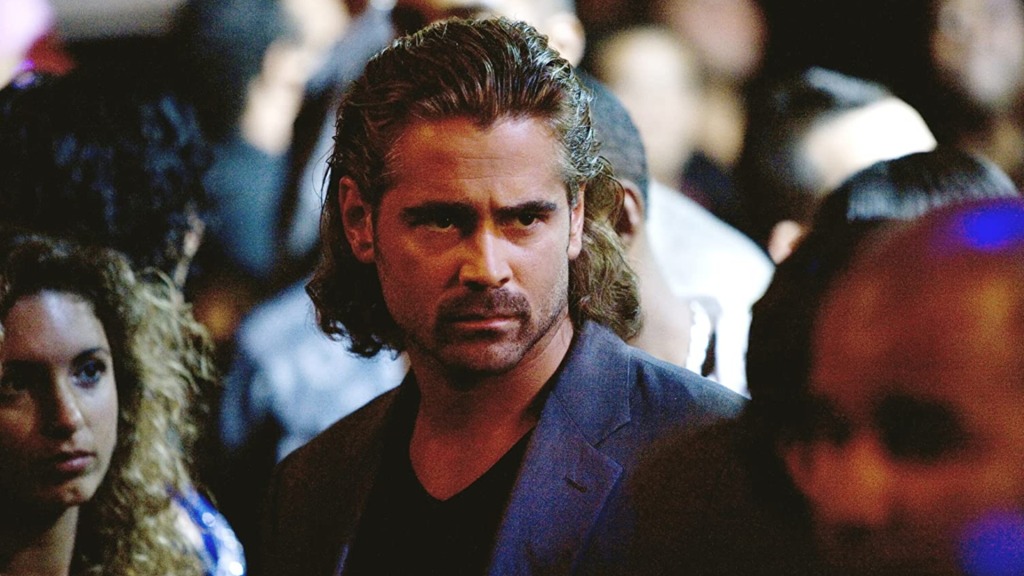
In that film, a 2000s update of the trendsetting 1980s cop show, images smear and blur, and occasionally fall prey to the pixelating effect wrought by digital visual noise. In other moments, Miami Vice‘s HD photography gives the film such clear, detailed visual comprehension of its world—scenery that you can see for miles, faces in which you can read every crack and blemish—that what’s on screen can appear almost uncomfortably close to reality.
When Miami Vice opened to mixed reviews 20 years ago, there was a general sense that this wasn’t what the film was supposed to be. It wasn’t only that Mann had remade a Reagan-era pop culture sensation for the War On Terror age, with the film’s international drugs trafficking plot taking Miami detectives Crockett and Tubbs (Colin Farrell and Jamie Foxx) in a darker, more uncompromising direction; this also just wasn’t what movies were supposed to look like, especially not those made at a blockbuster level with A-list stars.
Given that Miami Vice was written and directed by the meticulous Mann, the film’s design was, of course, deliberate. In Miami Vice, as in Mann’s primarily digital 2004 hitman thriller Collateral, this new type of image is a perfect match for the material, with the fledgling digital camera an ideal device for recording a changing world of cellphones and surveillance cameras. But this was also a filmmaker who had, like Picasso, mastered “normal” art early, with his superior feature debut Thief, before he began seeking to experiment with form. In digital, Mann identified the potential to explore new horizons in cinema, new ways to express himself. And so, having already thoroughly stress-tested the HD cameras on Collateral, Mann had in Miami Vice an opportunity—and an enormous budget—to really discover what the new cinematography could do.
Exploiting digital’s seemingly infinite depth of field, Mann in Miami Vice presents landscapes from Florida to Paraguay in all their immensity, making for godlike views of a speedboat carving a trail through the deep blue of an endless ocean, or a jet weaving through clouds like great white monuments in the sky. Approaching the new digital cameras’ extreme sensitivity to light as a feature rather than as a bug, Mann makes Miami Vice a largely nocturnal film, the plot unfolding in nightclubs and under dark city skies where the night photography always has an uncanny level of visibility. And, leaning into the detail and clarity offered by the high-definition images, Mann in Miami Vice emphasizes the verisimilitude of HD, with the film’s love scenes made especially intimate, and the action especially visceral, with none of the gloss of film to disguise the grisliness of a sudden bullet to the head.
For Mann, the whole point of digital was to create visuals like these, the kind that film never could. In a 2015 interview, Mann likened the use of digital to approximate film to how steel had initially been used to build skyscrapers which looked “like houses stretched skywards.” Mann sought a distinctly digital aesthetic; he wanted to build the Monadnock Building, a skyscraper in Mann’s native Chicago which was the first tall building with “a form derived from its function and technology.”
In one of many shots in Miami Vice that astonish in their depth and immediacy, Crockett and Tubbs are on the roof of a nightclub, flip phones to their ears as they try to get the facts on an undercover operation gone gruesomely wrong. At their backs is the glittering city stretching to a low horizon, and above that the faintly orange cloud cover of an urban night sky, into which a jet, its headlights beaming, disappears. Without the aid of any discernible artificial lighting, all of this is at once in startling focus in the murk of the Miami night.
Playing to digital’s strengths, Mann and cinematographer Dion Beebe present the crepuscular inverse of Miami: This isn’t the sunshine and beaches of the real Vice City (nor the pastels and neon of the Miami of the TV series), but an urban night-realm that manages to be both expressionistic and vividly real. It’s noir, but it’s a 21st-century noir, with a look not imitative of films past but rooted in the moment and the methods of the film’s production. Where the limited resources of the B-movie and the grave midcentury mood inspired the shadowy black-and-white cinematography of classic noir in the ’40s and ’50s, the post-9/11 anxiety—along with the capabilities and drawbacks of early digital filmmaking—led to an aesthetic that favors darkness and an almost confrontational degree of realism.
It’s that high realism, what Mann calls digital’s “truth-telling style,” that may be Miami Vice‘s greatest strength. A common criticism of the film goes that it lacks the depth of characterization that you’ll find in classic pictures from the first half of Mann’s career, from Heat or Manhunter. It’s a valid point—Mann, by his own admission, has shifted his priority to using the HD technology, with its capacity for intense truthfulness, to make his audience experience the story and the film world as the characters might. Under that approach, the characters in Mann’s digital pictures become almost like avatars, with the trade-off being that it can feel like you the viewer are living the film.Mann shows us the bumps on the skin of a character’s back, images that place us in the world of the film so effectively that it’s as if we could touch the actors if we just reached out. It makes for a film so immersive you might swear you can feel the humidity in the Floridian air.
Of course there were also limitations to early digital, many of which are right there on the screen in Miami Vice; these were obvious in 2006 and are even more so to anyone now used to a cleaner, more balanced modern digital image. Mann, though, uses the imperfections of nascent digital the way a filmmaker might use lens flare or prominent grain—”flaws” in film photography so familiar that they are no longer seen as flaws, and which can be used in their own right to great artistic effect.
The occasional motion-smearing and color bleed bring an impressionistic quality to Miami Vice, with the images lent a dreaminess and ephemerality that’s appropriate for a story of cops and criminals playing deadly make-believe. In some of the film’s low-light scenes, the visual noise becomes so pronounced that it amounts to a kind of techno-pointillism. This can be strangely beautiful, as when Crockett and Tubbs stand on that nightclub rooftop overlooking a Miami skyline buzzing with tiny squares of color, the city alive with the kind of energy that Mann so often strives to capture in his urban films. But that same pixelating distortion can also be wrenching, adding to the frenetic energy of a scene, as in the moment Crockett and Tubbs race after John Hawkes’ doomed Alonzo, the visuals breaking down in the fragile undercover world as Alonzo’s world simultaneously collapses.
Digital filmmaking has evolved considerably since Miami Vice—it now has the potential to produce images so sharp that movies can more than ever bear an eerie resemblance to life, all while an image of theatrical quality is today possible with cameras which can fit in one’s palm. (Jonathan Glazer’s fly-on-the-wall Holocaust nightmare The Zone of Interest is an example of the former, and Danny Boyle’s dynamic iPhone-shot folk horror 28 Years Later the latter.)
Less interestingly, digital cinematography is now better than ever at convincingly recreating the film “look,” through false grain and halation, mimicry of specific film stocks, or a deliberately shallow depth of field—though when film cameras already exist to give us all of that for real, it is, to use Mann’s analogy, like building a very tall house when you have the potential to build a skyscraper. With Miami Vice, Michael Mann built one of the first cinematic skyscrapers, constructing from the foundations of an old property something thrillingly new. Two decades since its release, the film perhaps still better than any other makes the case for digital not as a substitute for film, but as its own complementary art form.


 Keep scrolling for more great stories.