Bad art is everywhere, but the studio behind Sharknado has made an art out of making cheap movies fast. Like Roger Corman’s American International Pictures or Lloyd Kaufman’s Troma, The Asylum has found an audience hungry for scrappy, low-budget films, like riffs on public domain properties, disaster pictures like the Sharknado franchise, or Temu knock-offs of the latest tentpoles, affectionately known as mockbusters. Its recent slate includes “sounds like” titles like Frankenstein’s Bride, Alien Discovery Day, Ballerina Assassin, and The Last Hail M.A.R.Y.
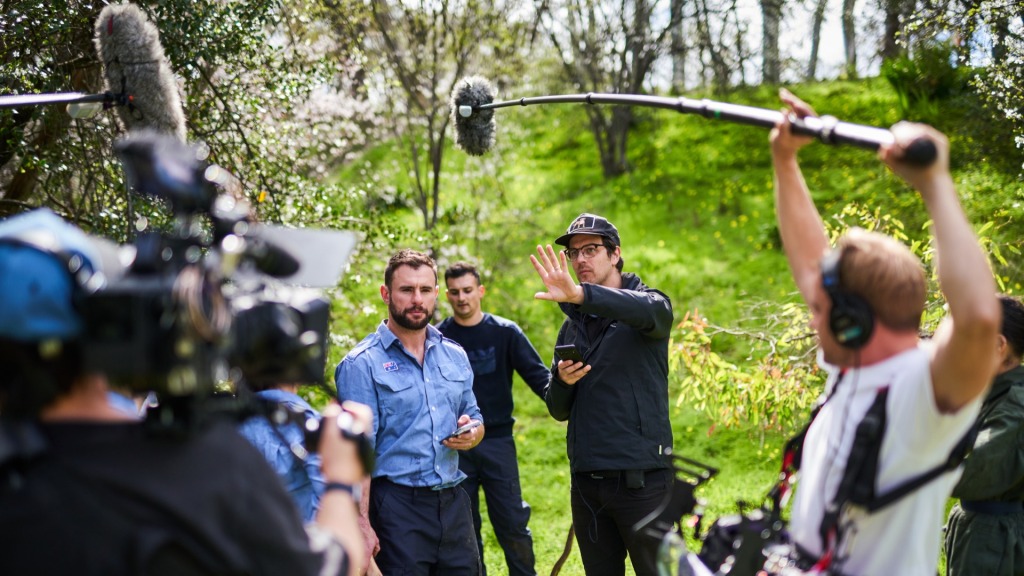
At the heart of these bargain bin projects is an undeniable love of—and, sometimes, addiction to—making movies, which is what makes Anthony Frith’s documentary Mockbuster so endearing. Part studio history, part behind-the-scenes production diary, Mockbuster captures Frith’s venture into The Asylum’s assembly line, which is a crash course for the young filmmaker, much in the way Corman threw young directors like Jonathan Demme and Martin Scorsese into the deep end when helming their first Hollywood assignments. But what’s apparent in every tense conversation or sweaty race against the sunset is the human effort it takes to throw together these slapdash productions and the craft it still takes to make a film like this. Even with a miniscule crew and a microscopic budget, there are still people rigging the lights, holding the boom mics, and calling the shots before the film heads to post-production to add all the CGI dinosaurs.
Modeled after making-of documentaries like Lost In La Mancha and Burden Of Dreams, Frith’s film begins with his own story at a time in his life when he’s shelved filmmaking in favor of supporting a family. But after a solid pitch to make a movie and document the process, The Asylum rekindles his directorial aspirations beyond making safety videos for his parents’ company. Assigned to remake The Land That Time Forgot with little more than a one-page treatment and a bare-bones budget for a six-day shoot, Frith rallies together his friends, family, and fellow filmmakers for a chance to build a submarine out of half a painted pipe, carefully angle shots of the ocean to avoid windsurfers, and make caves out of local rock formations in Adelaide, Australia.
In the first documentary about The Asylum, the studio’s employees speak candidly to Frith’s camera, almost seeming to caution him. They’re not here to make art, they’re here to keep the assembly line running smoothly. “We’re, you know, barely above porn,” jokes Paul Bales, one of The Asylum’s co-founders. But even the disillusioned producer assigned to Frith’s feature debut, tasked with keeping him under budget and approved by the team back at the studio in Burbank, is excited—maybe even relieved—to see the film in action.
The human element of filmmaking is also prone to mistakes, which in the case of a first-time director, are plenty. Frith is horrified by the setbacks: flags sewn incorrectly on uniforms, continuity accidentally abandoned. He also needs to manage the stress of shooting dozens of script pages in a day and double-checking if the production can actually afford any overtime. This crash-course film school comes with some bumpers, but there’s enough at stake to make Frith wonder if he’s botching the job so badly, it spells the end of his career before it really started.
With a little encouragement from the likes of legendary bargain-bin star Eric Roberts and Australia’s latest horror darlings, the Philippou brothers, Frith brings along a second camera and crew to capture the ordeal of creating something with almost nothing, celebrating those who made it possible with a screening of their very own mockbuster. At a time when the temptation to take shortcuts in order to make art faster and cheaper has never been stronger, Mockbuster is more than just a tribute to a studio with low-budget (yet human) ambitions. It’s an homage to the real people who come together to tell a story—no matter how goofy or schlocky it may be.


 Keep scrolling for more great stories.