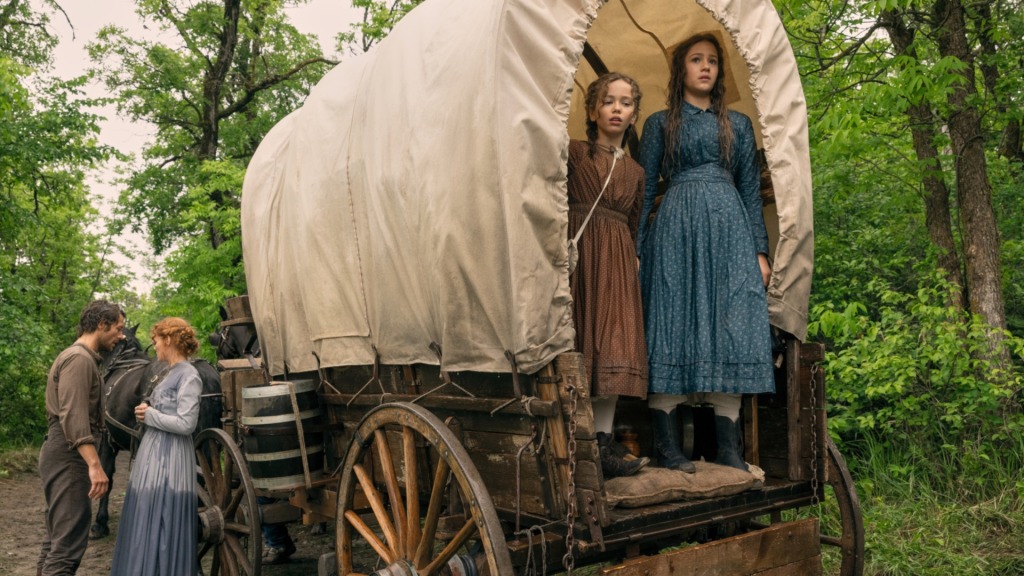
Like so many Netflix originals, this Little House On The Prairie looks flat, polished, and without texture, making it hard to feel fully immersed in its time warp. An early scene involving a nearly disastrous attempt to ford a raging river looks painfully fake. It’s shaky footing to start on, making it tough for the show to hit its stride. The cast—consisting of Luke Bracey as Charles Ingalls, Crosby Fitzgerald as Caroline Ingalls, and Skywalker Hughes and Alice Halsey as their young daughters Mary and Laura—does its best to sally forth, and they deliver some earnest performances. Unfortunately, with an overreliance on montage and a cloying score dictating how the audience should feel in any given scene, the show rarely affords Bracey, Fitzgerald, Hughes, or Halsey a moment to authentically act.
This Little House is haunted by ghosts: of war, displacement, and of an onscreen predecessor whose emotional strength it can’t replicate. The whole series feels cursed by aspirations to be the more mature telling of this story, yet it ends up shortchanging the more serious questions it raises—namely any grappling with how the Ingalls are “settling” on someone else’s property. The show is candid about taking place in Osage Nation territory; and, while the settlers want to buy some of that land so they can properly build a home there, that offer isn’t unanimously accepted. It’s an admirable through-line, reminiscent of Killers Of The Flower Moon. The trouble is, where that film didn’t shy away from the ugly realities of American violence, this series feels like it’s sanding down the more sinister truths of its subject. It doesn’t need to be as heavy as a three-hour historical epic directed by Martin Scorsese, but it should at least be honest. Everything between the two parties ends up feeling copacetic in a way that, when paired with the lack of interiority given to most of the Osage characters, undercuts any go at reframing key parts of this story.
The best episode of the season arrives with a massive snowfall. Directed by Erica Tremblay of Fancy Dance fame, the episode suggests a show that’s settling into a rhythm closer to the ’70s show’s. The scenes are subtle and more resonant, and the cast is given more to work with. Just sitting with these characters in confined spaces as they slow down to reflect on where they are and where they might be going next is captivating—in a way the rest of the season isn’t. Similarly, when Charles steps outside his home in a subsequent episode and the light catches his face just so, it’s almost like he’s walking into something closer to Train Dreams. For a brief moment, Little House On The Prairie invites more melancholic, measured contemplation. Alas, this too comes and goes, and the rest of the season never manages to challenge this technical high point.
While not as bad as Netflix’s abysmal live-action Avatar: The Last Airbender, Little House falls prey to many of the same adaptation pitfalls. There are plenty of elements rearranged and expanded on, with no greater depth of feeling to be found. It’s mostly an act of compression, rushing through the basics of storytelling while setting up for more to come on the horizon. It winds up feeling like the fording of the river from the start of the season. The show makes it to the opposite bank, though only barely, and with most of whatever promise it had going for it scattered across the landscape.


 Keep scrolling for more great stories.