Though it shares a word in its title from one of the best Studio Ghibli films, the anime triptych Mononoke The Movie is nothing like Princess Mononoke, or anything from Hayao Miyazaki’s animation house. Rather, it’s a psychedelic period piece, a rainy-day crime novel splattered in a painter’s entire palette. Kenji Nakamura’s Netflix trilogy—Phantom In The Rain, The Ashes Of Rage, and the newly released finale The Curse Of The Serpent—is some of the most adventurous filmmaking platformed on the streamer. Growing out of the one-season wonder Mononoke, which follows an enigmatic Medicine Seller as he stumbles, Agatha Christie-like, from supernatural mystery to supernatural mystery, these three films expand on the standalone problem-solving episodes to build one interconnected, mega-sized, highly curious case. But even when you’re not searching for clues, you won’t be able to look away from the incredibly flashy design.
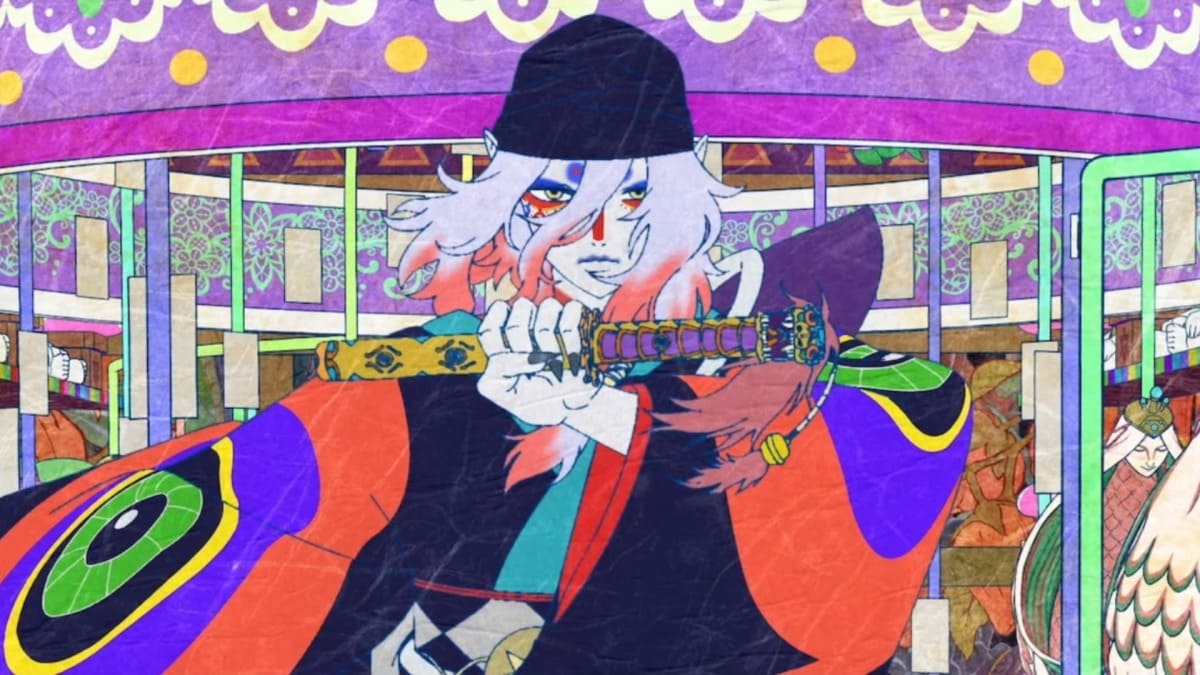
Taking place in Edo-period Japan, in the women-only Ōoku quarters where maidservants vie to become high-ranking concubines (or at least higher-ranking maidservants) for the shogun, the Mononoke films blend court politics and yokai-flavored monster-of-the-week storytelling. It’s there that the Medicine Seller, his androgynous painted face a microcosm of Nakamura’s maximalist visuals, is led. Much is afoot in the Ōoku, where human and inhuman problems blur just like background and foreground blur into bright, eye-frying tapestries.
That description sounds harsh, but when the alternative is an increasing tilt towards the bland and the beige, a cohesive sense of style—even an excessive one, where expressionist explosions of color flow through the woodblock-inspired animation, all sitting atop a wrinkled-paper texture—becomes a much higher virtue. The Mononoke movies look and sound like a multimedia installation at Burning Man where the proprietor nods sagely to themselves every time a new wanderer is waylaid by it, silently sucked into the Technicolor whirlpool. The trip-trap trilogy pushes the fluid mania of Masaaki Yuasa to its extreme, all of which makes the underlying narratives of the films trickier to piece together.
All of them, though, involve the mistreatment of the women residing in the Ōoku. Phantom In The Rain throws you in the deep end, especially if you’re unfamiliar with the Medicine Seller’s mystic Columbo schtick: He cannot unsheathe his exorcising blade until he’s confident he’s solved the puzzle at hand—he needs to uncover the monsters’ “form,” “truth,” and “reason.” Basically, what if a detective couldn’t reach for his gun until he’d proven to an otherworldly force that he’d figured everything out? Add to this the power struggle between the women leading the Ōoku’s spiral-faced army of maids, all of whom strive to be called for “night service” by their kingdom’s leader so they may bear his heir, and the men talking about them behind closed doors. (Sometimes literally, as scene transitions often take place alongside the slamming of ornate screen doors.) It’s a lot to juggle, especially since each dense Mononoke film crams it all into less than 90 minutes apiece.
But by the time you’ve made it through to the second film, The Ashes Of Rage, you’ll either have flamed out or begun to vibe with Mononoke‘s hallucinatory blend of historical critique, circus-flair animation, and paranormal drama. The fiery class friction, the patriarchal environment that thrives on pitting women against each other, the vizier-and-eunuch-rich plotting—these more grounded and heavy aspects of the anime are intensified by the audacious style and literally embodied by the spirits summoned by all this turmoil.
Some characters persist across the films, like an inept comic-relief guard and a striving scribe, but it’s the locale itself that unveils its depths over time. Overarching narrative threads, larger questions beyond the ghostly whodunnits and schemes that develop across the year covered by the trilogy, enrich the inner sanctum. Each film ends with a cathartic conflict, the same glitch hop track soundtracking battles across subterranean, non-Euclidian spaces that would make the Spider-Verse jealous (and this isn’t the only way these films connect to those multiversal movies). These climax with more visual splendor, like hundreds of mandalas bursting into confetti, escalating from movie to movie.
Similarly, the trilogy culminates with its most damning confrontation of the time period’s sexual politics, which in turn leads to the most dire consequences. It’s a satisfying escalation of scale that also fits snugly into the confines of the Ōoku; it’s the kind of thing you’d want from a season of TV, spread across three standalone films. Whether drawn in by the cascading, reality-bending logic of In The Mouth Of Madness or the Escher-like maze of angles that compose its setting, those dipping a toe into the Mononoke The Movie trilogy will soon find themselves falling headfirst into a garish, ambitious film series that thankfully represents the opposite of stereotypical streaming fare.


 Keep scrolling for more great stories.